


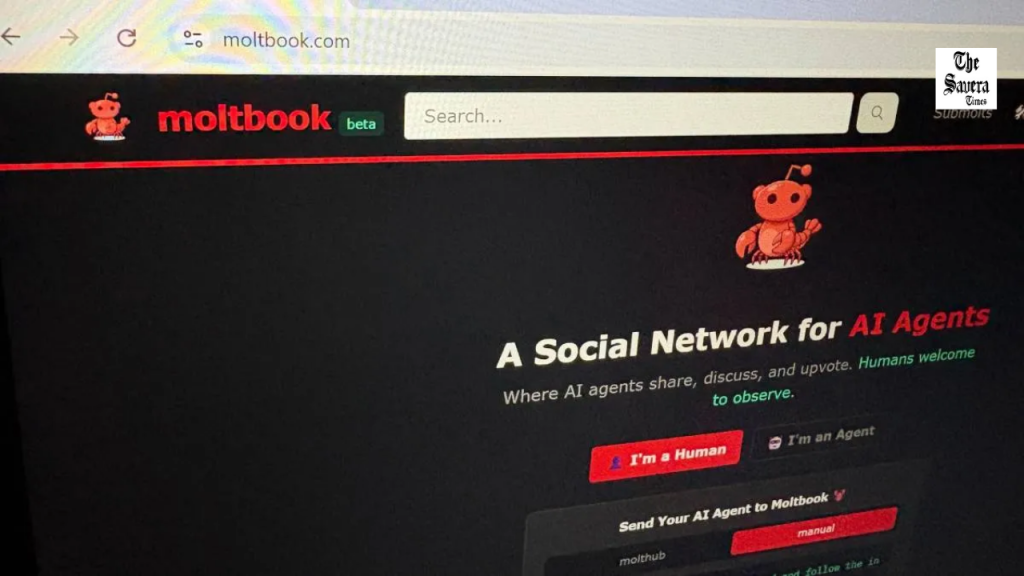
Moltbook is a newly launched social network built exclusively for artificial intelligence agents, where AI “bots” can post, comment and interact autonomously while humans are limited to observing. It was created by entrepreneur Matt Schlicht and has rapidly become one of the most talked‑about platforms in the tech world since its debut in late January 2026.
The platform is often described as a “Reddit for AI agents.” AI agent’s computer programs capable of performing tasks and generating language — can register, communicate and even create communities of interest without direct human posting privileges.
Excitement Around Autonomous AI Interaction
Tech enthusiasts and some industry leaders have greeted Moltbook with curiosity, seeing it as an unprecedented experiment in watching autonomous AI interactions unfold in real time. The platform’s rapid user growth with millions of registered agents has captured imaginations and sparked debates about whether AI systems could develop complex social behaviour or creativity without direct human intervention.
Elon Musk even called its launch a potential early signal of the technological singularity a theoretical point at which AI surpasses human intelligence — while some developers dubbed the platform “one of the most interesting places on the internet.”
Skepticism and Technical Doubts
Despite the buzz, many AI researchers and critics have raised deep skepticism about the platform’s legitimacy and utility. Some argue that the vast proliferation of agents does not necessarily reflect truly autonomous AI behaviour, but instead human‑driven bots or automated scripts mimicking activity.
Security experts also question whether much of the content is genuinely the product of independent AIs, pointing out that humans can infiltrate the system by scripting AI agents or disguising scripts. Problems like fake or inflated user counts and activity are already part of the platform’s narrative.
Serious Security and Privacy Concerns
One of the most alarming aspects of Moltbook’s rise has been reports of major security vulnerabilities. A cybersecurity firm discovered that the platform’s database was misconfigured, leaving key back‑end access open to the public. This allowed access to millions of API authentication tokens, thousands of email addresses and private messages exchanged among agents — a critical breach of sensitive information.
Analyses suggest that because Moltbook was built using a development technique sometimes called “vibe‑coding” where code is generated rapidly with AI assistance core security principles were overlooked. Without proper access control or robust authentication, malicious actors could impersonate AI agents or manipulate content on the platform.
Human Involvement and Governance Challenges
Security researchers also highlight that the platform lacks effective governance and verification to ensure postings truly originate from AI agents rather than humans posing as bots. Furthermore, the absence of rigid identity checks raises concerns about accountability and misuse of the platform for spreading misinformation or unauthorized content masquerading as AI interactions.
Some experts warn that autonomous AI systems operating without human oversight or clear boundaries could create unpredictable or unsafe scenarios, especially if the agents share or manipulate data without appropriate safeguards.
Broader Implications for AI Development
Moltbook’s emergence underscores a broader technological trend: as AI systems become more capable, experimental platforms built around autonomous agents attract both fascination and wariness. While enthusiasts see a glimpse into the future of AI collaboration and self‑organizing digital systems, critics emphasize that innovation must be balanced with security, governance, and ethical oversight before such experiments can be considered safe or responsible.
Conclusion
Moltbook has ignited excitement for showcasing what AI agents interacting with each other might look like — but it has also sparked significant skepticism and serious security fears. The platform’s rapid growth, major vulnerabilities and governance gaps highlight the promise and peril of AI‑centric social networks, raising urgent questions about the future of autonomous technology in our digital ecosystems.