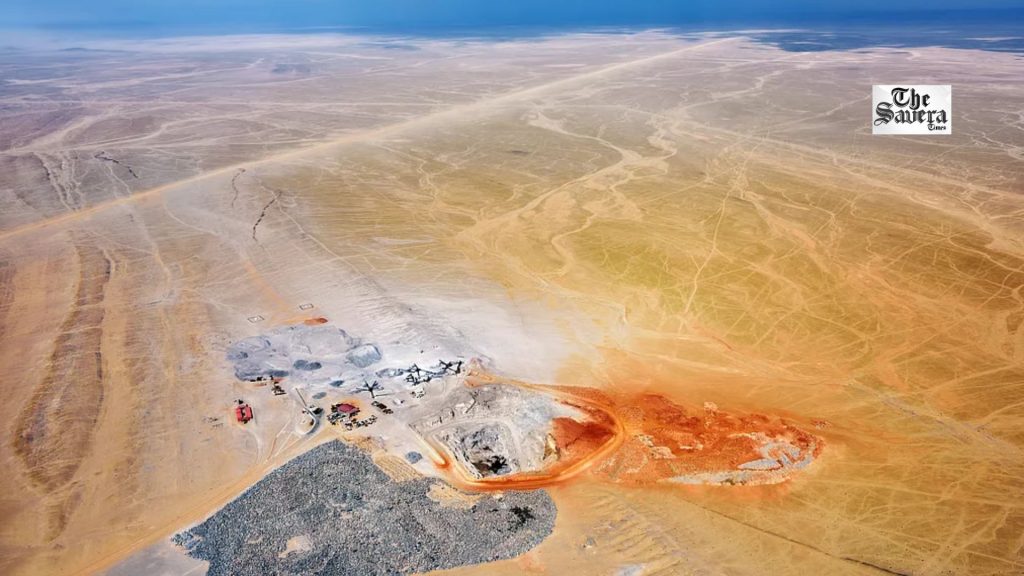
While their focus has been on educating, fostering twoway dialogue is essential to build trust, empower communities, and ensure sustainable resource management Namibia’s geoscientists play a vital role in bridging the gap between mining activities and community concerns. While they excel in scientific expertise, their engagement often focuses on educating rather than fostering dialogue. Addressing historical mistrust and promoting twoway communication can build trust, empower communities, and ensure sustainable resource management. Namibia is one of the world’s leading uranium producers. It also has significant deposits of diamonds, gold, zinc, copper and rare earth elements. As these sectors evolve, there’s a need for geoscientists to communicate with the public as well as communities. Geoscientists study the Earth: its rocks, water, minerals and hazards. They include geologists, hydrogeologists, geochemists, petroleum geologists and palaeontologists, among others. In Namibia, they work in government bodies, mining and petroleum companies, and at universities, guiding everything from mineral exploration to groundwater management and land-use planning. Marina Joubert, a science communication specialist, and Josephine Uushona, a geoscientist, set out their findings based on research with geoscientists on how they engaged with the public, what they understood engagement to mean and what motivated or discouraged them from taking part. How are communities being affected by mining? Namibia is a vast, dry and sparsely populated country of about 3 million people. In recent years the resources sector has grown substantially. In 2022, Shell and TotalEnergies discovered sizeable offshore oil reserves. The same year also saw the country’s largest-ever find of rare earth elements. Namibia’s mineral resources and growing energy sector make geoscience an important contributor to national economic development, resource management and environmental sustainability. Geoscientists contribute to mineral exploration, groundwater management, land-use planning and informed decision-making. As these activities increasingly intersect with communities and other stakeholders, effective public engagement becomes essential for promoting scientific understanding, building trust and encouraging meaningful dialogue about geosciencerelated issues. We interviewed 13 geoscientists, aged 30 to 40, working in government, industry and universities, about how they see the public, what engagement means to them, and what motivates or holds them back. It is one of the first studies of how geoscientists in Africa view and practise public engagement. What gaps did you identify? The clearest finding was that Namibian geoscientists mostly see public engagement as a one-way street: explaining and educating, rather than listening and exchanging ideas. Only two of the 13 geoscientists we spoke to defined engagement as a two-way process. Most assumed that the public simply lacked scientific knowledge. They believed filling this “knowledge gap” was a necessary first step before communities could meaningfully take part in decisions about mining or water resources. This contrasts with current science communication scholarship, which shows that knowing more about something does not necessarily lead to support. Building trust requires meaningful and constructive dialogue between scientists and communities. Encouraging signs of change included eight respondents who saw benefit in engagement for scientists and communities, recognising that scientists could learn from communities living in the areas they study. Separately, eight participants said the public should have a voice in policy decisions about mining and exploration, because these activities affected people’s daily lives.
Mining, water and trust: how Namibia’s geoscientists see their role with communities