


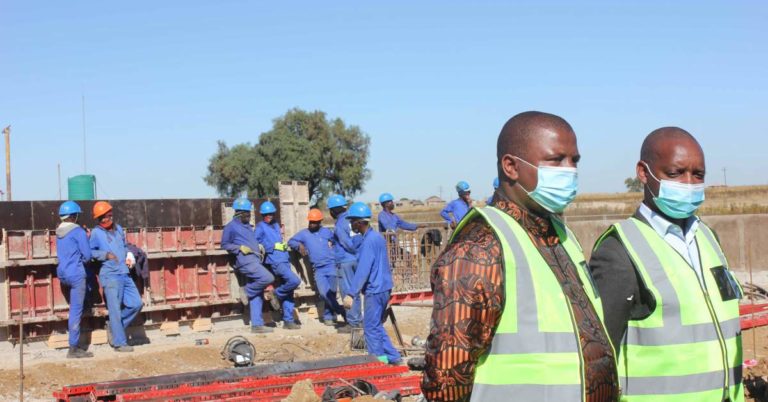
At first glance, Newcastle in KwaZulu-Natal’s Amajuba district appears to be a city on the rise. New sanitation projects, upgraded infrastructure, and visible government initiatives suggest progress. Yet beneath this surface optimism lies a more complex and fragile reality — one shaped by aging infrastructure, vandalised assets, irregular industrial discharges, and a gap between official records and the daily experiences of residents. During a three-day field assessment in September 2025, officials from the Department of Water and Sanitation (DWS), Newcastle Local Municipality, and engineering consultancy JG Afrika, joined by experts from Delhibased think tank Centre for Science and Environment (CSE), examined the city’s sanitation systems.
Their visits to wastewater treatment plants, on-site containment facilities, and sludge management sites revealed both advancement and vulnerability — evidence of a municipality making strides toward sustainable faecal sludge management (FSM) while struggling with operational and institutional shortcomings.
Strong beginnings, uneven outcomes
Over the past decade, Newcastle has invested heavily in improving sanitation access and wastewater treatment. It has expanded sewer networks, built new wastewater treatment plants (WWTPs), and promoted inclusive development through Reconstruction and Development Programme (RDP) housing. At Charlestown, on the city’s western edge, the municipality constructed anaerobic baffled reactors (ABRs) with French drains for RDP households — a decentralised system designed to treat waste affordably in areas without sewer connections. The idea was sound, but implementation faltered.
During inspections, several ABR chambers were found uncovered or damaged, their concrete lids stolen. The air carried a strong odour, and nearby residents complained they had not been consulted before installation. The French drains, meant to disperse treated effluent safely, were no longer working. Without maintenance or community involvement, the system’s sustainability is uncertain. A similar picture emerged at the Charlestown “Class E” wastewater pond, a designated faecal sludge decanting site. Here too, critical infrastructure had been stripped — screens removed, fencing stolen, and the guardroom left derelict. Yet the site continues to function, receiving sludge from vacuum trucks that service household collection tanks in the area.
A system under strain
Newcastle operates five major wastewater treatment plants, each in varying states of performance and maintenance. At the central “Class A” facility in the Central Business District (CBD), designed to treat 25 million litres per day (MLD), the team found relatively strong operations. The activated sludge process was running efficiently, with municipal staff monitoring influent and effluent flows.
This central WWTP also doubles as a faecal sludge disposal site, where private operators discharge waste collected from septic tanks and mobile toilets.
Officials estimate that more than 100 mobile toilet service providers are active across the city, though enforcing proper disposal and monitoring compliance remains a challenge.In contrast, conditions at the Osizweni WWTP, located to the east of the city, highlighted the consequences of poor asset management. The facility, with a combined capacity of 15 MLD across its activated sludge and biofiltration units, currently receives only about 4 MLD — less than onethird of its designed load. Vandalism, equipment theft, and non-functional intermediate pumping stations (IMPS) have crippled its performance.
Screens have been torn out, pumps stolen, and pipelines blocked. As a result, untreated wastewater is spilling into nearby low-lying areas. The stagnant pools that have formed now mimic wetlands but lack any ecological function. These pools not only pose public health risks but also underscore how infrastructure neglect can quickly reverse environmental progress.
Balancing progress and resilience
Newcastle’s efforts reflect genuine commitment — visible in its investments and willingness to collaborate with national and international partners. However, infrastructure alone cannot guarantee success. Without maintenance, community participation, and enforcement of environmental standards, these facilities risk falling into disrepair. The city’s sanitation journey illustrates a broader lesson shared by many urban areas across South Africa: progress built on fragile systems can quickly unravel if institutional coordination and public engagement do not keep pace. Newcastle’s challenge now lies in transforming its strong beginnings into a resilient, well-managed sanitation network — one that can sustain both its people and the environment