


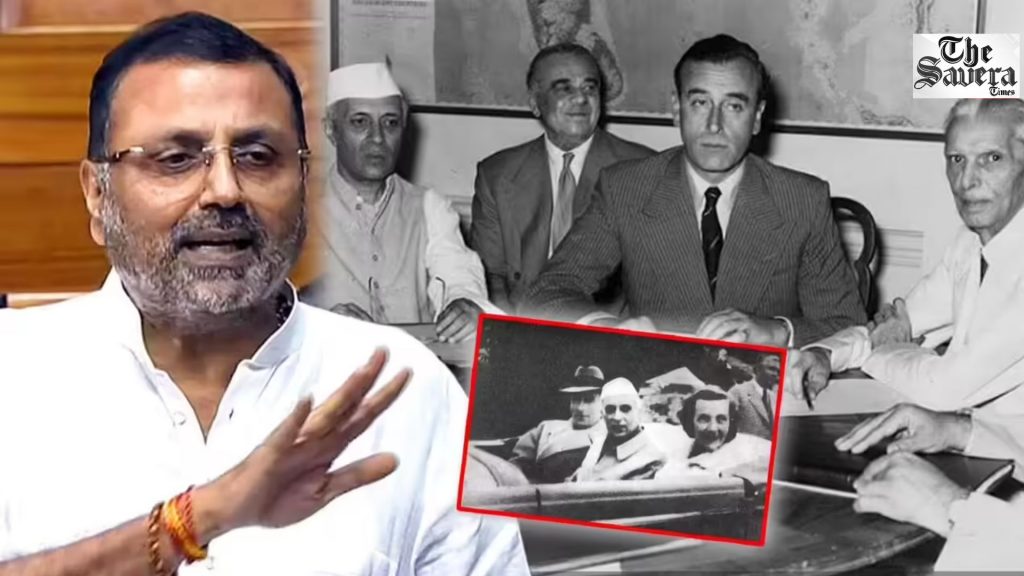
New Delhi: BJP MP Nishikant Dubey on Monday launched a sharp attack on the Congress party, alleging that decisions taken by its leadership during the Partition period had long-term consequences for the country.
In a post on X, Dubey referred to July 13, 1947, as a “dark chapter” in Congress history and accused former Prime Minister Jawaharlal Nehru of accepting the Partition of India under pressure.
कांग्रेस का काला अध्याय
119. 13 जुलाई 1947 श्रीमति एडविना माउंटबेटन के दबाव में आकर नेहरु जी ने महात्मा गांधी जी के विचारों को तिलांजलि देकर भारत का विभाजन स्वीकार कर लिया ।30 जून 1947 को माउंटबेटन जी ने बंगाल और पंजाब के विभाजन के लिए रेडक्लिफ के नेतृत्व में कमिटि बनाने का… pic.twitter.com/UkAGTSrHJV— Dr Nishikant Dubey (@nishikant_dubey) July 13, 2026
Dubey Raises Partition-Era Claims
Dubey alleged that the formation of the Punjab and Bengal Boundary Committees during the Partition process resulted in India losing several strategically and culturally important regions.
He claimed that areas including the Chittagong Hill Tracts and Sylhet district were lost during the boundary decisions. He also alleged that Kolkata could have gone to Pakistan if leaders such as Syama Prasad Mookerjee had not intervened.
Dubey further claimed that disagreements among leaders including Nehru, Muhammad Ali Jinnah and Huseyn Shaheed Suhrawardy influenced decisions related to Bengal.
BJP MP Targets Congress Leadership
Referring to Punjab, Dubey alleged that regions including Lahore, Kartarpur Sahib and Nankana Sahib were affected during Partition-era decisions.
He also linked Partition-related boundary decisions with later challenges such as infiltration, terrorism and smuggling, alleging that these issues were a result of those decisions.
“The Congress-Nehru-Gandhi family means a machine for creating problems,” Dubey said in his post.
Remarks Come Amid Debate Over Partition History
Dubey’s comments came while recalling events of July 1947, when India was moving towards Independence and the Partition process was underway.
During this period, the Indian Independence Bill was being debated in the British Parliament. The Punjab and Bengal Boundary Commissions, headed by Sir Cyril Radcliffe, were also carrying out the process of demarcating borders under the June 3, 1947 Mountbatten Plan.
The final Radcliffe Award was announced on August 17, 1947, two days after India and Pakistan became independent.
Meanwhile, Mahatma Gandhi continued his efforts to promote communal harmony amid widespread violence during the Partition period and had opposed the division of India and Bengal.