


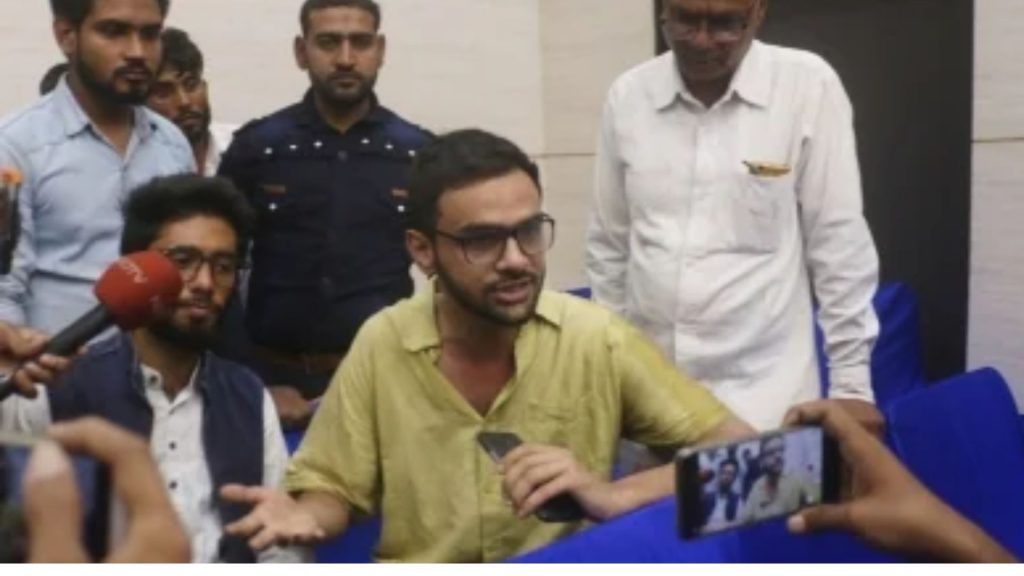
New Delhi: The Supreme Court on Wednesday issued a notice to the Delhi Police regarding new bail pleas filed by student activists Umar Khalid and Sharjeel Imam, who are currently incarcerated in connection with the alleged larger conspiracy behind the February 2020 Delhi riots. However, the Court declined to grant any interim relief to either of them at this stage.
A bench comprising Chief Justice (CJI) Surya Kant, Justice Joymalya Bagchi, and Justice V. Mohana directed that the matters be placed before the Chief Justice of India (on the administrative side) for the constitution of a three-judge bench.
This directive follows a reference made on May 22 this year by a two-judge bench in the case of co-accused Tasleem Ahmed. In that instance, the need was highlighted to examine a potential legal conflict between two previous Supreme Court rulings concerning the granting of bail under the Unlawful Activities (Prevention) Act (UAPA)—specifically regarding the legal grounds for bail in cases involving prolonged incarceration and delays in trial proceedings.
Umar Khalid has been in jail for over six years
Senior Advocate Kapil Sibal, appearing for Umar Khalid, urged the Court to consider his plea for interim bail, pointing out that Khalid has been in custody for more than six years.
Similarly, Senior Advocate Siddharth Dave, representing Sharjeel Imam, also sought interim relief.
However, the bench led by CJI Surya Kant refused to entertain the request for interim bail for the time being, stating that the Delhi Police’s position on the matter must be heard first.
The Supreme Court ordered, “Issue notice. The Registry shall place this matter before the Chief Justice of India on the administrative side for the constitution of a three-judge bench.” Matter regarding bail under UAPA to be referred to a larger bench
The need for a larger bench arose after the Central government argued that different benches of the Supreme Court were applying the ‘K.A. Najeeb’ judgment inconsistently while hearing bail pleas under the Unlawful Activities (Prevention) Act (UAPA).
In the ‘K.A. Najeeb’ case, the Supreme Court had held that prolonged incarceration and excessive delays in trial proceedings could constitute grounds for granting bail. This principle can also be applicable to cases registered under stringent laws like the UAPA.
A two-judge bench, while hearing the case of ‘Syed Iftikhar Andrabi vs. National Investigation Agency’, raised questions regarding certain aspects of the ‘Gulfisha Fatima’ judgment (from January 2026). In that judgment, bail was denied to Umar Khalid and Sharjeel Imam in connection with the alleged larger conspiracy behind the Delhi riots, whereas five other co-accused were granted relief.
A bench comprising Justice Arvind Kumar and Justice Prasanna B. Varale, while granting six months’ interim bail to Tasleem Ahmed and Khalid Saifi, referred the matter to a larger bench to resolve the legal divergence concerning bail under the UAPA.
Five co-accused were granted bail in January 2026
Umar Khalid and Sharjeel Imam are among several individuals against whom cases have been registered under the UAPA and other penal provisions in connection with the alleged conspiracy behind the communal violence that took place in North-East Delhi in February 2020. The violence resulted in 53 deaths and left many others injured.
On January 5, 2026, the Supreme Court granted bail to five co-accused in the case—Gulfisha Fatima, Meeran Haider, Shifa-ur-Rehman, Mohammad Salim Khan, and Shadab Ahmed. However, relief was denied to Khalid and Imam. At that time, the court had granted both of them the liberty to re-apply for bail once the testimonies of the prosecution’s protected witnesses were concluded, or after one year had elapsed from the date of the order—whichever occurred earlier.
Bail Pleas Rejected by Both Trial Court and High Court
Subsequently, in June 2026, both activists approached the trial court. In their new applications, they cited subsequent developments, including Supreme Court observations—made in the context of another UAPA case—regarding prolonged incarceration and delays in trial; the interim bail granted to co-accused Tasleem Ahmed and Khalid Saifi; and the additional time they had spent in custody.
The trial court rejected their bail applications. Following this, both individuals moved the Delhi High Court, arguing that the trial was unlikely to conclude anytime soon and that their continued detention—without any substantive progress in the proceedings—constituted grounds for reconsidering their bail pleas.
However, the High Court observed that no subordinate court could expand or alter the scope of the specific liberty granted by the Supreme Court. The High Court further noted that the Supreme Court had distinguished the alleged roles of Khalid and Imam from those of other co-accused who had been granted bail.
According to the High Court, the cases of Tasleem Ahmed and Khalid Saifi could not be compared to those of Umar Khalid and Sharjeel Imam. In an earlier ruling, the Supreme Court had characterized the alleged roles of Khalid and Imam as those of a “mastermind” and a “key conspirator.”