


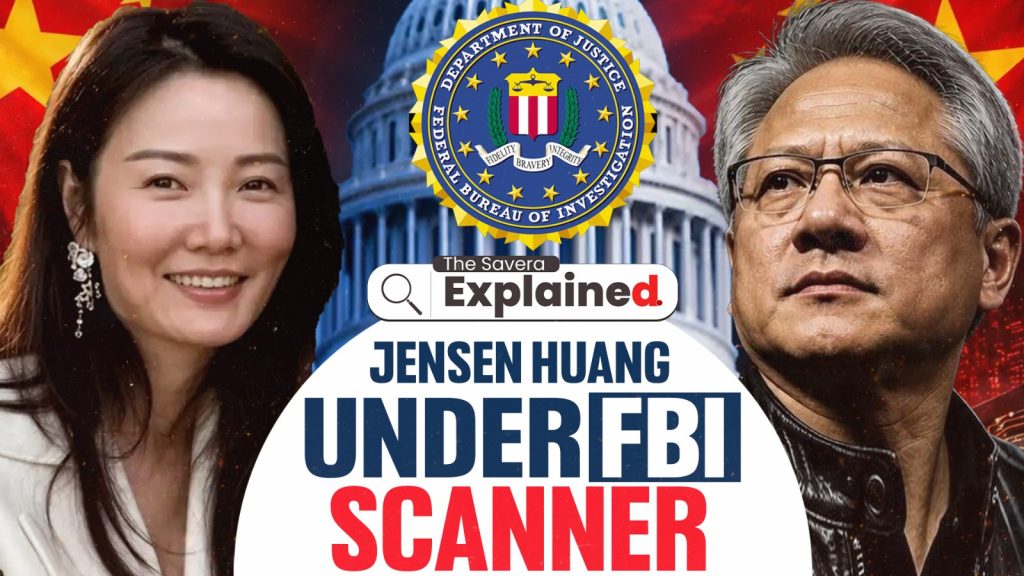
What began as a personal controversy involving Nvidia chief executive Jensen Huang has become a national security story. Huang has admitted being unfaithful to his wife. The concern centres on Alice Huang, a Chinese businesswoman whom US officials reportedly suspect of working for Beijing. She has not been publicly charged with espionage, and the allegations remain unproven.
The developments triggered a board investigation, FBI scrutiny, and a shareholder lawsuit. A November 10 report claims a network linked to Alice Huang helped move at least $ 7.5 billion’s worth of Nvidia chips to Chinese firms, according to the latest reports. So, what is at stake?
1. Why is Nvidia technology so valuable?
Nvidia makes graphics processing units, or GPUs, that power artificial intelligence. They handle calculations needed to train and run advanced AI models. Its CUDA software platform helps developers build applications around Nvidia hardware. Together, these give Nvidia a powerful position in AI.
Information about future chip designs, performance, production plans, software, customers and supply chains is commercially sensitive. Advanced chips also have national security importance because they can support military research, surveillance and high-performance computing.
2. What could a CEO potentially know?
As CEO, Huang is involved in strategy and major partnerships. A CEO may access confidential product roadmaps, upcoming chip capabilities, pricing strategy, customer relationships, manufacturing arrangements, and government discussions.
Such information could help competitors anticipate Nvidia’s next moves or help buyers understand how to obtain restricted technology. But there is no public evidence that Huang passed trade secrets to Alice Huang or that she transmitted confidential information to China.
3. How can business relationships become an espionage risk?
Intelligence operations can use ordinary commercial contact to build trust and access. An executive may seek introductions, favourable treatment or insight into decisions. Personal relationships can create opportunities for influence or pressure.
US intelligence officials reportedly believe Alice Huang was recruited by China’s Ministry of State Security and cultivated a relationship with the Nvidia chief. Huang has acknowledged an affair but has not publicly confirmed knowing of any alleged intelligence role. President Donald Trump said Huang told him he had no idea she was a spy. China has rejected the allegations as unsubstantiated.
4. What is Megaspeed’s alleged role?
Alice Huang was an executive at Singapore-based cloud computing company Megaspeed International, which has faced US scrutiny over suspected shipments of advanced Nvidia chips to China. Reuters reported she and relatives were linked to a network that included Shanghai Century Litong, which reportedly obtained preferred cloud partner status with Nvidia.
According to The Information, the network helped move around 240,000 H100, H200 and some A100 chips into China, with shipments valued at least 7.5 billion dollars. Some computing capacity was reportedly supplied to major Chinese technology firms and AI laboratories. Reuters said it could not independently verify the report. The US Justice Department is reportedly examining possible export-control violations.
5. Did China actually obtain Nvidia secrets?
This remains unclear. Reports describe alleged access to chips and possible efforts to exploit business connections. They do not establish that Nvidia’s confidential designs, source code, future product plans or internal data were stolen.
Nvidia’s board said on November 8 it had no reason to believe company secrets or US national security were compromised, but appointed independent counsel to investigate. The FBI is also examining whether Huang was targeted by a foreign intelligence operation. A shareholder lawsuit accuses Nvidia and Huang of misleading investors; those claims have not been proven.
Markets reacted. Reuters reported Nvidia lost hundreds of billions of dollars in market value over two sessions as investors weighed governance and export-control risks.
The distinction is crucial: an admitted affair, reported chip shipments and an ongoing investigation are part of the established record; espionage, the transfer of secrets and any role played by Huang remain allegations or unresolved questions. Investigators must establish what happened, who knew what, and whether protected technology reached China.