


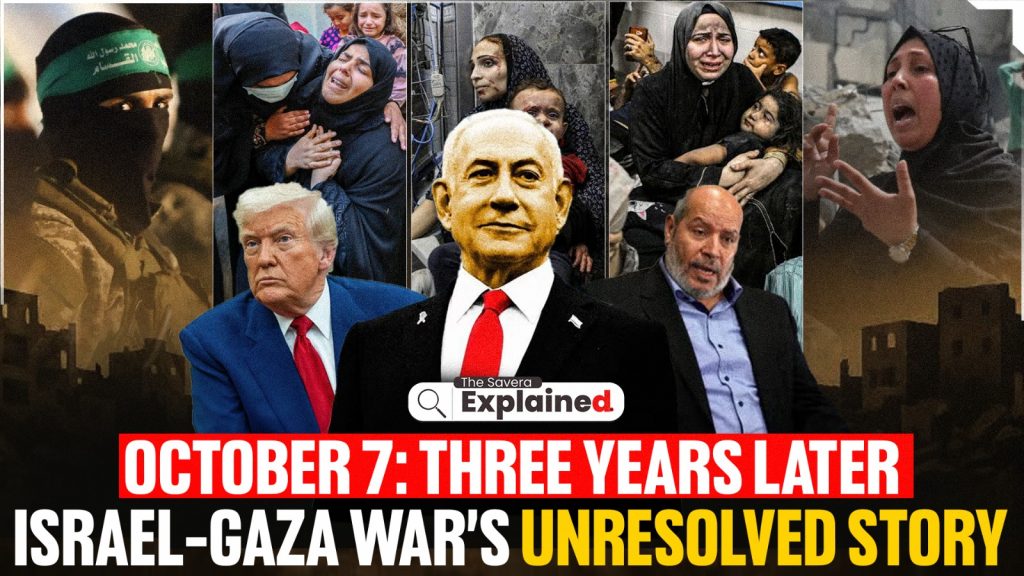
Three years ago, on October 7, 2023, Israel woke up to one of the deadliest attacks in its history. Today, the landscape looks completely different. At Israel’s southern communities, memorials still mark the places where people were killed and taken hostage. In Gaza, entire neighbourhoods have been reduced to rubble, while thousands of families continue to live in temporary shelters.
Three years later, October 7 is not just a date in history. It has changed Israel, Gaza and the wider Middle East.
How Did We Reach October 7?
The roots of the conflict go back decades.
In 1947, the United Nations proposed dividing British-controlled Palestine into separate Jewish and Arab states. Israel declared independence in 1948, followed by war with neighbouring Arab countries. Hundreds of thousands of Palestinians were displaced.
Then came the 1967 Six-Day War. Israel captured Gaza, the West Bank and East Jerusalem. Gaza remained under Israeli control until Israel withdrew its troops and settlements in 2005.
In 2006, Hamas won Palestinian parliamentary elections. A year later, Hamas violently took control of Gaza from the Palestinian Authority’s Fatah movement. Israel and Egypt then imposed a blockade on Gaza, while repeated rounds of fighting followed.
That was the situation on October 6, 2023.
The next morning, Hamas and other Palestinian armed groups launched a large-scale attack from Gaza into southern Israel. Around 1,200 people were killed and 251 people were taken hostage, according to UN and Israeli figures. The attack shocked Israel and triggered the war that followed.
Three Years, Two Deeply Scarred Societies
For Israelis, October 7 remains a national trauma.
Border communities were attacked, families lost loved ones and hundreds of people were taken hostage. Many of those who survived the attack or captivity continue to deal with psychological trauma. Hostage families have also spent years demanding answers and accountability.
For Palestinians in Gaza, the scale of destruction is even larger.
More than 74,000 Palestinians have been killed since the war began, according to figures cited by the Associated Press. UN satellite analysis found that by June 2026, around 201,290 structures — about 82 percent of all structures in Gaza — had been damaged. More than 134,000 were assessed as destroyed.
The humanitarian crisis has also continued despite the ceasefire. More than 1.2 million people are facing acute food insecurity, while damaged homes, water systems, hospitals and basic infrastructure have made normal life extremely difficult.
A Ceasefire, But No Real Settlement
A ceasefire began in October 2025 and brought a major reduction in the intensity of fighting. But it did not solve the central questions.
Israel still maintains military positions over a large part of Gaza. Reuters reported in October 2026 that Israel controls roughly two-thirds of the territory, while disarmament of Hamas, Israeli withdrawal and large-scale reconstruction remain unresolved. More than 1,400 Palestinians have reportedly been killed since the ceasefire began.
So, the war has slowed — but the conflict has not been politically settled.
The October 7 Question Is Now Also Political
Inside Israel, another question has become central: Who was responsible for the failure that allowed October 7 to happen?
Recent reports have revived claims that Israel received warnings from Egypt and other regional sources before the attack. The Egyptian warning has been reported in detail, while some other reported warnings remain disputed. Netanyahu’s government has faced growing criticism over intelligence and security failures.
That debate is now entering Israel’s politics. The October 27, 2026 election is the first national election since the attack. Netanyahu is campaigning heavily on security, but opponents argue that his government must answer for the failures of October 7.
What Changed Beyond Israel and Gaza?
The shockwaves have gone far beyond the battlefield.
The conflict has deepened divisions across the world and changed attitudes towards Israel. A 2026 Pew Research Center survey found that a median of 67 percent of adults across 36 countries had an unfavorable view of Israel.
Regional diplomacy has also become harder. Saudi Arabia has continued to hold back from joining the Abraham Accords without progress towards Palestinian statehood, putting the wider normalization agenda under pressure.