


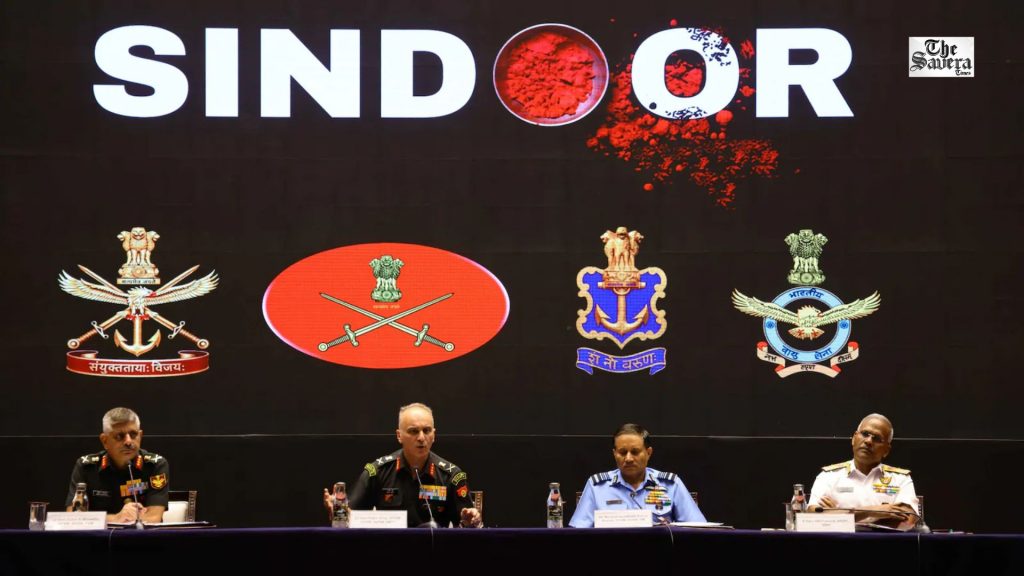
New Delhi: For the first time since Operation Sindoor, the Indian government has officially released the names of six armed forces personnel who were killed in action during the operation, marking a significant moment of recognition for the fallen soldiers.
Official Recognition of Fallen Soldiers:
The names of the six personnel have now been included in the National War Memorial’s Roll of Honour and engraved on the memorial in New Delhi.
Subedar Major Pawan Kumar, Rifleman Sunil Kumar, Lance Naik Dinesh Kumar, Agniveer Murali Naik, Havildar Sunil Kumar Singh, and Indian Air Force Sergeant Surendra Kumar were among those killed in the line of duty.
This is the first public acknowledgement of casualties suffered during Operation Sindoor.
The names of these heroes of Operation Sindoor were released alongside the list of all soldiers who made the supreme sacrifice during various military operations in 2025.
The ‘Tyag Chakra’ (Circle of Sacrifice) at the National War Memorial is dedicated to the nation’s bravehearts. It comprises 16 circular granite walls; the name, rank and unit of every soldier who made the supreme sacrifice for the country after Independence are inscribed on the bricks of these walls.
Now, these six heroes from Operation Sindoor will also become a permanent part of this memorial.
India launched strikes on May 7 last year, targeting what it described as terrorist camps in Pakistan and Pakistan-Occupied Kashmir in retaliation for the terror attack in Jammu and Kashmir’s Pahalgam that claimed 26 lives.
According to official reports, the six soldiers belonged to both the Indian Army and the Indian Air Force, reflecting the joint nature of the operation.
What is Operation Sindoor?
Operation Sindoor is a major Indian armed forces counter-terror operation launched in May 2025 in response to the Pahalgam terror attack in Jammu and Kashmir, where 26 civilians were killed. The operation involved coordinated strikes on terror infrastructure across Pakistan and Pakistan-occupied Kashmir (PoK), targeting camps and launch pads linked to terror groups.
Why Was the Operation Launched?
The operation was carried out as a direct response to escalating cross-border terrorism. Intelligence inputs linked the Pahalgam attack to Pakistan-based terror networks, prompting India to adopt a more aggressive and targeted military response strategy against terror infrastructure.
How the Operation Was Conducted
Operation Sindoor was executed as a joint tri-service mission involving the Indian Army, Air Force, and intelligence agencies. Precision strikes were carried out using advanced surveillance and missile systems, focusing only on terror infrastructure while avoiding civilian areas. The operation is widely seen as part of India’s shift toward intelligence-led, surgical counter-terror action.
Impact of Operation Sindoor on India and the Region
The operation had significant strategic and psychological impact. It strengthened India’s counter-terror doctrine, increased military preparedness along sensitive borders, and sent a strong deterrent message to terror groups operating across the region. It also marked a shift toward faster and more proactive military responses in national security policy.
The operation led to intense cross-border hostilities between India and Pakistan for several days. While India reported successful destruction of multiple terror facilities, the operation also involved casualties among Indian armed forces personnel, reflecting the high-risk nature of the mission.
Why This Operation Matters Today
Operation Sindoor is now viewed as a turning point in India’s modern military strategy. It reflects a doctrine that prioritises precision strikes, rapid retaliation, and coordinated tri-service operations against terrorism, while also highlighting the sacrifices made by armed forces personnel.
Operation Sindoor stands as a key example of India’s evolving counter-terror approach combining intelligence, technology, and military precision. With the recent official recognition of six fallen soldiers, the operation also carries renewed emotional and national significance.