


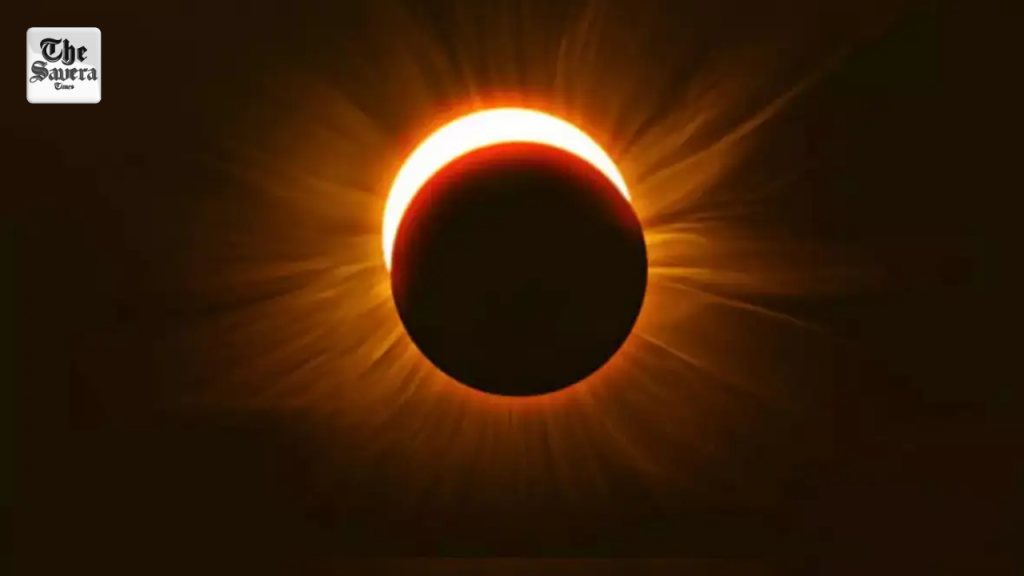
New Delhi: The solar eclipse on September 21, 2025, will be a partial solar eclipse and will not be visible in India. This celestial event occurs when the Moon passes between the Earth and the Sun, partially obscuring the Sun’s disk, creating a crescent-shaped appearance. It will take place during nighttime in India, making it impossible to observe from the country.
As a result, no Sutak period (ritual restrictions in Hindu tradition) will be observed in India.
Where Will the Solar Eclipse Be Visible?
The partial solar eclipse will be primarily visible in the Southern Hemisphere, with the following regions and countries able to witness it:
- New Zealand: Up to 72% of the Sun will be covered in areas like Dunedin, particularly during sunrise on September 22, 2025, local time.
- Eastern Australia: A thin strip along the eastern coast will see the eclipse, with partial coverage.
- South Pacific: Regions including Fiji and other Pacific islands will experience the eclipse.
- Antarctica: Significant solar coverage is expected, offering dramatic sunrise views.Parts of the Indian Ocean: Some visibility is expected in this region.
- Southern Africa: Limited visibility in southern parts of the continent.
The eclipse will have a magnitude of 0.855, meaning 85.5% of the Sun’s diameter will be obscured at its peak in the most affected areas, such as southern New Zealand.
Timing of the Eclipse
The eclipse will occur from 10:59 PM IST on September 21, 2025, to 3:23 AM IST on September 22, 2025, lasting approximately 4 hours and 24 minutes. The peak will be around 1:13 AM IST on September 22, 2025. Since it occurs at night in India, it will not be visible.
Countries Where the Eclipse Will Not Be Visible
In addition to India, the eclipse will not be visible in:
- Pakistan
- Sri Lanka
- Nepal
- Afghanistan
- North America
- Most of South America
Astrological and Cultural Significance
The eclipse coincides with Mahalaya Amavasya and the end of Pitru Paksha, a spiritually significant period in Hindu tradition for honoring ancestors. It occurs in the Virgo zodiac sign under the Uttara Phalguni Nakshatra, with astrologers noting potential challenges for individuals born under this sign or nakshatra. While India will not observe the eclipse, symbolic spiritual practices like prayer and meditation are recommended during this time.
Safety Note
For those in regions where the eclipse is visible, never view a solar eclipse with the naked eye. Use ISO-certified solar eclipse glasses or indirect viewing methods like pinhole projectors to observe safely.
For precise visibility details for specific locations, interactive eclipse maps or tools like those provided by timeanddate.com or TheSkyLive.com can be used.