


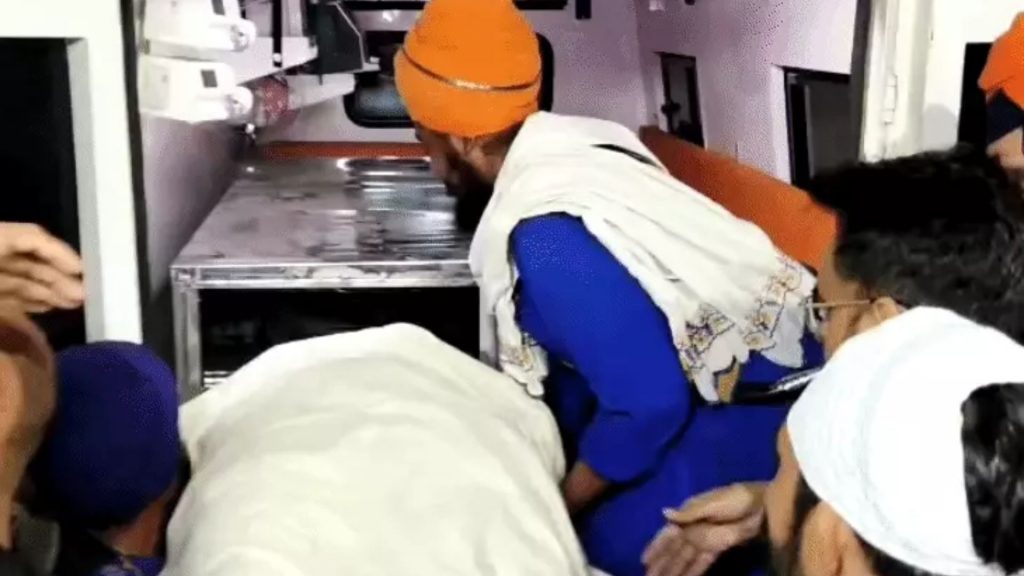
Mansa: The postmortem of Parvinder Singh Jhotha, an activist who raised his voice against drug abuse in Mansa, Punjab, will be conducted at the Chandigarh PGI on Friday (November 6). His body was flown from the Mansa Civil Hospital mortuary to Chandigarh at around 12 midnight on Thursday. The postmortem will be conducted 24 days after his murder.
Jhotha’s body was brought out of the mortuary while chanting “Satnaam Waheguru.” He was then placed in a modern ambulance equipped with an ICU, ventilator, and freezer, which was used to transport the body to Chandigarh.
Earlier on Wednesday night, Jhotha’s father, Bhim Singh, and representatives of the Insaaf Committee had reached an agreement with the government. The government has assured Jhota’s wife, Manpreet Kaur, a government job based on her merit and a compensation of ₹2 crore (approximately $1.5 million USD) to the family.
This settlement has raised many questions. People on social media are asking why the family and the Justice Committee have abandoned their demand for the resignation of Chief Minister Bhagwant Mann and DGP Gaurav Yadav. Was a settlement reached in exchange for a government job and ₹2 crore (approximately $1.5 million USD) compensation?
However, there is also an important legal aspect to this entire case. The post-mortem was considered crucial to convicting the accused in the Jhota murder case. There was a fear that delaying it would weaken the scientific and medical evidence obtained during the investigation.
According to a Dainik Bhaskar investigation, the family had received advice from legal experts that any further delay could compromise crucial evidence. The CBI was also urging the family to have a post-mortem conducted.
Why is the post-mortem report necessary? Learn about its importance in the investigation and the court.
The post-mortem in the Parvinder Jhota murder case is not just a process of autopsy; it can also help answer many important questions related to the murder.
1. Determining the Real Cause of Death
A postmortem helps clarify which part of the body the bullet hit and whether that injury caused Jhota’s death. It can also provide information about which vital organs and blood vessels were damaged by the bullet.
2. Evidence of Bullet and Body Injuries
During a postmortem, the bullet’s entry and exit marks can be examined. This helps determine the bullet’s path through the body, bone fractures, and other internal injuries.
3. Estimating the Distance and Direction of the Bullet
Examining gunpowder particles, burn marks, and other signs around the wound can help estimate the possible distance from which the bullet was fired. The path of the bullet’s entry and exit can also help determine its direction.
4. Help in identifying the weapon used
If a bullet or part of it is found inside the body, it can be removed and sent for forensic examination. This can help establish a link between the recovered bullet and the suspected weapon.
5. Scientific evidence to prove charges in court
The post-mortem report can provide medical and scientific evidence to the CBI. This helps understand the connection between the gunshot wound and death. This evidence can be presented in court along with other evidence.
6. Corroboration of eyewitness accounts
The post-mortem findings can be compared with eyewitness accounts. This can determine whether the direction, distance, and circumstances of the incident match the witnesses’ accounts. Any contradictions that arise can be investigated.
What was agreed upon in the agreement between the government and the family?
Following talks between the government and Parvinder Jhota’s father, Bhim Singh, and the Insaaf Committee, several demands were agreed upon. The key terms of the agreement are as follows:
– Jhota’s wife, Manpreet Kaur, will be given a government job based on her qualifications. The family will receive a compensation of ₹2 crore (20 million rupees).
– Cases filed against Jhota’s father, Bhim Singh, and members of the Anti-Drug Task Force will be dismissed.
– Cases filed against Jhota for tearing flex cards in Punjab will also be withdrawn.
– A statue of Parvinder Jhota will be installed in Mansa.
– A trauma center will be built in Jhota’s native village, Khyala, in his name. Approval for this has been assured within a week.
– Four people injured in the firing will receive a compensation of ₹5 lakh each. The government will bear the entire cost of their treatment.
– A notification will be issued within a week to control the sale and misuse of Pregabalin capsules.
– An agreement has also been reached to provide compensation to the family of the young man who lost his life during the protests in Ludhiana.
– Assembly Speaker Kultar Singh Sandhwan apologized for the alleged misconduct with activist Arvinder Kaur.
An assurance has been given to file a cancellation report with the court in the cases filed against Jhotha’s father, Bhim Singh, and other associates.
From October 13th to November 5th: What happened when in the Parvinder Jhotha murder case?
Since Parvinder Jhotha’s murder, protests and demands for justice have steadily increased in Punjab. The family refused to conduct a post-mortem or cremation. Subsequently, the case reached the CBI, and negotiations between the government and the family continued for over three weeks.