


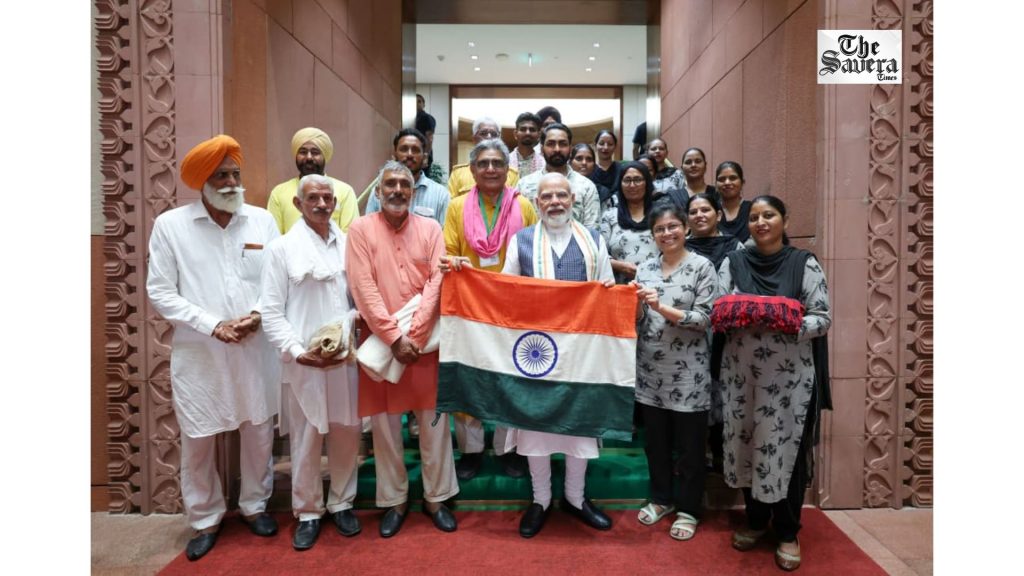
New Delhi: On the occasion of National Handloom Day, a 20-member delegation of Kheti Virasat Mission (KVM), Punjab met Hon’ble Prime Minister Shri Narendra Modi at the Prime Minister’s Office in Parliament House and presented him with an Indian National Flag made from handspun and handwoven khadi produced from indigenous, non-Bt cotton grown through natural farming methods.
The delegation comprised 10 weavers and 10 natural farmers, farmer-trainers and key team members associated with the initiative. A majority of the weavers were rural women from Nav-Trinjan who have been directly involved in transforming cotton into yarn and yarn into handwoven khadi.


The occasion was not merely about presenting a National Flag. It represented the complete “Seed to Tiranga” journey—bringing together natural farming, indigenous seeds, desi cotton, khadi, hand spinning, handloom weaving, women’s empowerment, skill development, rural livelihoods, decentralised economy and Atmanirbhar Bharat within one integrated model.
Prime Minister holds an open and warm interaction
Hon’ble Prime Minister Shri Narendra Modi interacted with the delegation in a warm and informal atmosphere for nearly half an hour. He asked about the background and work of the members, listened to their experiences and especially appreciated the labour, skill, patience and dedication of the women weavers.
During the interaction, the Prime Minister remarked:
> “Today, by coming here, you have truly made my National Handloom Day meaningful.”
Speaking about natural farming, he said:
> “There is no other way apart from natural farming. This is what has to be done.”
Encouraging the delegation, he further said:
> “It is inevitable that you will move forward.”
The Prime Minister also shared reflections on compassion, service, sensitivity and responsibility towards society, underlining the importance of human values in creating lasting social change.
Nav-Trinjan: from farm to loom, and from loom to the Tiranga
The delegation explained that Nav-Trinjan, an initiative of Kheti Virasat Mission, is not merely a weaving project but an integrated model of rural regeneration and Farm-to-Fabric development.
Under this model, natural farmers cultivate indigenous, non-Bt, toxin-free cotton. Rural women then prepare the cotton, spin it by hand on traditional charkhas and weave it into khadi on handlooms. The fabric is subsequently transformed into value-added products such as khes, shawls, stoles, garments and the National Flag itself.
In this way, the initiative connects farmers, weavers, women, youth, artisans, conscious consumers and local markets within a decentralised rural economy.
Swadeshi, khadi and natural farming integrated in one model
The delegation also highlighted that the Prime Minister has repeatedly emphasised Swadeshi, khadi, natural farming, Atmanirbhar Bharat, Vocal for Local and rural entrepreneurship as national priorities.
The Nav-Trinjan initiative brings all these ideas together in one practical model.
Here, indigenous cotton is grown through natural farming, value is added locally, women and youth gain skills and dignified livelihoods, traditional crafts are revived, farmers gain stronger market linkages, and economic value remains rooted within rural communities.
In this sense, Gram Swaraj, Swadeshi and decentralised economy are not merely concepts but living practices within the Nav-Trinjan model.
Rupsi Garg presents the Nav-Trinjan journey
Sushri Rupsi Garg, Director of Kheti Virasat Mission and Head of the Nav-Trinjan Organic Handloom Initiative, presented the complete journey and working model of Nav-Trinjan to the Prime Minister.
She explained how traditional spinners and weavers were identified village by village, how learning was gathered from khadi and handloom centres across India, and how a new generation of women and youth was trained to build a complete Farm-to-Fabric value chain rooted in indigenous cotton and rural craftsmanship.
She also explained that women in Nav-Trinjan are not merely beneficiaries, but artisans, producers, trainers, entrepreneurs and custodians of traditional knowledge.
Naturally coloured cotton draws attention
Shri Surinder Pal Singh Siyag, Chairman of the Nav-Trinjan Committee and a natural farmer, showed the Prime Minister seeds of naturally coloured indigenous cotton, the cotton lint and handwoven fabric produced from it.
He explained the potential of traditional Indian cotton varieties that naturally possess colour and can be used to make attractive, environmentally responsible textiles without depending entirely on artificial dyeing.
Handwoven khes by Ramandeep Kaur presented to the Prime Minister
Along with the National Flag, the Prime Minister was also presented with selected handloom products made from naturally grown indigenous cotton.
A beautiful handwoven khadi khes/shawl made personally by Smt. Ramandeep Kaur of Village Chaina was also presented to him. The Prime Minister examined it with interest and warmth.
The gift symbolised the transformation of a rural woman’s role—from limited livelihood opportunities to becoming a skilled artisan capable of creating high-value handmade products.
KVM’s wider work and policy suggestions shared
Shri Umendra Dutt, Executive Director, Kheti Virasat Mission, briefed the Prime Minister on KVM’s long-standing work in Punjab in the areas of natural farming, indigenous seed conservation, biodiversity, environmental health, pesticide-free agriculture, pest literacy, desi cotton, millets, rural livelihoods and Nav-Trinjan.
He also presented KVM literature and brief suggestion notes related to natural farming and rural reconstruction in Punjab.
20-member delegation represented farmers, master farmers, women and young weavers
The delegation included Shri Manbir Singh Reddu, President of Kheti Virasat Mission and natural farmer; Shri Surinder Pal Singh Siyag, Chairman of the Nav-Trinjan Committee; master natural farmer Shri Vinod Jyani; former KVM President and senior natural farmer Shri Hartej Singh Mehta; natural farming training expert Dr Jagtar Singh Dhaliwal; natural farmer and organic cotton field coordinator Shri Sukhdev Singh (Gora Singh); Shri Pulkit Jain; Shri Gurwinder Kumar Sharma; and Shri Umendra Dutt, Executive Director, KVM.
The weaving team included Smt. Shinder Kaur, Principal and Master Weaver of the Nav-Trinjan Weaving School; Smt. Gurmeet Kaur, Vice-Principal; Smt. Arun Kumari; Smt. Ramandeep Kaur; Smt. Rekha Rani; Smt. Suneha Devi; Sushri Rajni Kaur; Smt. Mona Devi; Smt. Sonu Rani; and 19-year-old young weaver Shri Gursimran Singh. Sushri Rupsi Garg coordinated and presented the initiative.
National recognition for nearly fifteen years of sustained work
Kheti Virasat Mission and the Nav-Trinjan family described the occasion as a historic milestone and an important national recognition of nearly fifteen years of sustained work.
For years, the initiative has been steadily working to revive indigenous cotton through natural farming, process it locally through hand spinning and handloom weaving, create dignified livelihoods for rural women, transfer traditional skills to a new generation and build a decentralised Swadeshi rural economy.
Presenting this work directly before the Prime Minister on National Handloom Day was therefore seen as recognition not merely of an organisation, but of the natural farmers, women weavers, young artisans and rural families whose labour and commitment have made the “Seed to Tiranga” journey possible.
A major boost for the future of Nav-Trinjan
According to Kheti Virasat Mission, the Prime Minister’s encouragement has given the Nav-Trinjan family a major moral and motivational boost.
It has further strengthened the conviction that natural farming, Swadeshi, khadi, handloom, Gram Swaraj, women’s empowerment, life skills, rural development and decentralised economy are not separate programmes, but interconnected pillars of a sustainable national development model.
KVM expressed confidence that this encouragement will help accelerate efforts in Punjab to expand natural farming-based indigenous cotton cultivation, bring more farmers into the programme, revive hand spinning and handloom weaving, create skills and livelihoods for rural women and youth, and strengthen local value-addition-based rural economies.
The “Seed to Tiranga” journey stands as a symbol of the immense possibilities that still exist in Punjab to build a new rural economy rooted in natural farming, indigenous cotton, khadi, traditional craftsmanship and Swadeshi entrepreneurship.
Kheti Virasat Mission and Nav-Trinjan view this recognition not only as an achievement, but also as a new responsibility to take forward the larger vision of natural farming, khadi, Swadeshi, Gram Swaraj and a self-reliant rural India with renewed commitment.