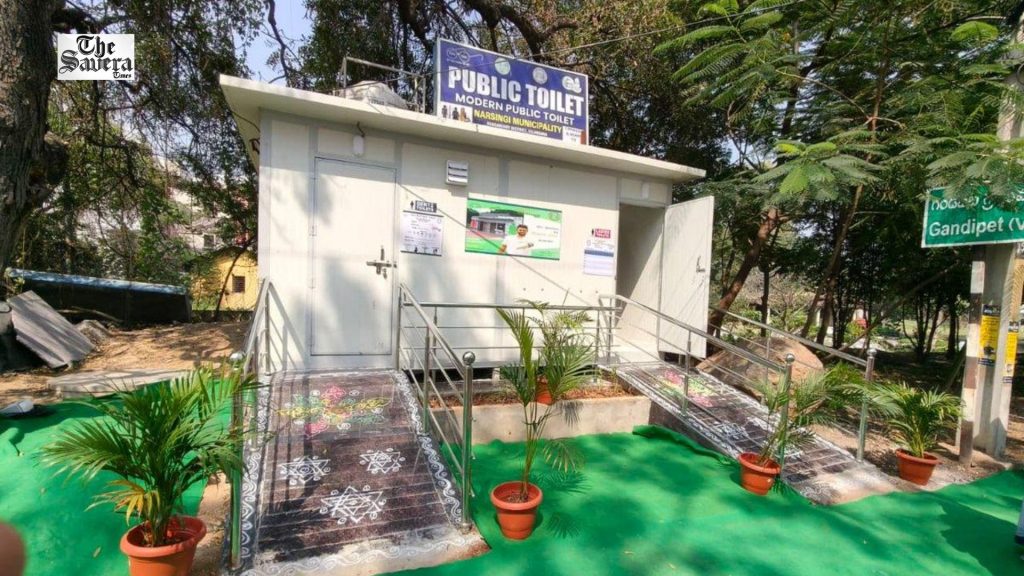
Over the years, India’s cities have made significant strides in expanding access to public sanitation facilities. From improving availability and cleanliness to enhancing safety and accessibility, cities are adopting innovative approaches to make public toilets more inclusive and user-friendly. Building on these efforts, the Swachh Bharat Mission (SBM), launched on 2 October 2014, has advanced sanitation innovation across India. Cities built toilets, raised awareness and worked towards becoming Open Defecation Free (ODF). Many went further, achieving ODF+ and ODF++ status. In 2022, the Toilets 2.0 initiative under Swachh Bharat MissionUrban (SBM-U) raised the bar again. Its aim was to make Community and Public Toilets (CT/PTs) safe, clean and inviting for everyone. Citizens can now find the nearest facility through the ‘SBM Toilet Locator’ on the Swachhata app. Today, the change is visible in unexpected places. An old bus has become a women’s toilet. Plastic waste has turned into building material. A busy market now hosts a smart lounge. A small city has found a safe way to handle sanitary waste. Pilgrim towns offer facilities open to all. Together, these stories trace the journey from basic access to dignity, safety and innovation. Women travelling through crowded bus terminals often struggle to find a clean and private toilet. In Bengaluru, Karnataka, an old bus found a new purpose to meet this need. The Sthree Toilet was set up at the Majestic bus terminal of the Karnataka State Road Transport Corporation (KSRTC). Built from a scrap vehicle, it serves women exclusively. The toilet has three Indian-style and two Western-style commodes. A sanitary napkin vending machine and an incinerator support menstrual hygiene. A dedicated space lets mothers feed their babies and change diapers. Sensor lights run on solar power generated by the facility itself. Waste drains into the nearest sewage chamber at the bus station. The toilet has proved especially helpful for mothers travelling with young children. Can a public toilet be built from what a city throws away? Navi Mumbai has shown that it can. The Navi Mumbai Municipal Corporation (NMMC) has developed Aspirational Toilets at Sector 14, Koparkhairane. The site lies near the Nisargudyan urban garden, a busy public space. Around 8,000 to 9,000 visitors use the facility every day. The structure uses 426 square metres of recycled plastic sheeting. This includes 5.3 metric tonnes of single-use plastic, 11,700 plastic bottles and 35,200 bottle caps. Builders also reused 85 repurposed computer keyboards and 284 kg of scrap metal. The project puts the principle of Reduce, Reuse and Recycle into everyday practice. Safety and comfort are built into the design. Separate sections for men and women ensure privacy. Units for children and persons with disabilities, baby care stations and sanitary pad vending machines serve all users. A fountain running on treated sewage water completes its green design. The complex now stands as a symbol of environmental innovation and civic pride. Shoppers, vendors and commuters crowd Bhopal’s 10 Number Market every day. The Bhopal Municipal Corporation has set up ‘Freshrooms’, smart and luxury public convenience centres. They follow a Design-Build-Operate-Transfer (DBOT) model under a Public-Private Partnership (PPP). The Smart Lounge at the market covers 800 to 1,000 square feet. It serves 500 to 1,000 visitors daily.
Dignity by Design