


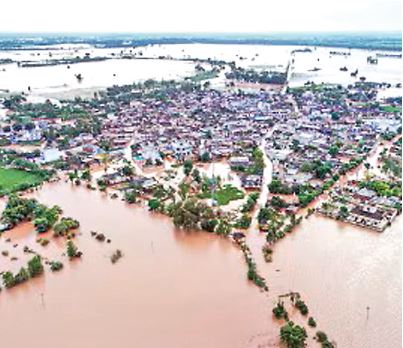
The floods that swept through Punjab this monsoon have left behind more than physical devastation. They have also exposed the fault lines in Centre-state relations, where relief and rehabilitation too often become arenas for political contest rather than cooperative governance. From Pathankot and Gurdaspur to Amritsar and Ferozepur, homes, farms and roads lie damaged. The challenge now is not only to rebuild but also to ensure that such crises are met with foresight, not finger-pointing.
The Centre’s swift response
In the early weeks of September, when swollen rivers and sudden dam releases inundated Punjab’s border districts, the Union government acted quickly. On September 1, an Inter-Ministerial Central Team (IMCT) was dispatched to assess damages, even before a formal request from the state. Prime Minister Narendra Modi flew into Punjab on September 9 for an aerial survey, after which he announced a relief package of Rs 1,600 crore.
Of this, more than Rs 800 crore has already been released. In addition, Punjab has access to over Rs 12,500 crore in its State Disaster Response Fund (SDRF), meant precisely for relief and immediate restoration. Central agencies including the NDRF, Army and Air Force were pressed into service for evacuations and rescue operations. Union Home Minister Amit Shah, after meeting Chief Minister Bhagwant Mann in Delhi, assured that the Centre “stands shoulder to shoulder with Punjab.”
This is not tokenism. It reflects an operational and financial commitment that helped contain the immediate fallout of the disaster.
The state’s counter-narrative
Yet, Chief Minister Mann has called the package “miniscule” against estimated losses of nearly Rs 14,000 crore. Opposition voices have echoed that line, demanding more funds and revisions to SDRF and NDRF norms. The frustration is understandable: Farmers have lost crops, shopkeepers their livelihoods, and countless families their homes. Punjab’s fragile agrarian economy, already under stress, now faces further uncertainty.
But politics cannot substitute for governance. Relief is not simply about announcing packages; it depends on quick paperwork, efficient disbursal and smart use of resources already at hand. The fact remains that Punjab has yet to submit its detailed memorandum of losses, a procedural step necessary for additional central disbursements. Every day lost in filing delays pushes rehabilitation further away.
To its credit, the state has cancelled officer leave in affected zones, launched relief campaigns, and promised free wheat seed to farmers for the Rabi season. Health drives across flood-hit villages have treated thousands for post-flood illnesses. But execution on the ground — restoring embankments, distributing compensation without leakages, and preparing for the next cycle of rains — remains the real measure of success.
The Ranjit Sagar question
The floods also raise uncomfortable questions about dam management. The Ranjit Sagar (Thein) Dam on the Ravi was built partly for flood moderation. Instead, sudden releases, inadequate advance warning, and weak downstream embankments worsened the inundation.
Suspending a few engineers at Madhopur headworks is not enough. What is required is a systemic shift: phased release protocols that give downstream districts days of notice, joint dashboards integrating rainfall and reservoir forecasts, desilting and embankment strengthening, and transparent post-event audits of dam operations. The recurring tussle over dam control between state and central boards must also be addressed — at the very least through joint operational oversight with stronger state participation.
Without such reforms, Punjab will remain at the mercy of both nature and administrative lapses.
The Centre’s role beyond money
If the state has lessons to learn, so does the Union government. Punjab’s demands for more flexible relief norms are not baseless. Rigid guidelines on crop compensation or SDRF expenditure may not fully reflect the realities of a border state with intensive agriculture. A degree of flexibility — faster releases, customised norms — would go a long way in reinforcing trust.
The Centre must also invest in strengthening Punjab’s flood infrastructure as a national priority. Desiltation, embankment reinforcement, and modern forecasting systems require long-term commitment. Rebuilding schools, hospitals and roads after a disaster cannot be left to state budgets alone.
Cooperative federalism in action
The floods have once again highlighted the dangers of political theatre during crises. For Punjab to recover, what matters is cooperative federalism in practice, not just in rhetoric. The Centre has already moved with funds and forces; the state must match it with accountability, transparent use of SDRF reserves, and credible planning.
Citizens care little for blame games between Delhi and Chandigarh. They want to see broken roads rebuilt, crops resown, children back in classrooms and health centres functional. They expect governments to collaborate, not compete.
A chance to rebuild trust
Punjab is no stranger to adversity. Its people have endured militancy, economic shifts, and repeated ecological stress. They remain remarkably resilient. But resilience is not infinite. Repeated floods without systemic reforms will erode both livelihoods and trust in governance.
The 2025 floods offer both governments a chance to reset their approach. If Centre and state can treat this crisis as an opportunity to modernise flood management, strengthen hydrological infrastructure and embrace transparency, the monsoons of the future may bring life, not loss.
That will require less finger-pointing and more foresight. Less posturing, more planning. Less rhetoric, more results. Punjab deserves no less.