


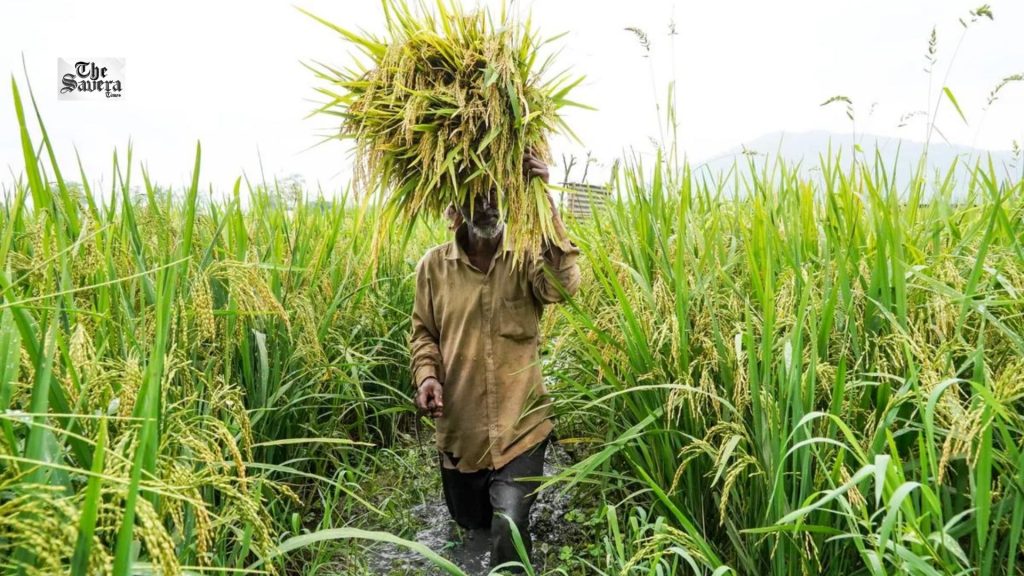
New Delhi: The procurement of six Rabi crops have increased to 3921 lakh metric tonnes (LMT) from 2014-15 to 2025-26. During this period, the Minimum Support Price (MSP) amounts paid to farmers have increased to Rs 8.36 lakh crores from Rs 2.65 lakh crores from 2004-05 to 2013-14, according to an official government factsheet.
The government has approved higher Minimum Support Prices for all six mandated Rabi crops in 2027-28 and the Cabinet Committee on Economic Affairs approved the new rates on September 30. Safflower has received the highest increase.
The government has estimated that farmers will receive Rs 90,962 crore for 324 lakh metric tonnes of produce during 2027-28. The new pricing aims to ensure better revenues for farmers and persuade farmers to look at diversifying their crops.
What is Minimum Support Price?
Minimum Support Price is the price announced by the government for certain crops. This aims to prevent farmers from selling their produce for very low prices.
Every year the government announce Minimum Support Price for 22 mandated agricultural crops following recommendations from the Commission for Agricultural Costs and Prices (CACP).
This gives farmers a benchmark for deciding what they will plant and where they will sell. However, it will only benefit those who can access procurement facilities.
Pulses and oilseeds have been encouraged by the government alongside cereal crops. By providing support prices for these crops, they aim to encourage diversification of crops. The increase in Rabi Minimum Support Prices aims to do the same.
How much has increased?
From 2004-05 to 2013-14, procurement of the six Rabi crops were 2302 LMT. With payments of Rs 2.65 lakh crore.
However, procurement increased to 3921 LMT and payment increased to Rs 8.36 lakh crore between 2014-15 and 2025-26.
Wheat procurement alone increased to 3715 LMT compared to 2254 LMT. While payments increased to Rs 7.31 lakh crore from Rs 2.56 lakh crore.
What crops have received the highest increase in Minimum Support Price?
Safflower has received the highest increase in 2027-28 with an increase of Rs 675 per quintal. Rapeseed and mustard have received an increase of Rs 413 per quintal. Lentil (Masur) have received an increase of Rs 390 per quintal.
Barley has received an increase of Rs 136 per quintal. Gram will receive an increase of Rs 83 per quintal. Wheat has received an increase of Rs 25 per quintal.
The new Minimum Support Price rates for the six crops are:
- Wheat – 2610 per quintal (+25)
- Barley – 2286 per quintal (+136)
- Gram – 5958 per quintal (+83)
- Lentil (Masur) – 7390 per quintal (+390)
- Rape Seed and Mustard – 6613 per quintal (+413)
- Safflower – 7215 per quintal (+675)
The new rates will apply to 2027-28 Rabi Marketing Season. Safflower, Rape Seed and Mustard and Lentil have seen the highest increase in rupees.
Wheat Provides Highest Estimated Profit Margins
The government have also provided details on the estimated profit margins.
Wheat has the highest profit margin at 106% over cost of production. Rapeseed and mustard provide a margin of 96% and lentil provides a margin of 92%.
Gram provides a margin of 59%. Barley provides a margin of 58% and safflower provides a margin of 50%.
These are estimated based on the governments estimated weighted average cost of production nationally. It does not guarantee that every farmer will make these amounts of profit. Depending on factors like inputs, labour, irrigation and growing conditions the cost of production may vary.
Following the Union Budget 2018-19 announcement that support prices should be set to a minimum of 1.5 times the weighted average cost of production nationally, the government have put in place the new policy.
Digital Platforms Make Tracking Easier
The government have also implemented digital platforms which make tracking easier.
As of October 19th 2026, over 43 lakh farmers have accessed procurement via the e-Samyukti platform. Over 37.45 lakh metric tonnes have been procured and over Rs 13000 crore paid into farmers accounts.
Over 1.37 crore registered farmers have used the e-Samriddhi platform. Over 2.25 crore units of produce have been procured and over 81 lakh payouts have been made.
These platforms are making procurement more accessible by increasing transparency with payments. Combined with higher Minimum Support Prices and increased procurement, this will give farmers more confidence.
The government have said that the support pricing, increased procurement and technology driven implementation will make access to markets easier for farmers and encourage diversification.