


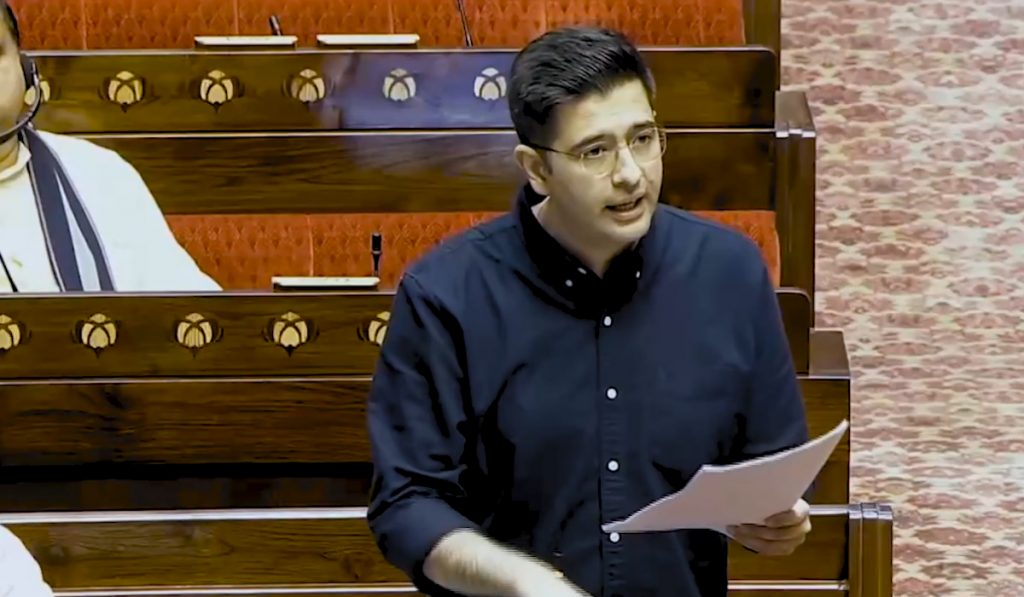
India’s First-Ever Anti-Paper Leak Framework Is Here, says Raghav Chadha While Backing It In The Parliament Participating in the debate on the Public Examinations (Prevention of Unfair Means) Amendment Bill, 2026, Rajya Sabha MP Raghav Chadha extended his wholehearted support to the legislation, describing it as a landmark reform that introduces India’s first-ever dedicated Anti-Paper Leak Framework.
Calling paper leaks a chronic national challenge that has undermined merit and shattered the aspirations of lakhs of students, Shri Chadha said the country has finally moved beyond temporary responses and media soundbites to establish a robust legal and institutional framework capable of dismantling organised examination mafias. He said the legislation marks a historic shift from merely reacting to paper leaks after they occur to preventing them through strong laws, swift investigations and strict accountability.
He said the Bill demonstrates the Government’s commitment to protecting honest students and restoring public confidence in India’s examination system.
Raghav Chadha praised Modi Government and said “Students Demanded. The Government Heard. The PM Acted like a Guardian”
Beginning his speech by addressing NEET aspirants directly, Shri Chadha acknowledged that their anger was justified, their pain was real and their concerns about the examination system were genuine.
He said every student’s voice mattered and when students expressed their concerns, the Government listened with sincerity and acted decisively. He remarked that the Hon’ble Prime Minister heard the students not merely as the head of the Government, but like the head of a family determined to safeguard the future of the nation’s youth.
Shri Chadha spoke emotionally about the sacrifices made by students and their families while preparing for competitive examinations. Mothers reduce household expenses, fathers spend their life savings and often take loans to pay for coaching, while students leave their homes to study in cities like Kota, Delhi, Jaipur, Chandigarh and Patna. They sacrifice festivals, friendships, sleep, comfort and even their health because they believe one examination can change the future of their family.
“When a paper leaks,” he said, “it is not merely the examination that gets leaked. A student’s dreams, hard work, self-belief, trust and aspirations are also destroyed.”
Recalling his own journey as a Chartered Accountancy student, Shri Chadha said he personally understood the pressure and emotional burden associated with India’s competitive examinations.
Highlighting the Government’s response after the NEET controversy, Shri Chadha listed a series of decisive measures taken to restore trust in the examination system. These included immediate re-examinations to ensure students did not lose an academic year, transfer of the investigation to the CBI, constitution of a Special Investigation Team, arrest of the alleged kingpins, filing of the chargesheet within just 75 days, restructuring of the National Testing Agency, transfer of senior officials, resignation of the Education Minister on moral grounds, withdrawal of cases against protesting students, compensation for bereaved families, strengthening of examination security protocols and the decision to conduct future NEET examinations through a fully computer-based system to eliminate even the remotest possibility of paper leaks.
He also welcomed the constitution of a High-Powered Task Force, comprising eminent experts including Nandan Nilekani, to recommend long-term reforms for preserving the integrity of India’s public examination system.
Government Chose Institutional Reform Over Political Rhetoric: Raghav Chadha Credits Government’s Swift Action on Paper Leaks
Shri Chadha said paper leaks cannot be eliminated through temporary measures or political speeches.
Drawing a striking analogy, he remarked that just as cancer cannot be cured by administering Crocin, paper leaks cannot be eliminated through media soundbites. They require institutional reform, technological safeguards and strong legal deterrence.
He said the Government has responded not with rhetoric but with systemic change by introducing India’s first comprehensive anti-paper leak law.
Quoting Benjamin Franklin’s famous words, “Well done is better than well said,” Shri Chadha said that while paper leaks had been discussed for years, the Government has now delivered concrete reforms that will permanently strengthen India’s examination system.
Every Honest Student Deserves a Fair Examination where hard work and merit, not a leaked paper, decide the result, says Raghav Chadha
Shri Chadha said the new legislation is designed to ensure that every honest student competes on a level playing field where merit alone determines success. He explained that the Bill fundamentally changes the way paper leaks will be treated in India by recognising them not as isolated offences but as organised crimes involving coaching mafias, insiders, printing presses, logistics operators, solver gangs and corrupt officials.
He highlighted that the legislation provides for imprisonment of up to 10 years and fines of up to ₹10 crore, while making offences cognizable, non-bailable and non-compoundable. The Bill also mandates Special Investigation Teams, time-bound investigations, fast-track courts, day-to-day trials and dedicated Special Public Prosecutors to ensure swift punishment.
Shri Chadha said these reforms will create a powerful deterrent, dismantle organised examination mafias and ensure that every deserving student receives a fair opportunity based solely on merit.
Nothing Matters More Than Students and Their Future: Raghav Chadha Says Student Movements Must Not Be Politicised
Shri Chadha said every reform contained in the legislation reflects one central principle—that nothing is more important than India’s students and their future.
He said students have every constitutional right to ask questions, protest peacefully and demand accountability whenever injustice occurs. However, he cautioned that student movements should remain focused on students’ interests and should not become platforms for political mobilisation.
“Students want justice. Some political parties want footage. Students want secure examinations. Some politicians want viral clips,” he remarked, urging political parties not to exploit students’ emotions for political gain.
He added that the debate is not about one political party versus another, but about merit versus mafia, and about ensuring that honest students are never deprived of opportunities because of organised cheating.
An Examination May Decide a Rank, Never a Student’s Worth: Raghav Chadha Highlights the Need to Protect Students’ Mental Well-being
Expressing concern over the growing academic pressure faced by young people, Shri Chadha said increasing competition, constant comparison and unrealistic expectations have placed enormous stress on students.
He urged parents, teachers and society to remember that examinations are important, but students are even more important. “An examination may decide a rank,” he said, “but it should never decide a student’s worth, dignity or future.” He called upon society to create a supportive environment where every student feels valued beyond examination results.
Today Is the Historic Day When the System Is Getting Fixed: Raghav Chadha Says Paper Leak Mafia Will Now Face the Full Force of Law
Shri Chadha said Parliament was not merely debating the issue of paper leaks but was delivering a lasting solution.
He observed that paper leaks have occurred across governments and political parties over the years and therefore accountability should never depend upon which party happens to be in power.
Referring to several paper leak incidents during the UPA years, including alleged irregularities in the AIIMS PG Entrance Examination (2006), Railway Recruitment Board Examination (2009), All India Engineering Entrance Examination (2011) and SSC Combined Graduate Level Examination (2013), Shri Chadha noted that despite repeated incidents, no dedicated anti-paper leak law had been enacted until now.
He remarked that while political memory may be selective, public record is not, and stressed that a national challenge requires one national standard of accountability.
From Pharmacy Recruitment to PSTET, Raghav Chadha Lists AAP Punjab’s Long Leak History and Demanded Accountability
Shri Chadha said paper leaks cannot be viewed through a political lens and that accountability must remain uniform irrespective of which party is in power.
Referring to Punjab, he said the State has witnessed a series of examination controversies under the AAP Government. He cited the Pharmacy Officer Recruitment Examination, where alleged Bluetooth-enabled cheating networks reportedly surfaced, and further referred to alleged irregularities in the Naib Tehsildar Recruitment Examination, Punjab School Education Board Class XII English Examination, Punjab State Teacher Eligibility Test (PSTET), Agriculture Development Officer Recruitment Examination, PSB Officer Recruitment Examination, and the Excise & Taxation Inspector Recruitment Process.
Shri Chadha said these repeated incidents underline why India needs a strong national legal framework with zero tolerance for organised examination fraud. He asserted that the pain of students cannot change with the party in power and that every deserving candidate deserves an examination system based solely on merit, fairness and transparency.
“His Own PA Was Arrested for the Leak”: Chadha’s Explosive Charge Against Karnataka Congress Minister
Shri Chadha also criticised the Congress Government in Karnataka, alleging that repeated paper leak incidents reflected a complete failure of accountability.
He referred to the SSLC paper leak earlier this year and recalled the 2016 Karnataka Pre-University Chemistry examination leak, where the original examination was cancelled after the paper leak, only for the re-examination paper to be allegedly leaked again, forcing authorities to cancel the examination twice.
Referring to the subsequent investigation, Shri Chadha said the Karnataka CID arrested several individuals, including the then Personal Assistant to the then Medical Education Minister. He criticised the absence of political accountability despite the seriousness of the incident, noting that the Minister neither resigned then nor has been held accountable.
Shri Chadha said these repeated incidents underline why India needed a strong national anti-paper leak law, adding that accountability cannot change with the party in power.
“I Wanted an Outcome, Not a Headline”: Chadha’s Emotional Sign-Off on NEET Bill Debate
Concluding the debate, Shri Chadha reflected on his own journey in Parliament, stating that while he had spent years in the Opposition asking difficult questions, his responsibility today was to support reforms that deliver durable solutions.
He said he could have chosen daily political commentary and media soundbites, but instead made a conscious decision to speak on the issue when Parliament was actually fixing the system.
“I didn’t want headlines. I wanted outcomes,” he said, adding that today is the historic day when Parliament is delivering precisely those outcomes.
Welcoming the legislation, Shri Chadha expressed confidence that the reforms would make India’s examination system stronger, examinations more secure, merit more respected and organised paper leak mafias a thing of the past.
“The system will become stronger. Papers will become more secure. Examinations will become fairer. Merit will be respected. The mafia will go to jail. The Government will stand guard. Students will win, Shri Chadha added.