


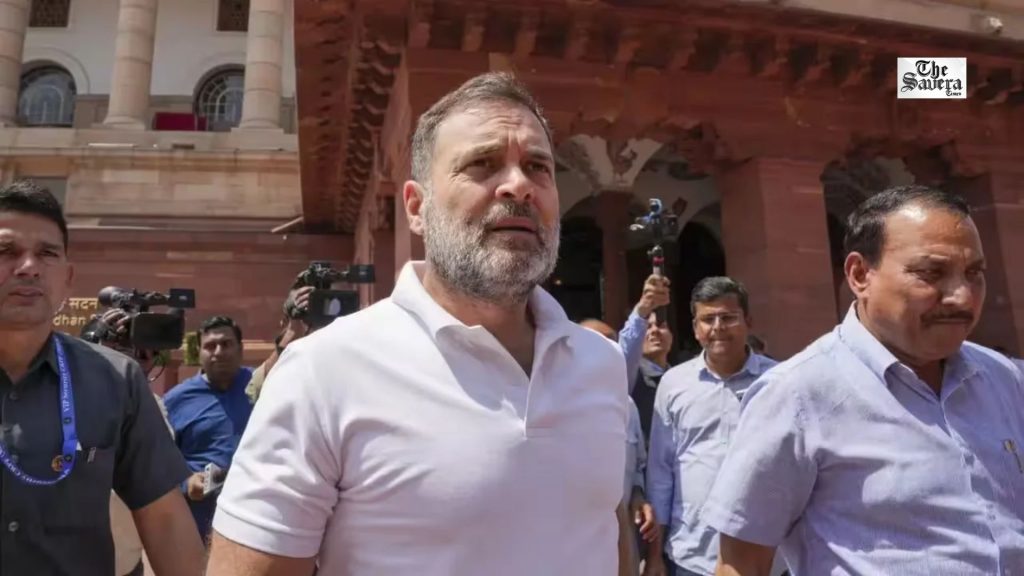
Sultanpur: Congress leader Rahul Gandhi was acquitted by a special MP-MLA court in Uttar Pradesh’s Sultanpur on Monday, October 26, in a criminal defamation case linked to remarks he made about Amit Shah during the 2018 Karnataka Assembly election campaign.
The case began after a local BJP leader, Vijay Mishra, filed a complaint alleging that Gandhi had made objectionable remarks against Shah, who was the BJP’s national president at the time and is now the Union Home Minister.
After years of court proceedings, witness statements and challenges over evidence, the court ruled in Gandhi’s favour. According to legal news outlet Bar and Bench, the court held that Gandhi’s remarks were not defamatory in nature.
Gandhi appeared in person for the pronouncement of the verdict. The acquittal brings the criminal case to a close at the trial court level, although any subsequent legal challenge would depend on further action by the complainant.
What Did Rahul Gandhi Say About Amit Shah?
The case arose from remarks Gandhi allegedly made at a press conference in Bengaluru on May 8, 2018, during the Karnataka Assembly election campaign.
Referring to the BJP’s claims about clean and honest politics, Gandhi said the party’s president was an accused in a murder case. His comments were directed at Shah, who had been named in connection with the Sohrabuddin Sheikh encounter case.
Gandhi’s statement referred to Shah’s earlier legal proceedings in that case. A special CBI court had discharged Shah in 2014.
Mishra alleged that Gandhi’s remarks were defamatory and filed a criminal complaint against him. The case was not a separate prosecution of Gandhi over the encounter case itself; it concerned whether his comments about Shah amounted to criminal defamation.
Who Filed the Case and Why?
BJP leader Vijay Mishra filed the complaint on August 4, 2018, in Sultanpur. Mishra was a former chairman of the Sultanpur District Cooperative Bank and was associated with the BJP locally.
The complaint concerned Gandhi’s remarks about the BJP president during the Karnataka election campaign. Mishra alleged that the comments harmed Shah’s reputation and sought legal action against Gandhi.
The matter proceeded before a court dealing with cases involving MPs and MLAs. Gandhi was eventually summoned to face the complaint, setting off a legal process that continued for several years.
Rahul Gandhi Defamation Case: Full Timeline
May 8, 2018: Gandhi allegedly made the remarks about Shah during the Karnataka Assembly election campaign in Bengaluru.
August 4, 2018: BJP leader Vijay Mishra filed the criminal defamation complaint against Gandhi in Sultanpur.
November 27, 2023: The court summoned Gandhi to face trial. A warrant was also issued later that year after he failed to appear, according to reports on the proceedings.
February 20, 2024: Gandhi appeared before the court after surrendering and was granted bail. Reports said he furnished two sureties of Rs 25,000 each.
July 26, 2024: Gandhi recorded his statement before the court. He denied the allegations and described the case as a political conspiracy, according to reporting at the time.
October 9, 2024: The court recorded the testimony of complainant Vijay Mishra.
February 28, 2025: A witness named Anil Mishra testified in the case.
December 8, 2025: Another witness, Ramchandra Dubey, gave testimony.
February 20, 2026: Gandhi appeared in court and his statement was recorded under Section 313 of the Code of Criminal Procedure, according to reports. The court subsequently asked him to present evidence in his defence.
March 12, 2026: An application was filed seeking to compare Gandhi’s voice sample with the recording of the remarks made in Bengaluru.
May 2, 2026: The trial court rejected the request for a voice-sample comparison.
May 21, 2026: Mishra challenged the trial court’s decision before the sessions court.
July 15, 2026: The sessions court dismissed the challenge to the rejection of the voice-sample application.
September 10, 2026: The Allahabad High Court also rejected a petition challenging the lower courts’ decisions on the voice-sample issue.
October 6 and 12, 2026: Final arguments took place in the case. The hearing concluded on October 12.
October 26, 2026: The special MP-MLA court in Sultanpur acquitted Gandhi in the criminal defamation case.
Why Was the Voice-Sample Issue Important?
One of the final disputes concerned Mishra’s request to compare Gandhi’s voice sample with the recording of the 2018 remarks.
Such a comparison could have been used as part of the evidence concerning the statement at the centre of the complaint. However, the trial court rejected the application in May 2026.
Mishra then challenged that decision before the sessions court and later the Allahabad High Court. Both challenges were dismissed, leaving the lower court’s decision in place.
The voice-sample dispute was a procedural part of the defamation proceedings. It was not itself the final verdict on whether Gandhi had committed criminal defamation.
What Does the Acquittal Mean?
The Sultanpur court’s decision means Gandhi was found not guilty in this particular criminal defamation case over his remarks about Shah. The reported finding that the remarks were not defamatory was central to the outcome.
The case should not be confused with the separate defamation case against Gandhi over his 2019 “Modi surname” remarks. In that case, a Gujarat court convicted him in 2023 and sentenced him to two years in prison. The Supreme Court later stayed that conviction, allowing him to continue as a Member of Parliament.
The Sultanpur case concerned different remarks, a different complainant and a separate set of proceedings.
The October 26 acquittal resolves the Sultanpur trial court case. Any further legal developments would depend on whether the complainant pursues an available challenge to the judgment.