


– Abhishek Vij
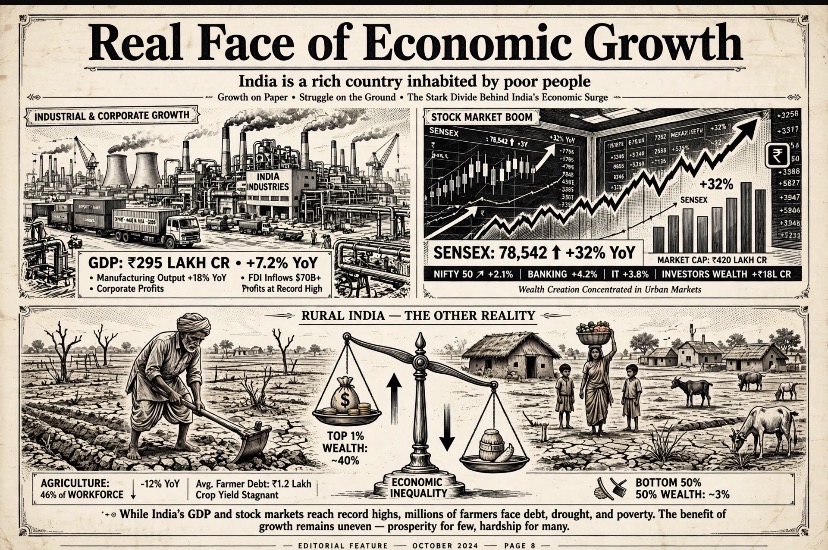
While the National Statistical Office’s data promises a better position for the country globally, it also leaves the common man stunned. The progress displayed in these statistics is not visible in the common man’s own life. He finds these figures to be mere talk.
Recently, the country’s economic growth rate for the first quarter was announced at 7.8 percent, higher than even the world’s richest nations. At a time when most countries are facing supply-side crises due to the US-Iran and Russia-Ukraine wars and are staring at a bleak future for their investors, how is India maintaining its growth rate at 7.8, the fastest in the world?
Forecasters even predict that this rate will continue for the next quarter. The next good news is about the Index of Industrial Production, whose figures are released monthly. While the country’s Industrial Production Index was showing a growth of 4.7 percent in August 2025, today it is showing 8 percent.
Furthermore, there is good news from the manufacturing sector. The vehicle trailer and semi-trailer finishing industry has grown by 25.2 percent. The same is true for transportation equipment processing. We are also claiming growth in the electrical equipment finishing industry and its components.
A new thing: this index shows that while primary goods grew by 111.8 percent, capital goods grew by 140.7 percent. Let’s clarify this a bit: primary goods are those that sustain people from the poor to all classes. Growth in these goods is low, while growth in capital goods is high. This explains the anomalous behavior we’re seeing in our economy.
It’s important to remember that the public sector has declined in importance over the past few years, and the private sector has become increasingly dominant. Now, if private sector investment has increased, it will be driven by capital goods. The private sector’s earnings from these goods have driven our country’s economic growth rate beyond that of other prosperous countries.
Undoubtedly, domestic investors contribute significantly to the country’s economic stability. Whenever India’s stock market collapses, it is private investors’ investments that lift it out of this predicament. However, gradually, in the name of public-private partnership, private investors are gaining dominance in this sector.
It’s obvious that if the public sector remains dominant, it will prioritize welfare schemes for the common man, the poor, and the lower strata. However, if, in pursuit of economic progress, we continue to privatize economic sectors, profit-driven initiatives prevail.
Now, the country will appear to benefit and progress, but the poor will not receive their fair share of these benefits because the wealthy will continue to monopolize these profits. The poor will become poorer, the rich will become richer, but the country’s indicators will continue to show progress.
Keep in mind that India is an agricultural country, with 60 percent of its population still engaged in agriculture, yet its contribution to gross domestic income has fallen to less than 25 percent. This outcry from the agricultural sector pales in comparison to the figures of industrial progress, fading away in the face of the prosperity of private investors.
The truth remains: India is a rich country inhabited by poor people.