


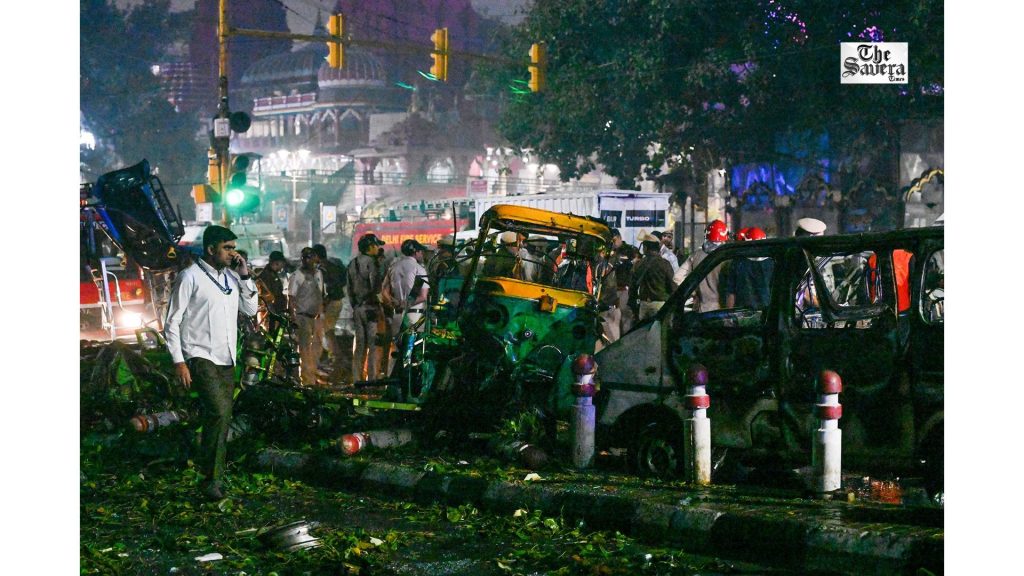
New Delhi: The National Investigation Agency (NIA) has detailed the planning and execution of the Red Fort car blast plot in November last year in a 7,500-page charge sheet filed before a special court, exposing a self-radicalisation module operating out of Faridabad.
One of the key findings was the recovery of a book titled ‘Lone Mujahid Pocket Book/How to Become an Assassin’, which was found among members of the Faridabad module and was linked to their radicalisation. The book was written by Al-Qaeda in the Arabian Peninsula (AQAP).
AQAP Material Raises Concern Over New Radicalisation Pattern
An Intelligence Bureau official said the presence of the AQAP manual signals a marked shift in how newer modules in India are operating.
“Outfits such as the Islamic State and Al-Qaeda have shifted a large part of their operations to the Arab nations. Most of the handlers that deal with the Indian recruits are from the Arab or African nations,” the official said.
These outfits, which have faced setbacks in countries such as Iraq, Afghanistan and Syria, have increasingly shifted their bases to Arab and African nations.
An official described AQAP as the most dangerous among the various Al-Qaeda units. Al-Qaeda has separate groups operating across regions including Afghanistan, Arab nations and Africa.
The official said the emergence of an AQAP-prepared manual was a worrying trend.
AQAP Maintains Links With India Through Propaganda
Another official said AQAP does not operate on the ground in India. Al-Qaeda had formed Al-Qaeda in the Indian Subcontinent (AQIS) for operations in the region.
AQAP, however, maintains tactical, ideological and organisational connections to India and seeks to connect with the Indian diaspora living in Arab nations.
“Currently, it has been looking for youth within India and using them to carry out terror acts,” the official said.
Officials also pointed out that a significant amount of AQAP propaganda material is being pushed into India compared with AQIS. According to an official, this could be linked to the greater scrutiny faced by AQIS.
AQAP also operates an English-language digital magazine called Inspire, through which it seeks to radicalise youth. Officials said the magazine and the Lone Mujahid Pocket Book/How to Become an Assassin have emerged as significant tools in AQAP’s efforts to reach and radicalise Indian youth.
Faridabad Module Reveals Serious Security Threat
Counter-terrorism experts said the concern extends beyond radicalisation, as such publications also contain operational information related to explosives, weapons, arson, vehicles and covert activities.
The NIA investigation found that the Faridabad module was allegedly planning an attack on a very large scale. The probe revealed the sophistication with which the module was operating, raising concerns about the potential scale of casualties and destruction had the plot been successfully executed.
AQAP publications contain information related to explosives including Triacetone Triperoxide (TATP). The NIA said the publications provided operational information concerning explosives, weapons, arson, vehicles and covert activities, including material related to remote-controlled mechanisms for detonating improvised explosive devices.
Officials said AQAP remains an outfit that security agencies will continue to closely monitor.
The Faridabad module investigation has highlighted the impact of AQAP’s propaganda on sections of India’s youth. AQAP has previously issued statements directly targeting India, while voice and video messages have accused India of waging a war against Muslims and called on Indian youth to join Al-Qaeda.
AQAP is also seeking to leverage localised communal issues in India to fuel its recruitment narratives. An official said the primary aim was to destabilise India and promote radicalisation among Indian youth.