


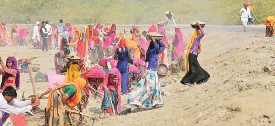
When Parliament enacted the Mahatma Gandhi National Rural Employment Guarantee Act (MGNREGA) in 2005, it marked a decisive shift in India’s welfare framework by transforming employment from a policy choice into a legal right. For the first time, rural households were empowered to demand work from the state, with the law placing a binding obligation on governments to provide at least 100 days of wage employment. Failure to do so attracted a statutory unemployment allowance, making the state legally accountable to its poorest citizens.
Rooted in decentralisation, transparency and social accountability, MGNREGA stood apart from conventional, scheme-based welfare approaches. Nearly two decades later, the Viksit Bharat—Guarantee for Rozgar and Ajeevika Mission (Gramin) Bill, 2025, introduced in the Lok Sabha on December 16, seeks to repeal and replace this landmark legislation. Framed as part of the broader Viksit Bharat @2047 vision, the Bill proposes a reimagined rural employment framework with notable expansions as well as significant departures from the original rights-based model. On paper, the new Bill enhances entitlements.
It raises the guaranteed employment from 100 to at least 125 days per rural household annually and explicitly includes climate-resilient works such as water conservation, drought and flood mitigation, and disaster risk reduction. This shift reflects the growing reality of climate-induced livelihood insecurity, as India faces more frequent heatwaves, erratic monsoons and extreme rainfall events. The Bill also introduces technology-driven planning through geospatial mapping, digital dashboards and automated audits, signalling a move towards tighter monitoring and integration with national infrastructure planning.
However, the most consequential changes lie in how employment is accessed and guaranteed. Under MGNREGA, the demand for work by households drove planning and budgeting. The state’s failure to meet this demand triggered legal liability. The proposed Bill reverses this logic by introducing state-wise normative allocations determined by the Centre, with any excess expenditure to be borne by states. This effectively weakens the enforceability of the right to work, making employment contingent on pre-approved limits rather than people’s needs. Further, the Bill restricts public works during peak agricultural seasons for up to 60 days, a provision absent in the 2005 Act. While intended to ensure labour availability for farming, it assumes that public employment competes with agriculture, overlooking the reality that most MGNREGA workers seek such work during periods of agricultural distress or uncertainty.