


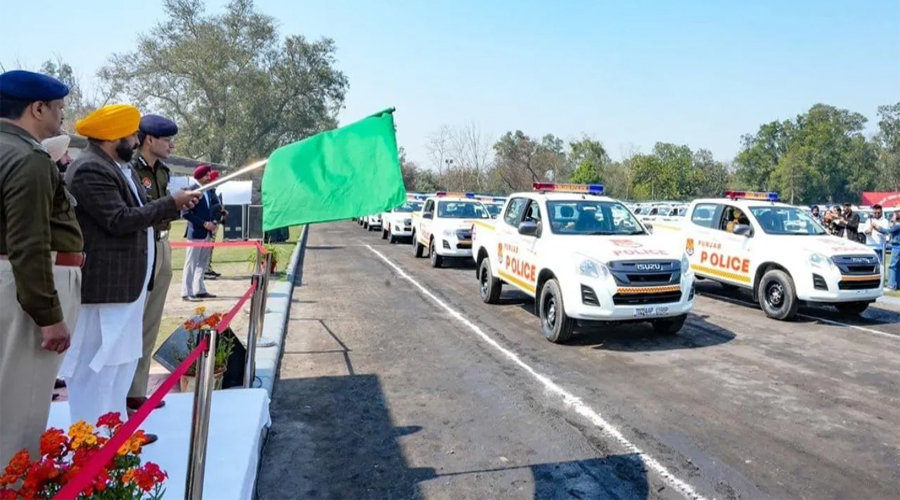
Punjab Police’s Road Safety Force (SSF) is moving beyond rapid response to road accidents and focusing on the use of advanced technology to improve road safety. The Punjab government plans to integrate Artificial Intelligence (AI), drones, satellite imagery and geospatial technology into the road safety system. The objective is to develop Punjab as a major road safety hub in the country.
SSF Responded to Thousands of Accidents in Two Years
According to the Punjab government, SSF teams responded to 43,983 road accidents between February 2024 and January 2026 and assisted around 47,386 people. Of these, 19,973 people received first aid at the accident site, while 27,413 injured persons were transported to hospitals. The SSF has been specifically deployed to provide rapid emergency assistance on highways and major roads.
Over 1,600 Personnel and 144 High-Tech Vehicles
The Road Safety Force has 144 high-tech vehicles and more than 1,600 trained personnel, around 28% of whom are women police personnel. SSF teams have been strategically deployed across thousands of kilometres of national and state highways as well as major district roads. According to the Punjab government, the average response time of the SSF after receiving an accident alert is around 6 to 10 minutes.
Focus on ‘Platinum 10 Minutes’
The SSF’s operational strategy is based on the concept of ‘Platinum 10 Minutes’. The objective is to reach an accident victim within the crucial initial minutes and provide immediate first aid. SSF vehicles are equipped with speed guns, breath analysers, e-challan machines, dash cameras and first-aid kits. Personnel have also received specialised training in accident investigation and emergency medical response.
Claim of Reduction in Highway Accident Fatalities
According to Punjab DGP Gaurav Yadav, a significant decline in road accident fatalities has been recorded on selected highways monitored by the SSF. He said the number of deaths caused by road accidents on these routes fell from 1,955 in 2023 to 1,016 in 2024. Police have linked the decline to the deployment of the SSF and its rapid response system.
SSF Coverage to Expand Under Phase II
Under the second phase of the SSF, the government plans to expand the coverage of the Road Safety Force. Under the Vision SSF-2047 initiative, emphasis is being placed on developing a comprehensive technology-driven road safety system. The plan includes the integrated use of AI, drones, satellite data and geospatial technology. The objective is to identify potential accident-prone areas, assess traffic conditions and make emergency response more effective.
Smart Surveillance Through a 3D Policing Model
The proposed 3D policing model will integrate drones, satellite imagery and AI-based predictive systems. This could help police obtain real-time information and anticipate potential risks in advance. According to the police, satellite communication and geospatial data will also be used for incident mapping, traffic congestion forecasting and disaster management.
Focus on Research and Training
The Punjab Road Safety and Traffic Research Centre has been developed as a key centre for research, training and consultancy related to road safety. For this purpose, collaboration is being undertaken with various educational institutions, including IITs, NITs, GNDC Ludhiana and Guru Nanak Dev University (GNDU), Amritsar.