


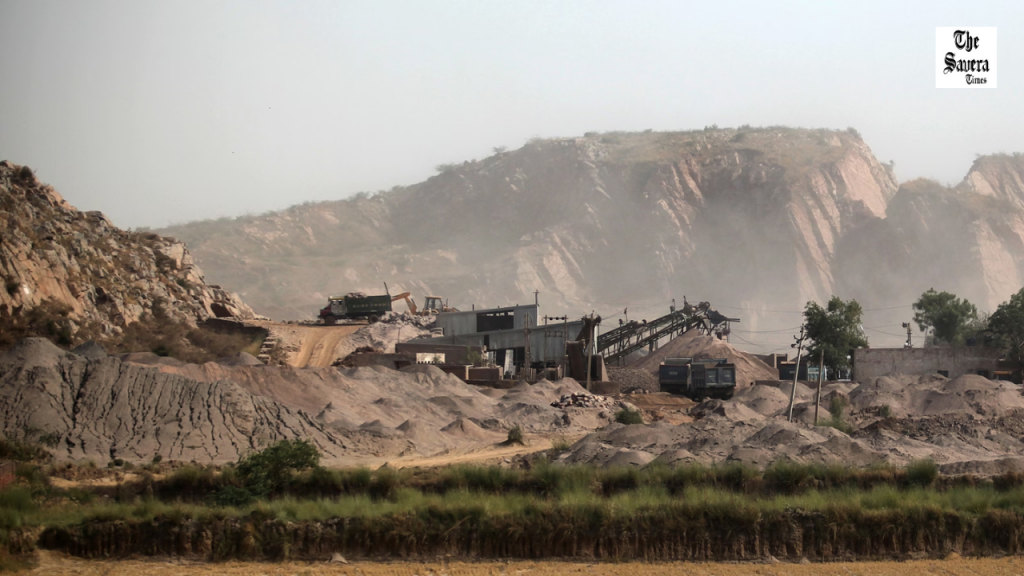
New Delhi, Dec 24, 2025: The Supreme Court of India has accepted the government’s “100-metre rule” for defining the Aravalli Hills and Aravalli Range a key criterion that could reshape protections for one of India’s most ancient mountain ecosystems. The decision, made on November 20, 2025, came despite objections from the court’s own Central Empowered Committee (CEC), which had opposed the yardstick proposed by the Ministry of Environment, Forest and Climate Change (MoEF&CC).
Under the new standard, an Aravalli Hill is defined as any landform in the designated Aravalli districts with an elevation of at least 100 meters above the local relief, and an Aravalli Range is a cluster of two or more such hills within 500 meters of each other.
Panel and Amicus Curiae Had Opposed 100-m Rule
Internal correspondence reviewed by The Indian Express shows that the Central Empowered Committee a body appointed by the Supreme Court to monitor environmental compliance did not endorse the ministry’s 100-metre definition. Instead, the CEC believed that the Forest Survey of India’s (FSI) older 3-degree slope-based definition better protected the ecological integrity of the Aravalli range.
Amicus curiae K. Parmeshwar, assisting the bench, also opposed the government’s definition, arguing in a presentation that the 100-metre yardstick undermines the continuity of the Aravalli’s landscape and ecological functions — potentially fragmenting the range and exposing significant tracts to mining and development.
Contention Over Mining and Ecological Protections
Critics and environmentalists have warned that the 100-metre rule could exclude ecologically critical lower hills and foothills from legal protection, exposing them to mining and other commercial activities even though existing protections for core conservation areas remain in place. Some analysts suggest that by strict application of the height criterion, a large portion of historically recognized Aravalli terrain may be excluded from the definition and therefore vulnerable.
The government, however, maintains that the 100-metre definition provides uniformity in regulating mining and land use, and that protected areas and environmentally sensitive zones remain shielded under existing statutory frameworks. Union Environment Minister Bhupender Yadav has rejected claims that the new definition weakens safeguards and emphasized that legal protections continue.
Public and Political Response
The apex court’s acceptance of the 100-metre rule has sparked protests in parts of Rajasthan and Haryana, with activists and local residents expressing fears about the future of the Aravalli’s ecology. Demonstrations have underscored concerns over groundwater recharge, biodiversity, wind-barrier functions, and overall environmental health.
Political figures, including former Rajasthan Chief Minister Ashok Gehlot, have criticized the shift in legal interpretation, warning that it could have severe ecological consequences and dilute long-term conservation efforts in the region.