


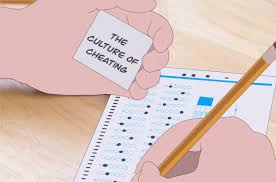
The nation requires an awakening—an awakening that necessitates a technological revolution, and alongside that, the advent of a digital and robotic era.
Education is becoming increasingly rigorous; curricula are evolving, and pedagogical methods have undergone a transformation. The significance of the Arts faculties has diminished. Yet, the one entity that has remained unchanged is the examination-conducting authority. The malady of cheating—introduced by unauthorized individuals—has now formally morphed into a full-fledged commercial enterprise.
In our peninsula-like nation, a system of “one exam, one admission” has been established; driven by the need to usher in a medical revolution and produce doctors, the NEET examination holds paramount importance. Millions of young people from the current generation, along with their parents, harbor the dream that their sons will become doctors and dedicate themselves to the service of the nation and humanity.
But how can such an idealistic era ever materialize? The fruits of their ceaseless, day-and-night toil are being stolen—a theft that has occurred once again this very year. While a National Testing Agency has indeed been established in the country, it is currently being operated by contractual staff. Every year, a massive conspiracy involving cheating is exposed—a conspiracy in which the dreams of hundreds of thousands of hardworking young individuals appear to be shattered. This phenomenon occurred on a massive scale in 2024 as well.
When the perpetrators of that incident were apprehended, a solemn pledge was made that this scourge of cheating would no longer be tolerated. In 2025, no major reports of such incidents surfaced. People assumed—perhaps optimistically—that compassion had finally been shown toward the dreams of the youth, that the malady of cheating had receded, and that their hard work would now be evaluated fairly.
However, in 2026, when the nationwide NEET examination was conducted, the stark reality—in all its ugliness—re-emerged: the act of cheating has now officially transformed into a commercial racket.
The initial reports originated from Rajasthan; subsequently, as investigations commenced, individuals implicated in this conspiracy were traced as far away as Latur in Maharashtra. From coaching instructors—tasked with imparting education to students—to various types of fraudsters, unscrupulous individuals are easily establishing contact with these young aspirants.
They are actively encouraging these young people to engage in cheating through digital mediums. Coaching centers, originally established for the betterment of education, now appear to be deeply embroiled in the illicit trade of cheating. Raghunath Motegaonkar, the founder of the Renukai Chemistry Center, was arrested in Latur—an incident that occurred just when it was widely believed that the cheating scandal had erupted solely in hubs like Jaipur, Rajasthan.
Time and again, Parliamentary Standing Committees—covering education, women, children, youth, and sports—hold consultations with bureaucrats from the Ministry of Education regarding paper leaks and reforms within the NTA; new precautionary measures are announced, yet the tide of cheating inevitably surges once more.
Due to the NEET exam paper leak, the futures of 2.3 million young aspirants have been shattered. There is no guarantee that this malpractice will not recur next year, for cheating has now evolved into a full-blown industry. The networks facilitating this cheating racket have extended their tentacles even into beauty parlors.
Everything from mobile phones to various other digital devices is being deployed to access and view exam papers. This illicit trade involving cheating has generated profits running into hundreds of thousands of rupees.
The accused individuals who are apprehended are often released on bail; subsequently, whenever the date for the next competitive examination approaches, this very same racket resurfaces in a new guise, once again becoming the scourge of cheating.
When will this vicious cycle finally come to an end? One alternative explored was to allow students to take examinations with their textbooks open; however, this approach proved unfeasible. After all, where would one find the teachers capable of discerning whether a student has merely copied verbatim—mimicking every stroke of the original text—or has genuinely applied their own understanding and knowledge?