


Estelle Razanatsoa
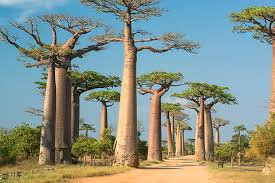
Madagascar is home to seven species of baobab trees, of which six are found nowhere else on the planet. Many of the trees have been alive for well over 1,000 years. The ancient trees have become symbols of Madagascar itself. They’re also gifts to climate science.
Imagine these trees as filing cabinets for climate history. Every year a tree grows, it lays down a new ring, and locked inside that ring are chemical fingerprints that reveal how much rain fell that year.
These records could tell society what it needs to know about the climate history of Madagascar. But until now, this information was hidden in the trunks of the trees.
We are a team of applied palaeoecologists and climate scientists who set out to provide the first ever tree ring rainfall record reconstructed from isotopes in baobab rings in Madagascar.
Isotopes are different forms of the same chemical element that have the same number of protons but a different number of neutrons in their nucleus. Baobab trees absorb carbon dioxide, which contains three carbon isotopes: carbon-12 (light, most common), carbon-13 (heavy, stable but less common), and carbon-14 (rare and radioactive).
The chemistry is elegant: in dry years, trees absorb more of a heavier form of carbon because they close their stomata to conserve water, which leads to higher absorption of ¹³C relative to normal conditions. In wet years, that signal drops. String enough of these signals together, and combine them with radiocarbon dating that establishes how old the trees are, and you have a natural rain gauge running through the centuries — the first of its kind ever produced for Madagascar.
Our research aimed to increase Madagascar’s palaeoclimate records. These are records of temperature, rainfall and climate that span centuries and millennia. When used along with other palaeoecological proxies such as pollen, they help to show how ecosystems function and change over hundreds of years.
Most of the palaeoclimate records in Madagascar are found in mineral deposits like speleothems, stalagmites and sediments, and to date there are not many. Although scientists have previously used this method to generate a 1,000-year rainfall record from baobabs for South Africa, this hadn’t been tried in Madagascar.
Our goal wasn’t just academic. This kind of long-term evidence has direct, practical relevance for biodiversity conservation, land management, and building resilience to global warming.
From the field to the lab
We went to four baobab trees across south-western Madagascar, the driest corner of the island, and inserted a long borer into the trees to extract samples of the core. This didn’t harm the trees. Afterwards, the hole was sealed with a tree sealer to prevent damage by insects or fungi.
The record tells a dramatic story. South-western Madagascar had its wettest era between 1350 and 1450. This was followed by a prolonged and brutal dry spell from 1600 to 1750. From 1750 until today, south-west Madagascar has been in a long-term trend of declining rainfall.
We didn’t stop there. We also took sediment samples and analysed charcoal deposits, pollen grains and isotopes preserved in nearby wetlands. These too are natural archives that track changes in fire and vegetation over the same period. We laid these side by side with the baobab tree samples — and something important emerged.
(Courtesy: DTE)