


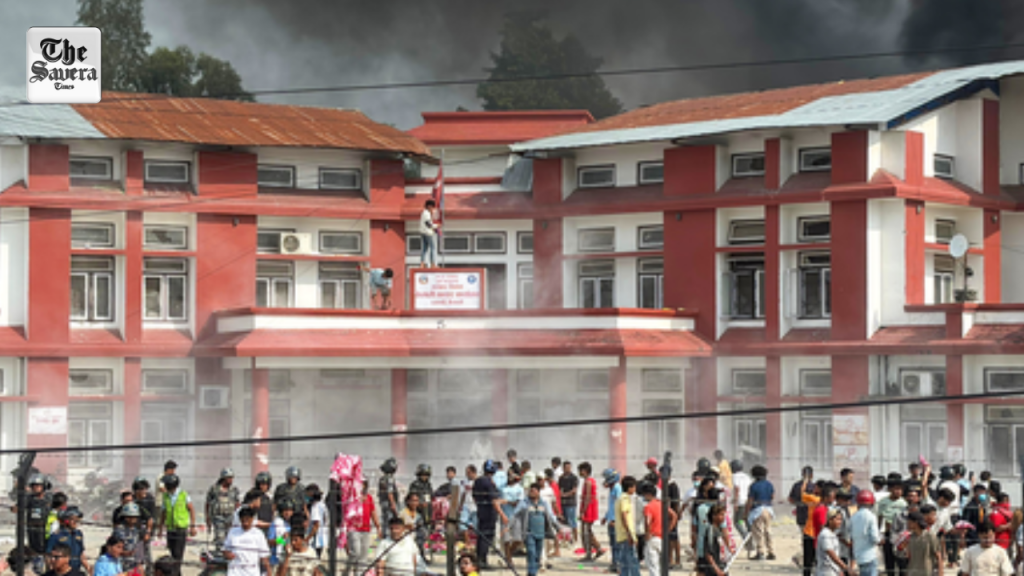
New Delhi: Security measures have been significantly strengthened along the Indo–Nepal border following violent protests and political turmoil in Nepal’s capital, Kathmandu. A large contingent of Sashastra Seema Bal (SSB) personnel has been deployed, with district police and security forces conducting joint patrols along sensitive stretches.
Border movement has been restricted, and several check posts on the Nepalese side have been set ablaze by protesters, leaving thousands stranded on both sides of the international boundary.
Araria SP Anjani Kumar has instructed all police stations and outposts in border areas to remain on high alert, monitor developments across the border closely, and provide immediate updates to district headquarters.
Escalation of Gen Z–Led Protests in Nepal
Nepal is experiencing widespread unrest driven by public anger over a government-imposed social media ban, along with grievances about corruption and nepotism. The Gen Z–led protests, initially focused on opposing the ban, have evolved into a broader anti-establishment movement.
The crisis deepened after Prime Minister K.P. Sharma Oli resigned, prompting protesters to set fire to the Supreme Court, Parliament, and other government buildings and official residences. Civilian authorities were overwhelmed as government and private properties were vandalized and torched during Wednesday’s protests.
Army Takes Control and Nationwide Curfew Imposed
With the civilian administration unable to contain the unrest, the Nepali Army assumed responsibility for maintaining law and order. Announcing a nationwide curfew on Wednesday, effective until Thursday morning, the Army cited the urgent need to “safeguard law and order.” Security officials confirmed that the prohibitory order would remain in place nationwide until 6 A.M. the following day.
Once regarded as one of South Asia’s politically stable countries, Nepal is now in the grip of an unprecedented crisis, mirroring recent unrest in Sri Lanka and Bangladesh.
India–Nepal Ties Under Strain but Stable
Nepal remains a strategically important neighbor for India, both culturally and economically. In FY 2024–25, bilateral trade reached $8.5 billion, with India exporting goods worth $7.33 billion and Nepal exporting $1.2 billion—around 16% of its GDP. India’s exports include petroleum products, vehicles, machinery, medicines, food items, and textiles, while Nepal sends agricultural produce, handicrafts, leather goods, and select industrial products.
Several cross-border infrastructure projects, including upgrades to roads, railways, and air links, are in progress to enhance trade and connectivity. Despite the political chaos in Nepal, India is working to keep bilateral relations stable, easing trade barriers, strengthening investment flows, and ensuring supply chains remain intact. New Delhi has also stepped up diplomatic engagement, reaffirming its support for Nepal during this turbulent phase.
Analysts believe that once stability returns, the India–Nepal partnership could expand further, boosting economic growth and contributing to broader regional stability in South Asia.