


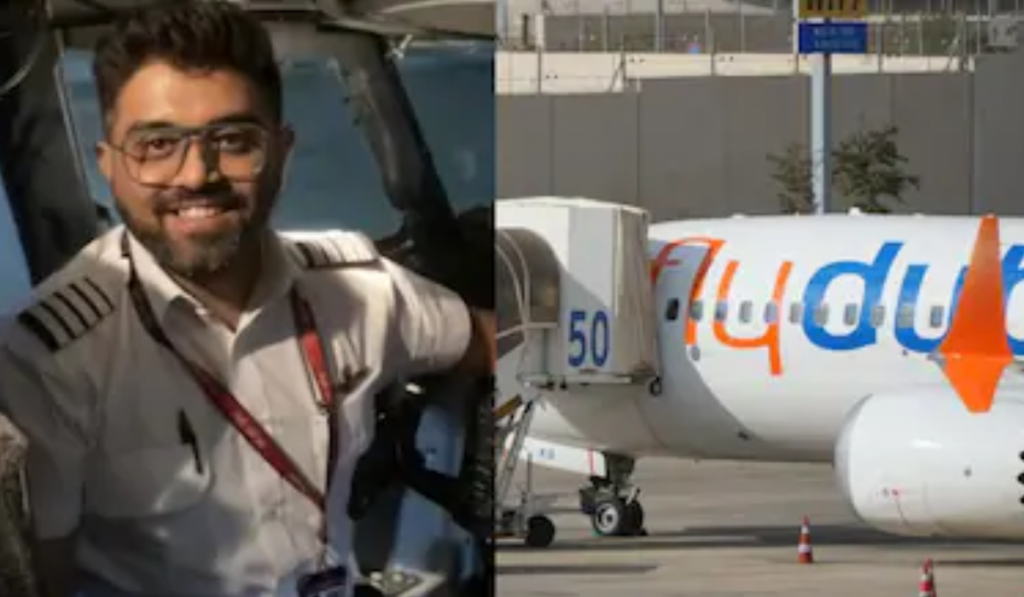
Imagine being seriously injured inside a flying aircraft, with blood on your clothes, passengers in panic and the plane rapidly losing altitude. At that moment, Captain Smit Machchhar, an Indian pilot flying a Flydubai flight from Dubai to Tel Aviv, made a decision that helped change the outcome of the crisis.
According to Israeli officials and passenger accounts, Machchhar was attacked and stabbed by his co-pilot during Flydubai Flight FZ1073. The aircraft then went into a rapid descent, losing nearly 14,000 feet in less than a minute, according to flight-tracking data cited by Reuters.
But despite his injuries, Machchhar managed to activate the cockpit door release. Passengers and crew entered the cockpit, overpowered the attacker and helped regain control of the aircraft. Two Flydubai pilots who were travelling as passengers then helped stabilise the plane. The aircraft eventually made an emergency landing in Tabuk, Saudi Arabia. All passengers reached safety.
Netanyahu Calls Indian Pilot A ‘True Hero’
The incident quickly became an international story because the flight was headed towards Israel and most of the passengers were Israeli.
Israeli Prime Minister Benjamin Netanyahu publicly praised Captain Machchhar and called him a “true hero.” Netanyahu said the Indian pilot’s decision to open the cockpit door, even after being seriously injured, allowed passengers and crew to intervene and prevented what he described as a potentially catastrophic disaster.
Netanyahu also said the incident appeared to involve an attempt to bring down the aircraft. However, the motive behind the attack remains under investigation, and authorities have not established a final explanation for what happened.
Indian Prime Minister Narendra Modi also praised Machchhar’s courage, saying his actions helped save lives and avert a major tragedy. Modi later described the incident as preventing a “9/11-like attack.” That is a description made by the Prime Minister; it is not an independent finding that the incident was equivalent to the September 11, 2001 attacks.
Israeli Passenger Also Played A Key Role
Captain Machchhar was not alone in preventing the disaster.
Israeli passenger Yaniv Hayun entered the cockpit after the door was opened. According to his account, he confronted the attacker and then returned to the controls while the aircraft was still descending. Other passengers and crew helped restrain the attacker, while the off-duty pilots eventually took over the aircraft.
The episode therefore involved several people — the injured Indian captain, Israeli passengers, cabin crew and off-duty pilots — working together during a rapidly developing emergency.
Why This Matters For India-Israel Relations
There is another important side to this story: India and Israel already have a deep and expanding strategic relationship.
India and Israel established full diplomatic relations in 1992. In 2017, Prime Minister Narendra Modi became the first Indian Prime Minister to visit Israel, and the relationship was upgraded to a strategic partnership.
In February 2026, Modi visited Israel again and held talks with Netanyahu. The two countries then took another major step by elevating their relationship to a “Special Strategic Partnership for Peace, Innovation and Prosperity.” Cooperation was identified in areas including defence, security, trade, investment, technology, cyber security, agriculture, water, space, energy and scientific research.
The two countries also have important economic links. According to India’s Ministry of External Affairs, bilateral trade stood at about $3.75 billion in FY 2024-25, while cooperation has expanded beyond traditional areas into technology, communications, medical equipment and other sectors.
Could Machchhar’s Heroism Add A New Human Dimension?
It would be too early to say that this single incident will formally change India-Israel policy. Foreign policy is shaped by governments, strategic interests, security concerns and long-term cooperation.
But the incident has created a powerful human connection.
An Indian captain was flying passengers towards Israel. An Israeli passenger entered the cockpit during the crisis and helped prevent the aircraft from going down. Israel’s Prime Minister publicly praised the Indian pilot, while India’s Prime Minister praised his courage.
So, beyond defence deals, technology and diplomacy, this incident has highlighted something simpler — ordinary people from India and Israel standing together during an extraordinary emergency.
At a time when India and Israel have already upgraded their ties to a Special Strategic Partnership, Captain Smit Machchhar’s story could become a memorable human chapter in that relationship — one built not only on governments and agreements, but also on courage, cooperation and lives saved together.