


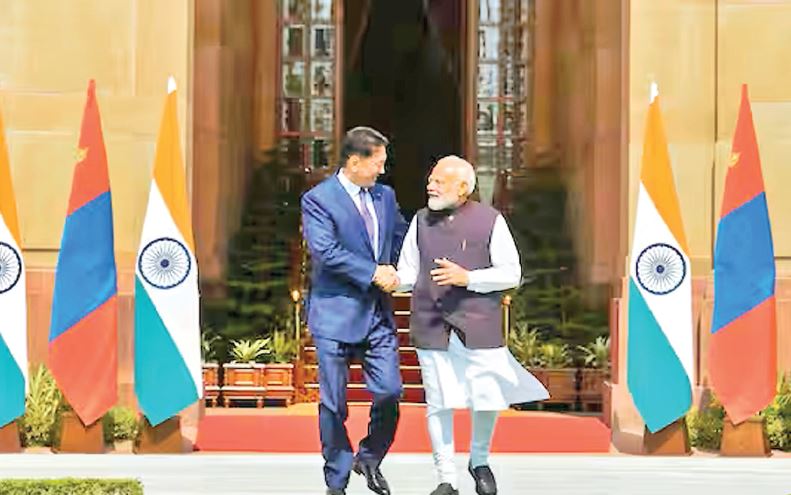
Mongolia has long been admired for its resilient, hospitable, and spiritually grounded people, with a unique cultural connection to India. This bond, rooted in shared Buddhist values, has grown steadily over decades, providing a platform for robust diplomatic, economic, and cultural ties. India’s engagement with Mongolia dates back to the early 1990s, during Mongolia’s transition from communism to democracy, when peaceful protests and human chains at Sukhbaatar Square marked the country’s democratic awakening. Indian diplomats and officials established close personal and professional relationships with emerging Mongolian leaders during this period, laying the foundation for enduring bilateral cooperation.
A key aspect of India-Mongolia relations was the posting of Rinpoche Kushok Bakula, a prominent Buddhist monk, as India’s ambassador to Mongolia. His influence, rooted in spiritual authority, strengthened people-to-people connections and led to major cultural engagements, including arranging a visit by the Dalai Lama despite political pressures. India also initiated its first open-ended India Technical and Economic Cooperation (ITEC) slots for Mongolian participants and extended the first line of credit beyond its immediate periphery.
Over time, the relationship has diversified into trade, investment, and strategic partnerships. India has invested over $1.7 billion in a refinery in Mongolia, the largest development project by India globally, employing more than 2,500 Indian professionals alongside Mongolian counterparts. Indian IT and other companies have also established operations in Mongolia, supporting infrastructure and developmental projects. The two nations continue to explore cooperation in defence, cyber technology, AI, higher education, industrial development, and space, with training and capacity building forming key components of military collaboration.
High-level exchanges have reinforced these ties. Prime Minister Narendra Modi became the first Indian PM to visit Mongolia in 2015, solidifying the strategic partnership. During the recent state visit of Mongolian President Khurelsukh Ukhnaa, from October 13 to 16, both countries celebrated 70 years of diplomatic relations and ten years of strategic partnership. The delegation included cabinet ministers, parliamentarians, senior officials, business leaders, and cultural representatives, highlighting the depth of bilateral engagement.
During meetings, PM Modi emphasized the spiritual and cultural dimensions of the partnership, noting India’s efforts to support Buddhist education in Mongolia. Plans were announced to send a Sanskrit teacher to Gandan Monastery and digitize one million ancient manuscripts. Mongolia’s President expressed appreciation for India’s support in joint projects, particularly the timely completion of the Oil Refinery Plant, which symbolizes bilateral cooperation.
Energy cooperation remains a key pillar, with India recognized for leadership in renewable energy, nuclear energy, and initiatives such as the International Solar Alliance. Defence collaboration has expanded through training programs, appointment of a Defence Attaché, and capacity-building initiatives for Mongolia’s border security forces. Both nations also maintain convergence on global issues, advocating dialogue and diplomacy, support for UN reforms, and India’s seat at an expanded UN Security Council.
Economic cooperation has deepened through shared industrial initiatives, including plans to export Mongolia’s key mineral resources, such as copper and coking coal, to India. The partnership leverages Mongolia’s mineral wealth and India’s technological and industrial capabilities, fostering mutually beneficial development.
India-Mongolia relations are anchored in three pillars: democracy, dharma, and development. Spiritual, cultural, and civilizational connections provide a framework of trust, while strategic, economic, and educational cooperation ensures long-term growth. The I ndia-M ong olia Joint Committee on Cooperation, co-chaired by External Affairs Minister S. Jaishankar and Mongolian Chief Cabinet Secretary Dashzegviin Amarbayasgalan, will continue monitoring projects, identifying new areas of collaboration, and ensuring coordinated progress.
As global uncertainties
continue, the India-Mongolia partnership exemplifies a resilient, multi-dimensional relationship that combines historical, spiritual, and strategic elements, positioning both nations to navigate emerging challenges and capitalize on shared opportunities.