


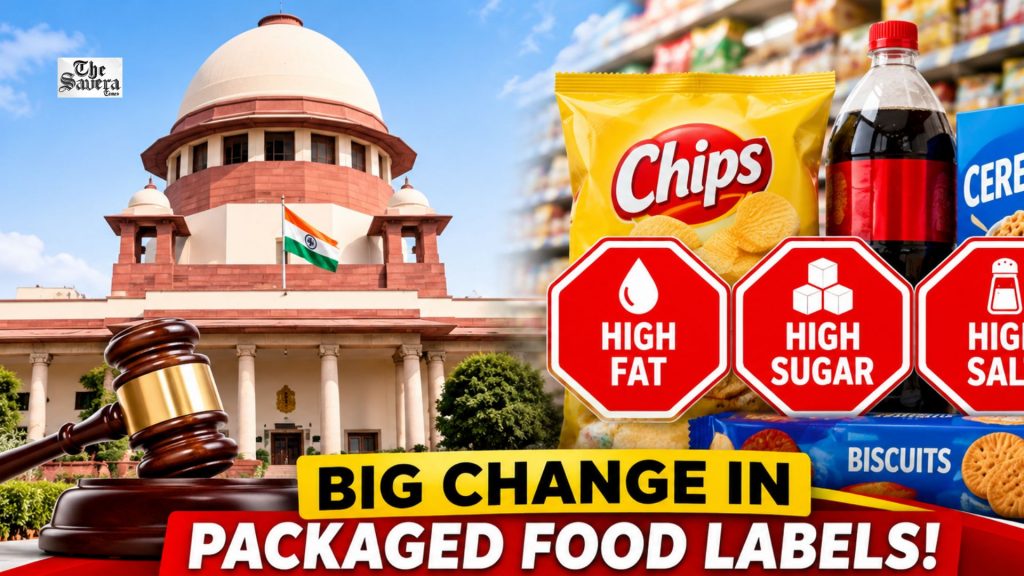
New Delhi: The Supreme Court has directed the Centre and the Food Safety and Standards Authority of India (FSSAI) to strengthen warning labels on packaged food products containing excessive amounts of fat, sugar or salt.
The court has said that such products must carry separate and clearly visible warning symbols on the front of their packaging so consumers can identify potentially unhealthy ingredients before making a purchase.
A Bench of Justices JB Pardiwala and KV Viswanathan said the warnings should appear as red hexagonal symbols, with individual labels for high fat, high sugar and high salt. The directions aim to make nutritional information easier to understand and help consumers make informed food choices.
Three Separate Red Health Warning Symbols for Fat, Sugar and Salt
Products which are above the set standards for fat, sugar and salt must display an individual health warning for each of those elements, the Supreme Court has ruled.
Each warning will be shown within a red hexagon alongside appropriate details and graphics. Consumers will easily recognise if a product is high in fat, sugar or salt.
Should a packaged food contain high levels of all three nutrients, then three different health warnings must be included. A joint warning for the three would not suffice.
Such warnings aim to enable people to easily recognise which foods are high in fat, sugar and salt.
FSSAI to take into account overall sugar and saturated fat content
In addition to analysing added fat and sugar content, the court has instructed FSSAI to analyse a product’s overall sugar and saturated fat content when assessing what level of health warning is appropriate for that food.
Scientific data and research should also be analysed to support this process.
Furthermore, the judges warned that both under- and over-setting health warning standards could present issues. Under-setting may result in the majority of packaged food displaying a health warning and thus dilute their effect. Conversely, where standards are set too high, foods which may include unhealthy levels of fat, sugar and/or salt could evade health warnings.
It was emphasised that the process of setting health warning standards should be both fair and grounded in science.
Warning Symbols to Cover 4-5% of Packet Display Area
The Supreme Court has also insisted that health warnings must be sufficiently noticeable.
Around 4 to 5% of the main food pack frontage will be taken up by each red hexagon warning. The font size of the warning details should also be large enough to be legible in typical light conditions.
In addition to following the court’s guidance, the Centre has been told to ensure effective application of the Food Safety and Standards (Labelling and Display) Regulations, 2020.
Supreme Court urges health eating education for children
Aside from health warnings, the Supreme Court has also emphasised that greater child education regarding healthy eating is required.
The Bench suggested that schools should review teaching methods so that children can practically engage with, and understand, what constitutes healthy eating – rather than simply studying this in books.
Schools may run workshops, and dynamic educational events and schemes to teach children which foods are healthy to eat and which should be eaten with care.
Lastly, the court has requested that FSSAI report on the current status of work being undertaken to develop a draft of the amended regulations.
Following 10 weeks, the case has been re-scheduled for another hearing. At this hearing, FSSAI will need to present both a report and an affidavit detailing the current stage of development of the planned regulatory amendment.