


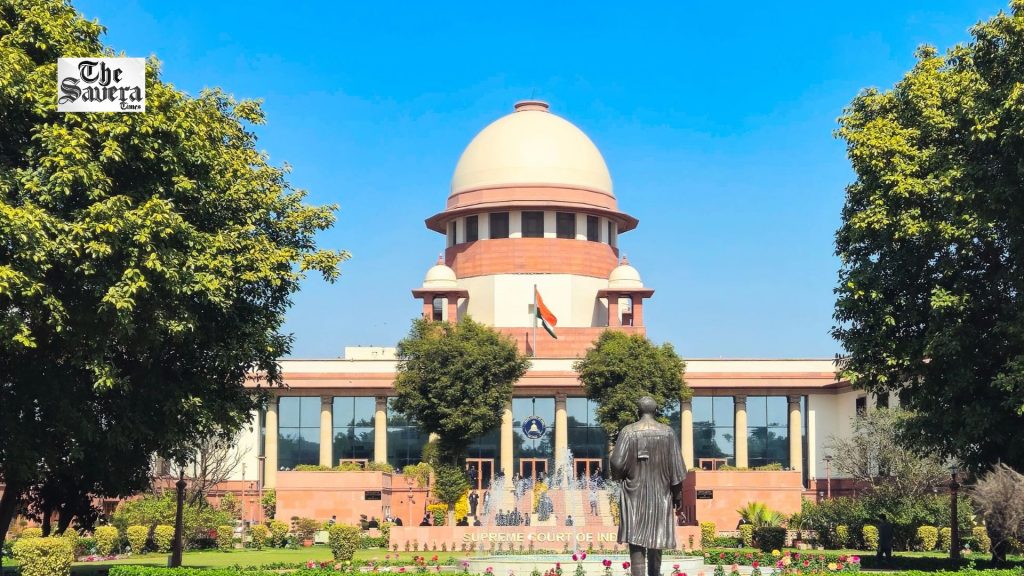
New Delhi: The Supreme Court on Friday rejected a Public Interest Litigation (PIL) asking for constitutional safeguards and objective criteria to be laid down for the appointment of Ministers with serious criminal charges.
A Bench of the Chief Justice of India (CJI) Surya Kant, Justices Joymalya Bagchi and V. Mohana were unsure about laying down guidelines for the appointment of Ministers, stating that criminal cases can also be filed against political leaders by their opponents in a democratic setup.
Justice Bagchi raised concerns while hearing the matter stating that it may not be appropriate for the Apex Court to lay down guidelines which would limit the freedom of the Prime Minister and Chief Ministers when appointing members to their respective Cabinets.
Advocate Nisha Tiwari, appearing for the petitioner stated that exercising this discretion would have to be done with reasonableness.
“All that I am saying is that the exercise of discretion has to be reasonable. There have to be certain parameters governing that discretion,” Tiwari said.
Justice Bagchi added that laying down guidelines may land the Apex Court in a tight spot when dealing with constitutional matters as criminal cases can be filed after a government changes.
Tiwari again stressed that there needs to be some reasonable limit put in place to make sure that people with criminal cases are not appointed as Ministers. She argued that voters aren’t necessarily agreeable to having legislators with criminal backgrounds in their Cabinet.
“Whenever I cast my vote, I do not necessarily endorse somebody with criminal antecedents becoming a Cabinet Minister. With respect, there has to be a reasonable limit. That is all I am saying,” Tiwari said.
The PIL was rejected by the Apex Court.
What Was The PIL About?
The PIL was filed by Dilip Kumar Sharma under Article 32 of the Constitution of India asking to direct that constitutional safeguards be put in place for the appointment of people with serious criminal charges as Ministers under Articles 75(1) and 164(1).
It stated that there are no objective criteria for what makes someone suitable to be appointed as Ministers, leading to people with serious criminal charges being appointed to the Council of Ministers.
The PIL cited data from the Association for Democratic Reforms (ADR) which stated that 47% of current Ministers in the country have pending criminal cases. 27 per cent face serious criminal charges.
The petitioner argued that by appointing Ministers with criminal charges to sensitive portfolios, there is a conflict of interest created. This also goes against the right to a fair trial under Article 21.
The PIL cited a Supreme Court Constitution Bench judgement from 2014 in Manoj Narula vs. Union of India. In this case, the Apex Court refused to read a disqualification clause into Articles 75(1) and 164(1), but stressed that the Prime Minister and Chief Ministers have a constitutional expectation to act with restraint when appointing Ministers with serious criminal backgrounds.
The petitioner argued that this expectation of political restraint has not been met so a clear framework must be put in place.
The PIL cited recommendations from various committees and commissions such as the Vohra Committee, the National Commission to Review the Working of the Constitution, the Second Administrative Reforms Commission and the Justice J.S. Verma Committee.
The PIL also cited three Bills passed by the Union Government in Parliament in 2025. These Bill’s propose for the removal of the Prime Minister/Chief Minister/Minister if they are arrested for more than 30 days for a serious criminal offence.
The petitioner stated that this would not be enough, as it does not account for those with serious criminal charges who are still holding Ministerial positions but aren’t arrested.
The PIL asked for a framework to be put in place to ensure that Ministers are only appointed after being assessed on their suitability. They also wanted reasons for their appointment to be made public in a “Suitability Memorandum”. Finally, they want to prevent Ministers being given portfolios where they have pending criminal charges meaning there would be a conflict of interest.
They made it clear that they weren’t asking for a new disqualification clause to be added to elections, but instead they want to ensure transparency and accountability whilst protecting the integrity of the criminal justice system.