


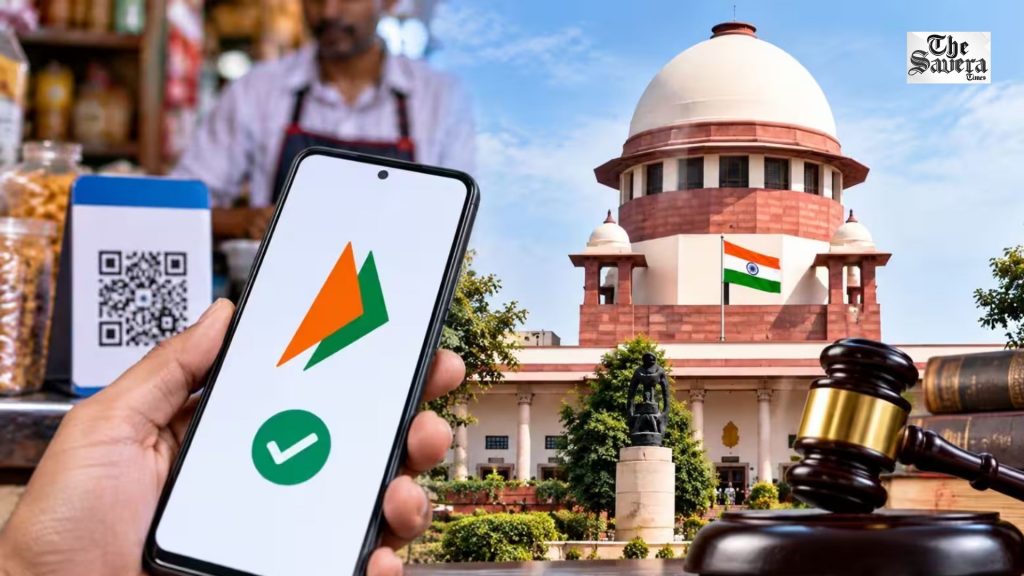
New Delhi: The Supreme Court on Monday refused to stay the Centre’s decision to introduce a Merchant Discount Rate (MDR) on specified Unified Payments Interface (UPI) person-to-merchant (P2M) transactions above ₹2,000. However, the court issued notices to the Centre, Reserve Bank of India (RBI), National Payments Corporation of India (NPCI) and the UPI Steering Committee on a petition challenging the notifications introducing the charges.
A three-judge bench headed by Chief Justice of India Surya Kant and comprising Justices Joymalya Bagchi and V Mohana heard the matter. During the hearing, the bench observed that the issue was “less a legal and more a technical issue.”
Additional Solicitor General N Venkataraman, appearing for the Centre, told the court that 96 per cent of users of the payment gateway would remain exempt from the new framework.
What Is the New UPI MDR Rule?
Under the new framework, a 0.4 per cent MDR will apply from October 15, 2026, to specified P2M UPI transactions above ₹2,000. The MDR will be capped at ₹300 for transactions of ₹75,000 and above.
The charge is a merchant-side payment processing fee rather than a charge imposed directly on ordinary UPI users. The government has clarified that MDR is neither a tax nor a fee collected by the government or NPCI. It is distributed among participants in the payments ecosystem.
The new framework does not apply to person-to-person (P2P) UPI transfers. Such transactions will continue to remain free irrespective of the amount transferred. Payments to merchants up to ₹2,000 and transactions covered under the zero-MDR framework for small merchants will also remain free. The Finance Ministry has said around 96 per cent of P2M transactions will remain unaffected.
Special MDR Rates for Essential Sectors
Certain essential and thin-margin sectors will have a flat MDR of ₹5 per transaction for eligible payments above ₹2,000. These include sectors such as railways, telecom, insurance, fuel and agricultural inputs.
Transactions involving mutual funds, securities and payments through stockbrokers and dealers will attract a lower MDR of 0.02 per cent, subject to a maximum cap of ₹300 per transaction.
The Supreme Court’s refusal to grant an interim stay means the new framework remains scheduled to take effect from October 15, while the court has sought responses from the Centre, RBI, NPCI and the UPI Steering Committee on the challenge to the notifications.