


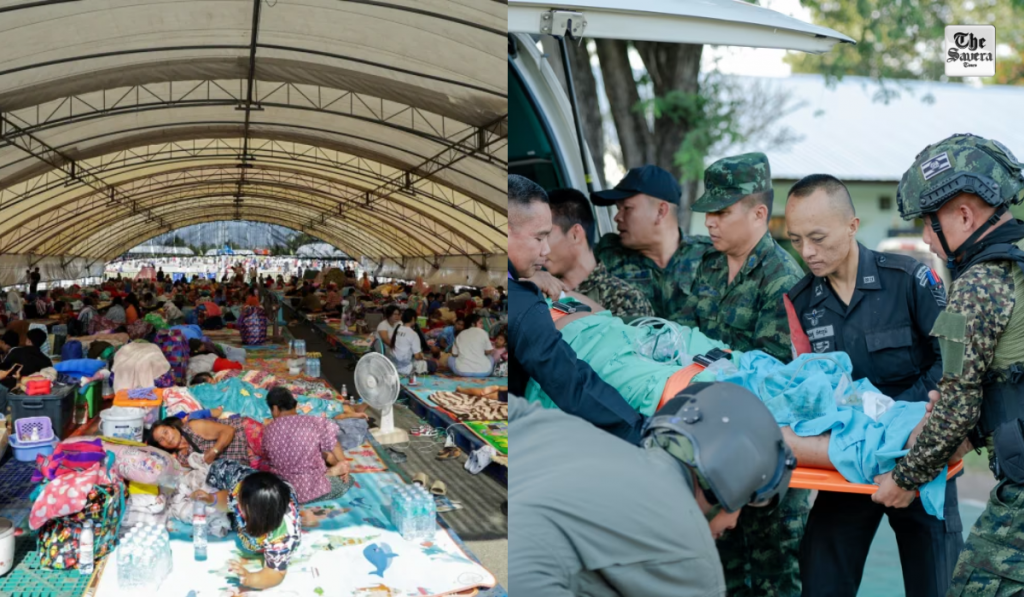
Thailand carried out airstrikes against Cambodia on Monday as fresh fighting erupted along their disputed border, sharply escalating tensions between the two Southeast Asian neighbours and threatening to unravel a ceasefire brokered just two months ago under the leadership of US President Donald Trump.
Thailand’s army said the airstrikes targeted Cambodian military infrastructure and were carried out in retaliation for an earlier attack that killed one Thai soldier and injured seven others.
“The target was at Cambodia’s arms-supporting positions in the area of Chong An Ma Pass,” Thai army spokesperson Maj. Gen. Winthai Suvaree said. He accused Cambodian forces of using artillery and mortar launchers to strike the Thai side at Anupong Base.
Opposing Claims Over First Strike
Thai military officials claimed that Cambodia began targeting the Thai border around 3 a.m. local time, mobilising heavy weapons and repositioning combat units. The Royal Thai Air Force (RTAF) described these movements as actions that could escalate military operations and pose a direct threat to Thai border areas.
Cambodia’s Ministry of National Defence, however, strongly denied the Thai allegations, calling them “false information.”
The Cambodian army countered by accusing Thailand of launching an attack on its forces at around 5.04 a.m. local time, after what it described as several days of provocation by Thai forces. The ministry insisted that Cambodian forces “did not retaliate at all.”
Civilian Deaths and Mass Displacement
Cambodian defence spokesperson Maly Socheata later accused Thai forces of burning homes, causing injuries and forcing civilians to flee from border villages in the northern provinces of Oddar Meanchey and Preah Vihear.
Cambodian Minister of Information Neth Pheaktra said at least four Cambodian civilians were killed and several others injured in the two provinces.
Thailand, meanwhile, began evacuating civilians from affected border towns on Sunday. The Thai army said about 70% of residents have already been relocated from danger zones.
Images released by Cambodia’s Agence Kampuchea Press showed villagers fleeing their homes in Preah Vihear province using tractors and motor carts.
Ceasefire Under Threat
Following a major flare-up earlier this year — the most serious fighting in years — Thailand and Cambodia agreed to an initial ceasefire on July 28, after Trump held calls with the leaders of both countries.
An expanded ceasefire declaration was later signed in Kuala Lumpur in late October, in the presence of Trump and Malaysian Prime Minister Anwar Ibrahim.
However, the agreement began to fray within weeks. Thailand suspended progress on the deal after a landmine explosion at the border injured several Thai soldiers.
Reacting to the latest fighting, Malaysian Prime Minister Anwar Ibrahim said on Monday that he was “deeply concerned” by the renewed clashes and urged both sides to exercise restraint.
“The renewed fighting risks unravelling the careful work that has gone into stabilising relations between the two neighbours,” he said in a statement.
Long-Running Border Dispute
Thailand and Cambodia share a 500-mile (800-km) land border, and their territorial dispute largely stems from colonial-era maps drawn up by French administrators, which Thailand has long contested.
The two countries have repeatedly clashed over the border in recent decades. The latest escalation follows a deadly five-day conflict in July that killed dozens and displaced nearly 200,000 people on both sides of the frontier.