


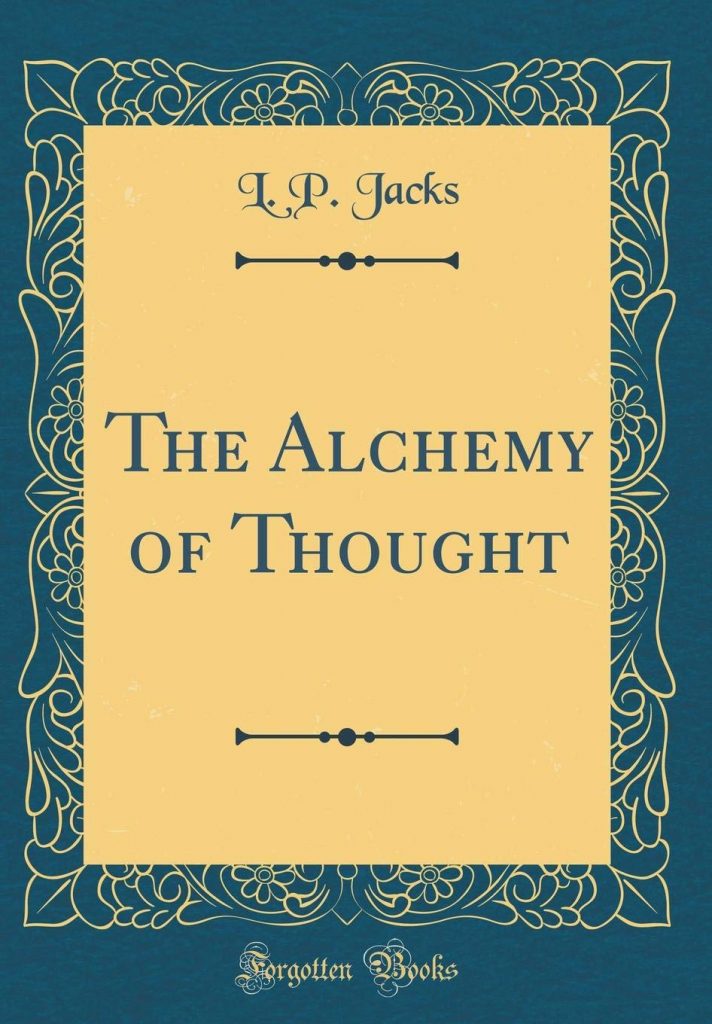
The winter of 1909 settled hard over St. Louis. Inside a book-lined study on Lindell Boulevard, a man sat alone long after midnight.
Charles Francis Haanel had, by every visible measure, arrived in life. He was the president of the Continental Commercial Company, a business empire that dealt in coffee, tea, and spices across the American Midwest. His name and his prosperity commanded respect in boardrooms. And yet, there was something missing.
Over the years, he had watched men of great intelligence fail and, paradoxically, men of lesser ability flourish. He had seen great enterprises collapse even though they had got everything right on paper. He understood that brilliance, hard work and good management alone did not guarantee success.
There was a profound secret at work beneath the surface of human achievement. He was certain of it — a secret few understood.
The way a chemist knows that beneath the visible transformation of substances lies an invisible law governing every reaction, Haanel knew that beneath the visible facts of success lay a governing principle — and he was determined to find it.
He read the Stoics and the Vedantic philosophers. He studied the emerging literature of modern psychology. He pored over the revolutionary discoveries of physicists who had found that matter, at its most fundamental level, was not solid at all — it was energy, vibrating, responsive, alive.
And the more he read across these vastly different traditions and disciplines, the more he was convinced that the great achievers of history had not succeeded by accident. They had, consciously or unconsciously, aligned themselves with a law as precise and as inexorable as gravity.
That night, as the gas lamps burned low and the city outside fell quiet, Haanel reached for a fresh sheet of paper and wrote:
«“The mind is the universal chemist.”»
Whether one looked at the Sanskrit texts of ancient India or the laboratory notebooks of modern physicists, the same truth kept surfacing: the universe is not a collection of separate, dead objects. It is a living, responsive field of intelligence.
And the individual human mind is not a passive observer of this field. It is an active participant.
The mind is a chemist who combines the raw materials of thought, emotion and intention to produce, with the same unfailing precision as any chemical reaction, a corresponding result in the physical world.
This was Haanel’s science.
With such a deep understanding, he then spent the next decade writing The Master Key System in 1912 and, with even greater depth and clarity, The Mental Chemistry in 1922.
These were not self-help books in the casual sense. They were, in his conception, instruction manuals for a laboratory that every human being carries within and that almost no one learns to use.
WHAT MENTAL CHEMISTRY ACTUALLY MEANS
Chemistry, he wrote, is the science that shows how intra-atomic and intra-molecular changes happen to material things under various influences.
Mental chemistry is the science that shows precisely how changes in material conditions happen through the operations of the mind.
In physical chemistry, when one atom of sodium combines with one atom of chlorine, the result is salt — a substance entirely different from either of its components, possessing properties that neither sodium nor chlorine possesses alone.
Haanel’s central claim was that the same principle operates in the domain of the mind.
When thought combines with emotion, when a clearly held mental image meets the sustained energy of feeling and desire, it manifests as changed circumstances, altered conditions, new opportunities and physical results in the world.
This is the revolutionary idea that most readers either seize with immediate recognition or dismiss as fantasy.
It is worth pausing, therefore, on what Haanel was and was not saying.
He was not suggesting that one may sit in an armchair, think pleasant thoughts and watch wealth fall from the ceiling.
He stated that every condition in a person’s life — every relationship, every financial reality, every state of health, every pattern of success or failure — is the externalised product of a prior mental state.
The outer world is the chemical precipitate of the inner laboratory.
Change the inner chemistry, and the outer conditions must change.
This is the Law of Nature — as indifferent to human preference as the law of gravity and as reliable in its operation as a chemical equation.
He identified two fundamental forces at work in the mental laboratory.
The first is the conscious mind, what he called the objective mind — the faculty through which we reason, analyse, judge and make deliberate choices. This is the mind we identify as ourselves. It is the director of the laboratory.
The second is the subconscious mind, the subjective mind — vast, tireless and utterly without the capacity for independent judgement.
The subconscious does not question. It does not distinguish between what is real and what is vividly imagined, between what is constructive and what is destructive.
It receives every impression delivered to it by the conscious mind and proceeds, with absolute faithfulness, to build the physical equivalent of that impression into the fabric of the person’s life.
Every other living thing responds to the world as it finds it. Man alone can conceive of a world that does not yet exist and then proceed to construct it — by the precise application of the aforementioned mental chemistry.
THE CONSCIOUS AND THE SUBCONSCIOUS: TWO MINDS, ONE LABORATORY
There is an experiment that Haanel described.
Consider the child who sits down at a piano for the first time. Every movement of the fingers is laboured, conscious and deliberate. The conscious mind is fully engaged, directing every micro-movement with concentrated effort.
But something remarkable happens over months of daily practice.
The fingers begin to find their positions without being told. The transitions happen without deliberate instruction. And eventually, the accomplished pianist can perform a complex concerto while carrying on a conversation.
The subconscious has become the performer. The conscious mind has been freed.
This migration, Haanel argued, is the fundamental mechanism by which all human behaviour is formed and all human reality is constructed.
Every thought that the conscious mind holds with sufficient intensity and repetition eventually sinks into the subconscious and becomes, from that point forward, an automatic operating instruction.
The subconscious then proceeds to organise the body, the emotions, the perceptions and, ultimately, the external circumstances of life in accordance with that instruction.
It cannot do otherwise.
This understanding places an extraordinary responsibility on the quality of conscious thought.
For most people move through their days delivering instructions to their subconscious minds of which they are entirely unaware.
Every habitual worry is an instruction.
Every repeated self-deprecating thought is an instruction.
Every idle rehearsal of a feared outcome is an instruction.
And every thought of hope and gratitude, too, is an instruction.
This is why Haanel was insistent, almost severe, on the matter of mental discipline.
The conscious mind is the guardian of the subconscious laboratory. What it permits to enter determines what the laboratory will produce.
Modern neuroscience has arrived at a similar conclusion. Research by Dr Joe Dispenza, drawing on studies in neuroplasticity, has argued that repeated patterns of thought can physically alter the structure and functioning of the brain by strengthening certain neural pathways and allowing others to weaken.
What Haanel called the subconscious has sometimes been compared with deeply established neural pathways and networks that operate below the threshold of conscious attention and influence human behaviour, perception and response.
Haanel went further. The subconscious mind, he observed, governs not only behaviour but biology.
Circulation, respiration, digestion, the repair of tissue and the regulation of the endocrine system — all of it proceeds under subconscious direction.
The body is, in his view, a subconscious creation.
And because the subconscious takes its instructions from the conscious mind, the state of the body is, over time, a faithful record of the state of habitual thought.
Haanel cited experiments conducted at Harvard College in which students on a weighing board were asked to imagine running a foot race. The board immediately tilted at the foot.
The body could not distinguish between the imagined race and the real one. It responded to the thought.
WHAT IT MEANS FOR US
This single insight, taken seriously, changes everything.
It means that the human being is not entirely at the mercy of circumstance. It means that the conditions of life are not simply imposed from without but are also influenced by processes within.
It means that the human laboratory can always uncreate and create differently its circumstances and life.
THE UNIVERSAL MIND: THE INFINITE SUPPLY BEHIND EVERY ACHIEVEMENT
In the summer of 1986, a young architect named Veronica Sanchez sat in a cramped apartment in Mexico City with eleven dollars in her savings account and a rolled-up set of blueprints she had no means of executing.
She had spent three years designing a community centre for a low-income neighbourhood on the city’s eastern edge. Every practical path to funding had closed. The project could never take off.
What happened over the following six months has been documented in a Mexican architectural journal.
Veronica, by her own account, changed the quality of her inner relationship with the project. She stopped treating it as a problem requiring a solution and began treating it as a reality already in existence, requiring only her faithful alignment with it.
She held the completed building in her mind with a clarity and a certainty she had not previously allowed herself.
Within five months, an unsolicited approach from a municipal development fund and a private donor she had never met arrived, and the community centre was built.
She had changed her chemistry.
This illustrates the most powerful and the most poorly understood element of Haanel’s system — the existence and accessibility of what he called the Universal Mind.
The individual conscious mind, Haanel argued, is real and necessary, but it is limited. It can only work with what it already knows, what it has already experienced and what already exists within the boundaries of personal memory and personal perception.
But it cannot access the truly new, the genuinely unprecedented, the solution that lies beyond the horizon of individual experience.
For that, something else is required.
The Universal Mind is the intelligence that pervades all space and animates all living things.
It is not a personal God in the theological sense, though it is not incompatible with that understanding.
It is the infinite field of intelligence from which all individual minds emerge, as waves emerge from the ocean without ceasing to be the ocean.
The individual mind and the Universal Mind are not two separate things connected by a tenuous thread. They are, in their deepest nature, one thing — and it is through the subconscious mind, operating in its deepest and most receptive states, that the individual makes contact with this infinite source.
Carl Jung’s patients regularly produced, in dreams and other experiences, images and symbols from cultures they had never encountered. Jung called it the collective unconscious — patterns of intelligence and meaning that no individual life could have generated alone.
Contemporary research at the HeartMath Institute in California has explored the relationship between the human heart, electromagnetic activity and emotional states. Some claims associated with this research have been interpreted as suggesting that human beings are not isolated units of consciousness but are interconnected in ways that extend beyond the boundaries of the individual self.
HOW TO DRAW UPON THE UNIVERSAL MIND
Haanel’s practical instruction was simple.
The way to draw upon the Universal Mind is through stillness — deep surrender.
He called this the silence, and he regarded it as the single most important daily practice available to any human being.
In the silence, in deep letting go and a state of profound relaxation, the individual mind ceases its restless, self-referential chatter and opens, like a clear receiver, to the intelligence of the whole.
Ideas arrive that the personal mind could not have generated.
Solutions appear that no amount of anxious thinking could have produced.
The right people, the right circumstances and the right resources begin to move, as though magnetised, toward the person who has learned to hold a clear and steady inner state.
This is the highest form of activity available to a human being: the conscious, disciplined alignment of individual mental chemistry with the infinite supply that, in Haanel’s philosophy, underlies all manifest reality.
Parneet Sachdev, IRS, is the Chairman of the Real Estate Regulatory Authority and a leading author.