


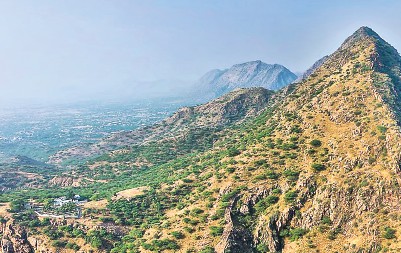
The government’s recent assertion that no new mining leases will be granted in the Aravalli hills has been projected as a decisive step toward protecting one of north India’s most fragile ecological zones. At first glance, the announcement suggests a clear and uncompromising stand against mining in a region long battered by environmental degradation. But a closer reading of the policy and its conditions reveals that the situation is far more complex than the headline claim implies.
The statement stems from a Supreme Court-backed move to adopt a uniform scientific definition of the Aravalli range. This definition was introduced to address decades of confusion caused by varying interpretations of what constitutes the Aravallis, a loophole that allowed illegal and unregulated mining to flourish. Based on this definition, the court directed that no new mining leases should be issued until a Management Plan for Sustainable Mining is finalised. The pause, however, is temporary and conditional, not a permanent prohibition.
One of the most significant caveats lies in the scope of the restriction itself. The ban on new leases largely applies to general or non-strategic minerals. Critical and strategic minerals, which are considered essential for national security, technology and energy transition, remain exempt. This distinction is crucial. It means that mining activity could still be approved in parts of the Aravallis if the minerals involved are classified as strategically important. From an environmental perspective, the hills do not differentiate between types of minerals, but the policy does.
Another important aspect is the role of the upcoming management plan. Once this plan is completed, it is expected to identify zones where mining may be allowed under regulated and supposedly sustainable conditions. In other words, the current freeze on new leases could eventually give way to fresh permissions, provided they align with the plan’s criteria. This raises concerns that the present restriction functions more as a pause for recalibration rather than a long-term commitment to conservation.
Existing mining operations further complicate the picture. The government’s claim does not automatically halt mines that already have valid leases. These operations can continue and, in some cases, renew their permissions if they comply with updated safeguards. For environmentalists, this continuation is worrying because ongoing mining has already contributed to deforestation, groundwater depletion and habitat loss across the range. A pause on new leases does little to reverse damage that is still unfolding.
The definition of the Aravallis itself has also sparked debate. Under the adopted criteria, only landforms rising above a certain height relative to their surroundings qualify as part of the range. Critics argue that this approach excludes many smaller hills, ridges and slopes that are ecologically integral to the Aravalli system. These features play a vital role in groundwater recharge, biodiversity movement and climate regulation, even if they do not meet the technical elevation threshold. By narrowing the definition, large stretches of ecologically sensitive land could fall outside strict protection.
Government officials maintain that the majority of the Aravalli landscape remains safeguarded and that forests, wildlife habitats and water bodies are not open for mining. They also argue that a scientifically guided management plan will bring clarity and prevent the kind of unchecked exploitation seen in the past. However, environmental groups remain sceptical, pointing out that ecological systems do not operate in neatly defined zones. Damage in one area often has cascading effects elsewhere.
The controversy highlights a broader issue in environmental governance: the tension between economic priorities and ecological limits. The Aravallis are not just mineral-bearing hills. They act as a natural barrier against desertification, support agriculture by replenishing groundwater and help regulate temperatures in surrounding regions. Treating them primarily as a mining resource risks undermining these functions.
Ultimately, the government’s claim of no new mining leases offers reassurance at a surface level but leaves many questions unanswered. The future of the Aravallis will depend less on interim announcements and more on how definitions are applied, how exemptions are used and how firmly ecological values are embedded in policy decisions. Without stronger, ecosystem-wide protections, the promise of safeguarding the Aravallis may remain more rhetorical than real.