


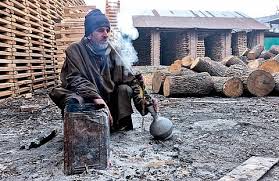
Arjumand Wani
The effects of climate change are being felt ever more strongly in the Kashmir Valley with each passing year. The latest to feel the impact is the region’s traditional cricket bat making industry.
According to a research paper, the Valley has a bat-making tradition that spans more than a century. Around three million cricket bats are manufactured annually in Kashmir, supplying domestic and international markets, says Fawzul Kabeer, spokesperson of the Cricket Bat Manufacturing Association of Kashmir (CBMAK). More than 150 bat manufacturing units and retail shops operate along the National Highway 44 in south Kashmir’s Sangam, the centre of the Valley’s willow bat industry.
Industry estimates suggest that around 1.5 lakh people are directly or indirectly associated with the bat industry in Kashmir, including labourers, craftsmen, traders and transport workers.
However, all this is under threat if the winter of 2025-26 is anything to go by. The Valley received little snowfall this time, allowing production to continue through months that were earlier marked by harsh weather and work stoppages. Industry stakeholders say this reflects a deeper shift in climate patterns that is affecting the very resource the industry depends on.
Water, willow and employment
“We had a natural advantage in south Kashmir because we had many streams full of water,” says Haji Mohammad Amin Wani, a sawmill owner who supplies clefts to bat manufacturing units. He explains that dense willow plantations once grew along stream banks and wetlands across the region.
According to him, rainfall has reduced and snowfall has become uncertain, even during Chilla-e-Kalan, the 40-day winter period traditionally associated with heavy snow. As streams and water bodies dry up, local willow plantations have declined sharply.
“There is almost no willow left in our area now,” he says. “We bring wood from northern districts like Bandipora, Baramulla and Kupwara, but supplies are declining there as well because plantation is not happening on a large scale.”
Three decades ago, farmers commonly planted willow along rivers, streams and moist lands. Once mature, the trees provided a steady return, as willow wood is used to make cricket bats. That practice has largely stopped.
“These lands have dried completely,” says Mohammad Ayoub, a farmer from south Kashmir. “Planting willow, which needs a lot of water, is not practical now.”
Ayoub explains that willow grown on dry land produces inferior wood and becomes vulnerable to pests. Given the long time required for the tree to mature, farmers are unwilling to invest without assured water availability.
Wood merchants are also feeling the impact of shrinking local supply. Fayaz Ahmad Wani, a timber trader, says that sourcing willow has become difficult even in districts that were earlier considered resource-rich.
“When willow is not available locally, we have to buy it from northern Kashmir, but availability is declining there too,” he says, attributing the trend to changing climate conditions and reduced snowfall.
The shortage of raw material has directly affected employment. “Earlier, a unit would employ around 20 workers,” Fayaz says. “Now many units operate with 10 or fewer workers due to lack of work.”
Sangam, about 50 kilometres south of Srinagar on the border of Pulwama and Anantnag districts, is also home to the GR8 bat manufacturing company, the only International Cricket Council (ICC)–approved bat manufacturer in Kashmir.
GR8 bats gained international attention during the 2022 T20 World Cup when United Arab Emirates (UAE) batter Junaid Siddique hit a 109-metre six using a Kashmir-made bat.
Kabeer, CBMAK spokesperson who is owner of GR8, says the industry is facing a raw material crisis. “Willow cultivation has declined steadily over the years,” Kabeer says. “Despite the importance of this tree, farmers are reluctant to grow it again.”
He stresses the need for a plantation policy and points to increased pressure from other wood-based industries such as pencil and plywood manufacturing.
Kabeer explains that Salix alba, commonly known as white willow, is the primary species used for Kashmir willow bats. It is a riparian tree that grows best in moist soil and is typically found along rivers, streams, nullahs and wetlands. Around 80 per cent of the raw material for bat manufacturing comes from such areas. “For more than a century, we have been cutting trees without adequate replantation,” he says. “This has led to a shortage that threatens the future of the industry.”
According to Kabeer, rising temperatures have reduced groundwater levels, while plantation efforts have remained limited. He says raw material supplies have declined by nearly 75 per cent over the past four years, with south Kashmir almost entirely depleted of usable willow.
“If this continues, the industry could face closure within the next 3-4 years,” he says.
Abdul Qayoom Bagaw, a veteran cricketer who played first-class cricket for Jammu and Kashmir and later served as a coach for the state association, draws a sharp distinction between Kashmir willow and its English counterpart.
The difference lies not just in wood quality but in cultivation practices. “In England, willow is grown specifically for the bat industry,” he says. “The trees are farmed with consistent grain structure suited to cricket bat requirements. Here in Kashmir, willow grows naturally — not in cultivated farms — which results in varying grain patterns across different trees.”
Bagaw adds that the lack of professional seasoning facilities in Kashmir is another limiting factor. While English willow benefits from a controlled drying process, Kashmir willow does not receive the same treatment, affecting the final quality of the bat. He argues that with proper farming methods and seasoning infrastructure, Kashmir willow could be made more competitive, but water scarcity and the decline of natural willow growth have made even basic cultivation increasingly difficult. Yet the wood’s potential remains evident. The 109-metre six struck by UAE batter Siddique at the World Cup using a GR8 bat made in Sangam is a testament to what the wood is capable of when crafted well. With the right investment in cultivation and processing, Kashmir willow does not need to play second fiddle to its English counterpart, he says.
Parvez Rasool, Jammu and Kashmir’s first cricketer to represent India at the international level, echoes this confidence.
He points out that affordability plays a significant role in their popularity among local and domestic players, as Kashmir willow bats are considerably less expensive than English willow alternatives, making quality equipment accessible to a wider pool of cricketers.
But the appeal of Kashmir willow is not limited to budget conscious players.
“Kashmir willow bats have reached the highest levels of the game,” he says. During his time at the top level, Rasool saw Sri Lankan all-rounder Thisara Perera among several international players who chose Kashmir willow bats.
For Rasool, this is proof that the wood, when properly crafted, can meet the demands of elite cricket. “The bat has gone to the best of levels,” he says. “That itself tells you what this wood is capable of.”
Shift in land use and plantation choices
According to environmentalist and climate expert Mohammad Anees, the wood of Salix alba has historically been used for baskets, firewood and various household purposes, and the tree was cultivated wherever water bodies existed. He says the tree requires moderate temperatures, ideally not exceeding 20 to 25 degrees Celsius (°C), along with highly saturated soil conditions. Willow has a shallow root system, rarely extending beyond 1.5 metres, making it dependent on surface and near-surface water.
“This is why willow grown near ponds, wetlands and streams produced wood of suitable density for bat making,” he says.
According to Anees, the Green Revolution period in the mid-1970s marked a shift in plantation choices. Farmers began favouring varieties that offered quicker financial returns. As temperatures rose and short-duration droughts became more frequent, willow productivity and wood quality declined.
“Farmers did not receive expected revenue and gradually shifted to other species like Russian poplar,” he says. “Poplar is more drought-resistant and its wood quality is less affected by water stress.”
Anees adds that over the past 20-25 years, average temperatures in the region have increased by around 2.5°C, based on available data. While poplar tolerates dry conditions, willow growth and harvest are directly affected by water shortages.
According to Anees, the areas that were considered suitable for willow cultivation two decades ago are no longer viable.
(Courtesy: DTE)