


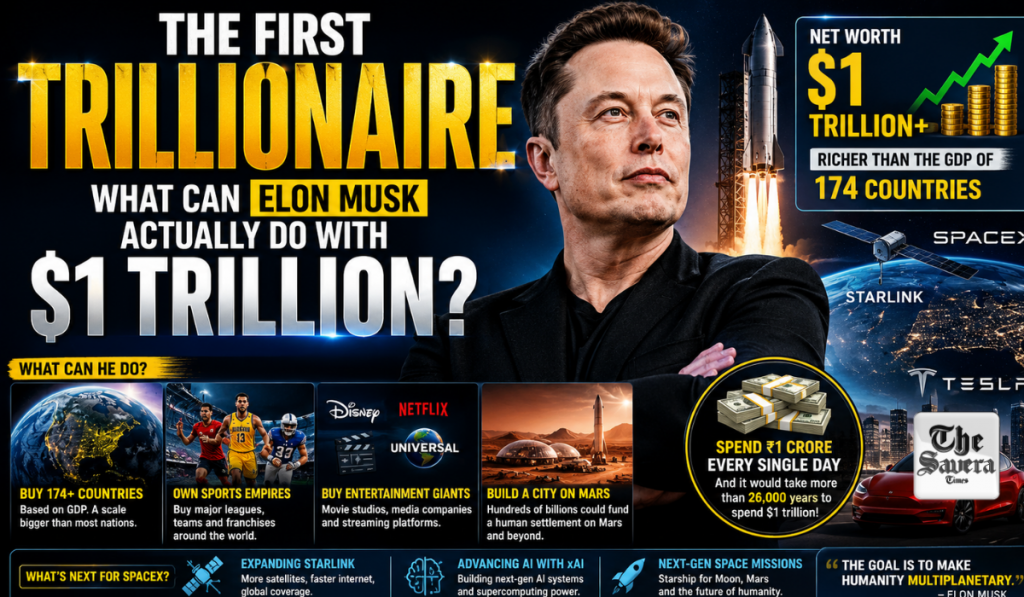
Imagine spending ₹1 crore every single day. No breaks, no holidays, no stopping. Even then, it would take roughly 23,000 years to spend one trillion dollars.
That is the scale of wealth now being associated with Elon Musk after reports that his net worth has crossed the $1 trillion mark, making him the first person in history to reach that milestone.
But how did he get there? How big is a trillion dollars? And what can someone actually do with that much money?
How Did Musk Reach This Milestone?
Elon Musk’s wealth comes mainly from his ownership stakes in companies rather than cash in a bank account.
His biggest assets include:
- SpaceX, the space technology company behind Starship and Starlink.
- Tesla, one of the world’s most valuable electric vehicle makers.
- xAI, the artificial intelligence company behind Grok.
The biggest boost came from the soaring valuation of SpaceX following its IPO. As investors valued the company higher, the value of Musk’s ownership stake also increased dramatically.
Combined with his Tesla holdings, this pushed his estimated net worth toward and beyond the trillion-dollar mark.
What Does Net Worth Mean?
A trillion-dollar net worth does not mean Musk has one trillion dollars in cash.
Net worth is the estimated value of all assets a person owns, including shares in companies, investments, and other holdings, minus debts.
Most of Musk’s wealth exists on paper through ownership of companies. Selling all those shares at once would be nearly impossible without affecting their value.
How Big Is One Trillion Dollars?
Large numbers are difficult to understand, so comparisons help.
Bigger Than Most Economies
Only about 15-20 countries in the world have an annual economic output, or GDP, above $1 trillion. That means Musk’s estimated wealth is larger than the yearly GDP of the vast majority of countries (roughly 175+ out of ~195 total countries).
This does not mean he could literally buy countries. Nations are not businesses and cannot be purchased. But it shows how enormous the figure is.
Compared to Everyday Income
If someone earns ₹1 lakh per month, their annual income would be ₹12 lakh.
Even if five family members earned the same amount and saved every rupee, it would take millions of years to accumulate wealth equal to one trillion dollars.
What Could Someone Theoretically Buy?
A fortune of this size could theoretically purchase:
Sports Leagues and Teams
Many of the world’s biggest sports franchises and leagues together are worth hundreds of billions of dollars. A trillion-dollar fortune could buy a large portion of the global sports industry.
Entertainment Companies
Several major movie studios, media giants, and streaming platforms could be acquired for a fraction of a trillion dollars.
Airlines and Corporations
Many leading airlines and large multinational companies have market values far below one trillion dollars. A fortune of this scale rivals the value of some of the world’s biggest corporations.
Could Musk Build a City on Mars?
For years, Musk has spoken about creating a self-sustaining human settlement on Mars.
Experts and Musk’s own estimates place the cost of establishing a permanent city on Mars in the range of hundreds of billions to trillions of dollars (potentially up to $10 trillion in some projections) over several decades.
While a trillion-dollar fortune alone would not guarantee success, it provides access to the kind of resources needed for one of humanity’s most ambitious engineering projects.
What’s Next for SpaceX?
SpaceX plans to invest heavily in three key areas:
Starlink Expansion
The company aims to launch more satellites, increase internet speeds, and expand global coverage.
Artificial Intelligence
Through xAI, Musk is investing in advanced AI systems and computing infrastructure.
Future Space Missions
SpaceX continues developing Starship for future Moon and Mars missions, projects that require enormous investment.
Conclusion
The story is not simply about one person becoming richer than ever before. It reflects how technology, artificial intelligence, space exploration, and global connectivity have created wealth on a scale never seen in human history.
One trillion dollars is more than a financial milestone. It represents the ability to fund projects that once belonged only to science fiction—from global satellite networks to the dream of building a city on Mars.