


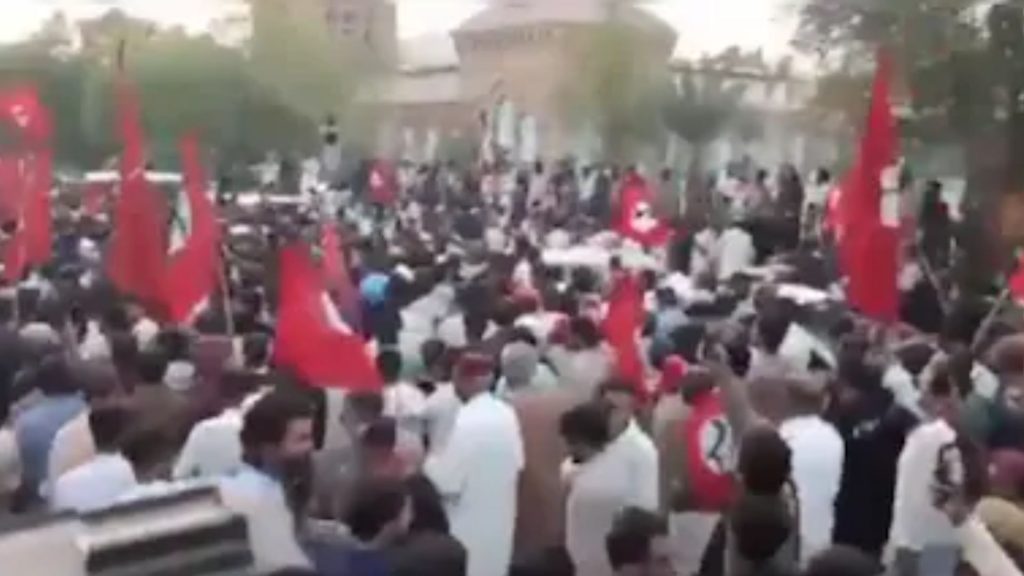
Karachi: Political protests have intensified in Pakistan amid discussions about the creation of new provinces and changes to the boundaries of existing ones. Thousands of activists from Sindhi nationalist organizations took to the streets in Karachi on Tuesday. The protesters opposed any attempt to divide Sindh province and accused Pakistan Army Chief Field Marshal Asim Munir of trying to undermine the region’s identity and integrity.
A proposal to divide Pakistan’s four existing provinces—Punjab, Sindh, Khyber Pakhtunkhwa, and Balochistan—into smaller administrative divisions to create new provinces is under discussion. However, this idea is facing strong opposition in Sindh. Protesters say that any changes to Sindh’s boundaries should not be made without the consent of the people there.
People took to the streets to save Sindh’s identity
The protest in Karachi was organized by the Jeay Sindh Rahbar Committee (JSRC), an alliance of four Sindhi nationalist organizations. Political activists, nationalist leaders, lawyers, and members of civil society participated.
Demonstrators wore traditional Sindhi ajraks and caps. They demanded the preservation of Sindh’s existing boundaries. The protesters stated that Sindh is not merely an administrative region, but has its own distinct language, culture, history, and civilization.
They also opposed the proposal to hold a referendum on the creation of new provinces. The protesters argued that this process could be used to justify predetermined decisions.
Rally leaders appealed to the federal government and relevant institutions of Pakistan not to take decisions that could lead to political tension and division in Sindh. They warned that any attempt to impose administrative changes without the consent of the people would be met with a constitutional and democratic response.
Allegations leveled against Asim Munir and the military establishment
Sindhi nationalist leaders accused the Pakistani military establishment of attempting to undermine Sindh’s political and economic interests. They claimed that the plan to create a new province could harm Sindh’s territorial integrity.
According to reports, protest organizers alleged that the Pakistani establishment controls millions of acres of Sindh’s agricultural land, coastal islands, and natural resources such as oil, gas, and coal.
Meanwhile, the Jeay Sindh Muttahida Mahaz (JSMM) announced plans to impose an economic blockade on Punjab. The organization stated that the campaign launched against the division of Sindh will now be expanded to demand a separate state, “Sindhudesh.”
JSMM President Shafi Muhammad Burfat, who lives in Germany, stated that Sindh’s independence is the main objective of his organization’s movement.
Bilawal Bhutto also opposed the division of Sindh
Pakistan Peoples Party (PPP) Chairman Bilawal Bhutto-Zardari has also expressed opposition to the division of Sindh. During an event at the Karachi Press Club on November 17, he warned that if attempts were made to forcibly divide Sindh, people could take up arms and this could lead to widespread violence.
Bilawal clarified that his party is not completely opposed to the formation of new provinces, but it is necessary to follow the procedures laid down in the Constitution and law. He stated that any such decision should be in accordance with the wishes of the people.
The PPP has been in power in Sindh continuously since 2008. The party fears that the division of Sindh, especially the separation of Karachi, could weaken its political influence and economic hold.
Meanwhile, the Muttahida Qaumi Movement-Pakistan (MQM-P) is supporting the proposal to create new provinces. It is also a partner in the ruling coalition at the center.
Why is the demand for new provinces rising in Pakistan?
Discussion about the creation of new provinces in Pakistan intensified when Home Minister Mohsin Naqvi suggested creating smaller administrative regions during the Pakistan Economic Summit in Islamabad. He also raised the possibility of holding a referendum on this issue.
Pakistan’s Planning Minister Ahsan Iqbal has proposed increasing the number of provinces from the current four to 12 to 15. Meanwhile, Defense Minister Khawaja Asif said on November 22 that discussions on a referendum could take concrete shape by the end of 2026.
Supporters of this proposal believe that the creation of smaller provinces will improve administrative systems and make governance more accessible to the public. Opponents, on the other hand, fear that this will undermine Pakistan’s federal structure and the political identity of the provinces.
At present, no final map of the new provinces or draft constitutional amendments have been made public.
Tensions in Karachi may escalate again on November 29th
Protests against the formation of new provinces in Sindh have been mostly peaceful so far, but tensions are expected to escalate in the coming days.
Sindhi nationalist organizations have planned another major rally in Karachi on November 29th. The MQM-P is also preparing to demonstrate in support of the new provinces on the same day.
With both parties taking to the streets on the same day, political tensions in Karachi could escalate.