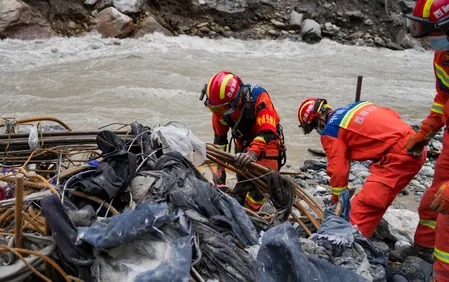
The Chinese government deployed its usual pattern of restricted coverage, censorship, and emphasising positive news to control the narrative of the Tibet floods. As a general practice, China’s state media outlets are instructed to emphasise ‘positive reporting’ during times of crisis, while censors remove criticisms of government responses or culpability online. It said that a fight over how the disaster is being reported has been growing in intensity on social media following the devastating floods in Nepal and Tibet. The dispute is around the claims and counterclaims after a story by Laura Bicker, BBC’s China correspondent, about China censoring videos of the devastation. Bicker said videos of the landslide and flood surge sweeping through Gyirong Port on the border were scrubbed from the internet, in part, because Beijing fears instability in the politically sensitive region of Tibet. As Bicker noted in her report, the most concrete example is the deletion of videos showing the massive wave of mud and water swallowing Gyirong Port. The footage was initially circulated on the platforms Weixin and RedNote, but users later could not access it. It noted that another form of control has been the restricted access for independent and foreign journalists. Allyson Horn of the Australian Broadcasting Corporation said she had made repeated requests to travel to Tibet, but was denied. Other foreign journalists have similarly been blocked. This makes it difficult, if not impossible, for foreign media to independently verify the Chinese government’s account of what happened there. It said that the absence of independent reporting, combined with the removal of footage from social media, has allowed the Chinese state media to dominate the narrative. This reflects a longstanding tendency in Chinese media to avoid material that could cause social instability or public panic. It highlighted that the coverage of the floods in Tibet by the state-controlled media has been focused heavily on the rescue operations of People’s Liberation Army (PLA) Premier Li Qiang’s visit to the disaster zone and President Xi Jinping’s leadership during the crisis. Efforts to reopen roads and the delivery of disaster-relief supplies to affected residents also received some coverage
Tibet Floods Narrative with Restricted Coverage