


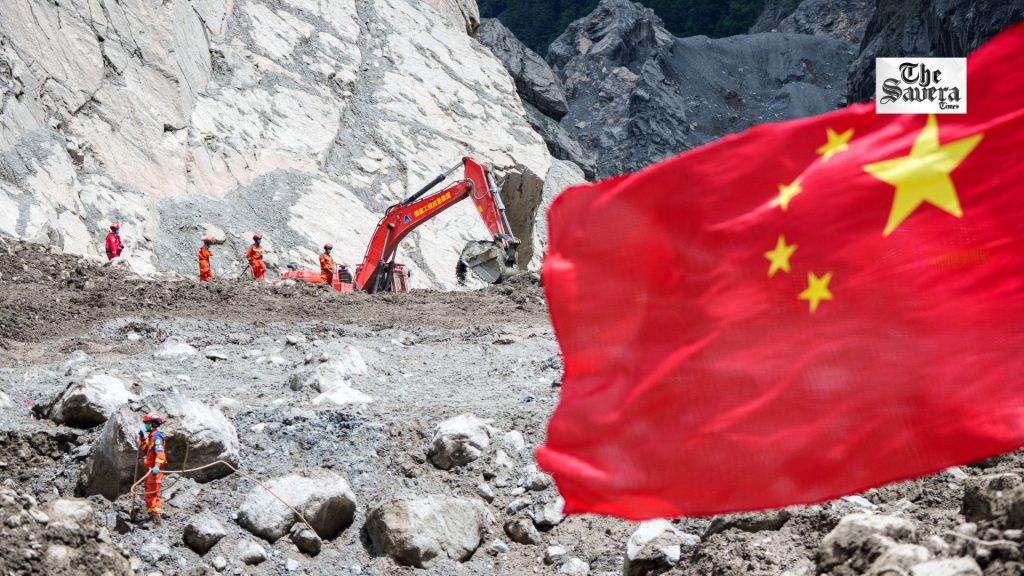
The August 2026 flood tragedy that struck the Tibet-Nepal border continues to raise questions weeks later, particularly over the sharply different reactions in Nepal and China — a contrast between Kathmandu’s open information environment and Beijing’s tightly controlled flow of information.
Satellite imagery shows that a massive part of a glacier, at an altitude of 5,200 metres, broke off the mountain and crumbled down the valley for more than 100 kilometres, collecting rock, ice, mud, and sediment along the way. From there, the glacier reached Kyirong Port in seven minutes, then continued its destructive path downstream in Nepal.
The five-story Chinese customs and immigration complex was entirely flattened and buried under mud. Roads, some 12 hydropower projects, communication networks, and bridges (including the Friendship Bridge on the border) were destroyed. While Nepal has recorded more than 1,300 deaths and rescuers were still finding people trapped in mud and debris after the floods, authorities in the Tibetan Autonomous Region (TAR) have put the toll at only 43.
Questioning the wide discrepancy in the figures, it said several Western agencies had accused China of manipulating data to understate the number of casualties. It added that although Beijing had rejected such allegations and taken action against people exaggerating the toll or challenging the official figures, it had not provided a satisfactory explanation for the conflicting data.
But there is an even more cogent and urgent question behind this: can such a tragedy occur again in the near future? Referring to Wang Pengling, a senior engineer at the National Climate Center, who was cited by Tibet Online and subsequently by China Daily — both staterun media outlets — the report said he acknowledged that climate change is altering the stability of highmountain environments and increasing the potential for cascading hazards.