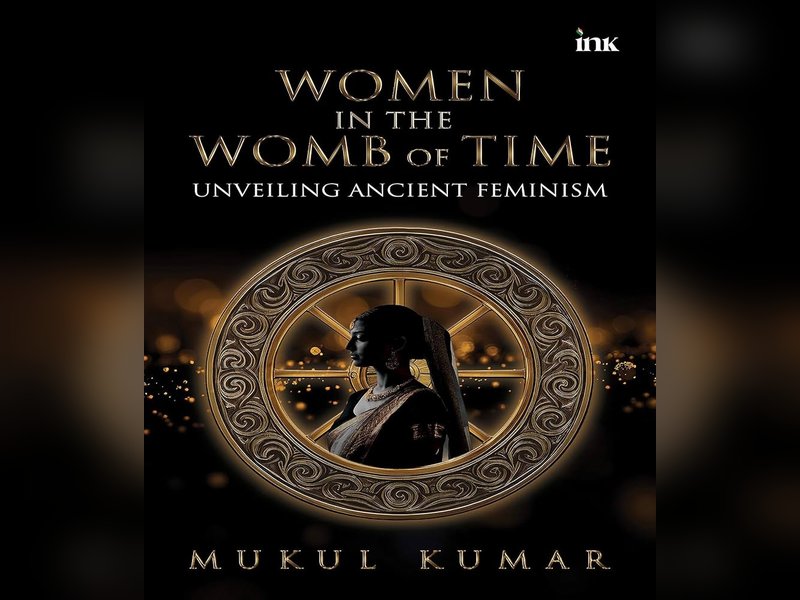
The feminine, leaving aside the sacred feminine motif present in several religions, is not just a concept of the human condition but rather a facet of creation itself, given its role in gestation and nurturing. Even if it is viewed as half of the equation of life, it unfortunately does not reflect in the social configuration, or the infamous patriarchy, which long deprived women of their due status and agency. In the Indian context, the question that crops up is whether it was always like this, given that this inequality is purported to be rooted in the hoary annals of “traditional and/or scriptural authority”. Or is this ruse another colonial construct, rooted in selective interpretation or mischievous misinterpretation in pursuance of vested interests? This is what civil servant Mukul Kumar seeks to investigate in his first non-fiction work, “Women in the Womb of Time: Unveiling Ancient Feminism” (BluOne Ink Pvt/328 pp/Rs 799), with his basic question being to find out “how did the discrimination against women emerge?” This he seeks to answer by undertaking a comprehensive and intense scrutiny of ancient texts and other evidentiary material to see what they tell us about the status of women in hoary antiquity. And what he finds is quite eye-opening, not to mention counter-intuitive! But before beginning what proves to be a most extensive – yet lucidly-presented – survey into Ancient India’s social mores and norms, Mukul Kumar, an Indian Rail Traffic Service officer whose previous published oeuvre comprises half a dozen works split between novels and poetry anthologies, seeks to clarify his terms of reference and yardsticks, particularly the contested definitions of the binary constructs of ‘feminity’ and ‘masculinity’. This entails an engrossing philosophical, historical, and anthropological excursion into the genesis and development of human society and gender roles and the definition and scope of feminism, which draws in Karl Marx – and his theory of the influence of the means of production, his collaborator Friedrich Engels, Simone de Beauvoir, Judith Butle
Tracing Feminine Fate Across Ancient Indian Ethos