


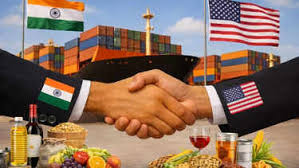
When India and the United States announced an interim trade agreement on February 7, 2026, it did not arrive with the drama of a full-fledged free trade pact. Nor did it promise sweeping market openings or headline-grabbing concessions. Instead, it did something far more important-and far more difficult in today’s fractured global trade environment: it stabilised a worsening situation, protected domestic interests, and secured meaningful relief for Indian exporters without compromising national priorities.
This agreement comes after nearly a year of trade uncertainty that began in August 2025, when a combination of reciprocal tariffs and Russia-related charges pushed duties on several Indian exports beyond 50 per cent. For exporters, particularly MSMEs clustered in coastal belts and industrial hubs, the impact was severe-orders were stalled, margins collapsed, and job security came under strain. The interim deal brings immediate relief by bringing the overall tariff burden down to 18 per cent, a move that restores competitiveness almost overnight.
For Indian exporters, this is not a symbolic win-it is a practical one. Industries across agriculture, seafood, rice, processed foods, textiles, gems and jewellery, pharmaceuticals, footwear, leather, metals, and engineering goods are once again able to compete in one of India’s most important export markets. More than $30 billion worth of exports that were at risk are now safeguarded, especially in labour-intensive sectors that directly support employment rather than just balance sheets. The impact is particularly visible in textiles and apparel. With tariffs on textiles slashed from 59 per cent to 18 per cent, Tamil Nadu is expected to reclaim nearly 20 per cent of its lost US market share, providing employment stability to an estimated 75 lakh workers.
The reduction in duties on knitted apparel-from 63.9 per cent to 18 per cent-directly narrows Vietnam’s cost advantage, benefiting clusters in Tiruppur and Ludhiana. Similarly, the cut in tariffs on woven apparel from 60 per cent to 18 per cent weakens Bangladesh’s competitiveness, offering a fresh lease of life to textile units in Gujarat and Delhi. Yet, what makes this agreement politically and economically significant is not just what India gained-but what it refused to give away. Agriculture, dairy, fisheries, and allied sectors remain fully protected.
Despite sustained pressure from the US for wider access to Indian markets for products such as legumes, sugar, dairy, and horticulture, India held firm. The government’s position was clear: unrestricted access would hurt small farmers and compromise food security. Prime Minister Narendra Modi made it explicit that farmer welfare was non-negotiable, and the final framework reflects that resolve. The agreement carefully navigates agriculture, traditionally the most sensitive area in trade negotiations. It preserves roughly $6.2 billion in agricultural trade between the two countries-a balance that clearly favours India-while helping revive sectors such as seafood, which had seen sharp declines due to tariff shocks.
Coastal livelihoods, particularly dependent on marine exports, stand to benefit as confidence and order flows return. Other sectors such as rice, spices, honey, dairy products, and processed foods are also poised for gradual recovery. On the US side, tariff reductions apply only to select goods that do not compete with Indian staples. Lower duties on items such as animal feed inputs help livestock producers without opening the floodgates for sensitive imports. Crucially, the dairy sector remains entirely shielded.
There is no risk of market flooding, and India continues to hold its position as a net agricultural exporter in the bilateral relationship. US agricultural exports to India, at around $2.25 billion, remain well below India’s agricultural exports to the US, which stand at about $6.2 billion.Much of the criticism around the deal hinges on semantics-particularly the distinction between phrases like “intends to” and “commits to.” But this is diplomacy, not deception. Claims that India conceded too much for too little do not stand up to scrutiny.
The country secured substantial tariff relief for its industrial and labour-intensive exports while insulating its most vulnerable sectors from new risks. This was negotiation with dignity, not deference.Importantly, this is not being sold as a final settlement. The interim framework is best understood as a stabilising bridge-one that reverses tariff damage, restores access to the US market, and buys time and space for a broader agreement on India’s terms. Alongside trade agreements with the EU and the UK, it also helps India diversify export destinations and reduce overdependence on any single market.
In a global trade environment marked by coercion, protectionism, and sudden shocks, India’s approach stands out for its balance. There is no reason for panic-and equally, no need for exaggerated celebration. What this deal demonstrates is a confident, strategic negotiating posture rooted in national interest. It protects jobs, supports exporters, safeguards farmers, and keeps strategic autonomy intact. In trade diplomacy, holding the line is often harder than crossing it. This agreement shows that India did exactly that-and emerged stronger for it.