


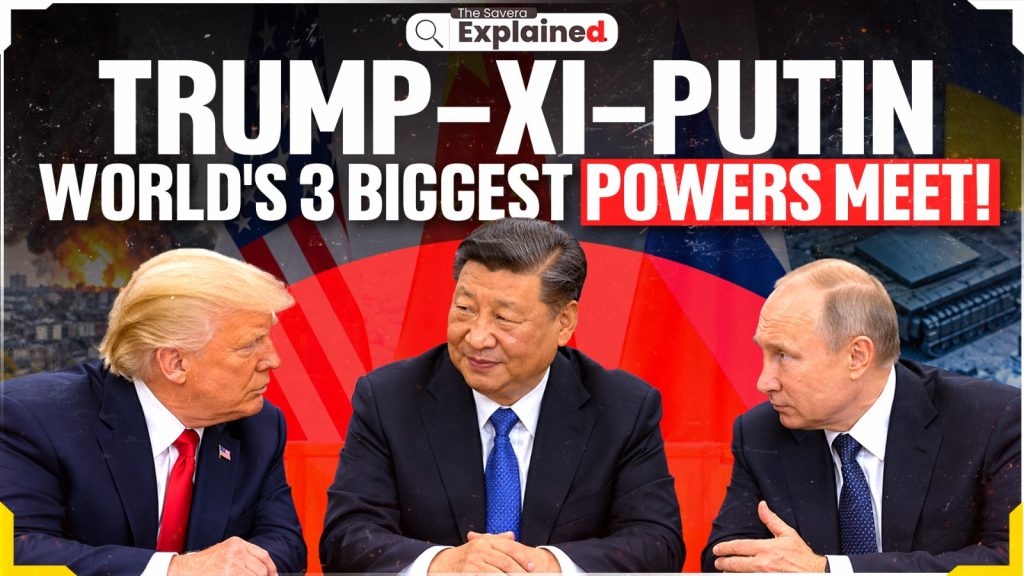
The world’s three biggest nuclear powers came together for the first time in history. US President Donald Trump, Russian President Vladimir Putin and Chinese President Xi Jinping held a historic trilateral meeting in Shenzhen, China, on November 19, on the sidelines of the Asia-Pacific Economic Cooperation (APEC) summit.
The meeting was expected to address some of the world’s biggest challenges, including the Russia-Ukraine war, the US-Iran conflict, nuclear weapons, global energy supplies and international security.
The leaders released a four-point joint declaration after their meeting. However, despite the historic photographs and big promises, the summit did not produce any major breakthrough on the ongoing wars or nuclear disarmament.
So, what exactly did the three leaders discuss, what did they agree upon, and why is this meeting important for the rest of the world?
1. Nuclear Arms Control: A Promise To Prevent Nuclear War
One of the biggest issues discussed was nuclear security. The United States, Russia and China together possess the world’s largest nuclear arsenals, making their cooperation important for global security.
Trump pushed for reducing nuclear weapons and preventing their spread. Xi also called for a comprehensive ban and the elimination of nuclear weapons, describing their threat as a ‘Sword of Damocles’ hanging over humanity.
The joint declaration stated that “a nuclear war cannot be won and must never be fought”. The three countries also agreed to hold discussions on reducing nuclear risks and preventing nuclear proliferation.
However, there was no agreement on reducing their existing nuclear stockpiles or a fixed timeline for arms-control negotiations. The announcement was therefore a starting point for dialogue, not a disarmament deal.
2. Energy Supplies: Three Powers Want Stable Oil Markets
Energy security was another major issue. The three countries agreed to increase the production and supply of refined petroleum products and maintain stable energy flows.
This becomes particularly important amid the ongoing conflict involving the US, Israel and Iran, which has raised concerns about oil supplies and shipping through the Strait of Hormuz.
The Strait of Hormuz is a narrow sea passage through which a significant share of the world’s oil and gas supplies travels. Any disruption here can push up international crude oil prices, affecting fuel costs, transportation and inflation across countries.
Trump said the US and China shared an interest in keeping energy flowing through the Strait of Hormuz and preventing Iran from acquiring nuclear weapons.
For countries like India, which depend heavily on imported crude oil, stable supplies are particularly important. However, the declaration did not specify how the three countries would achieve their energy commitments.
3. International Criminal Court: Why Did The Leaders Raise The Issue?
Another significant point in the joint declaration concerned the International Criminal Court (ICC), which investigates and prosecutes individuals accused of serious international crimes, including genocide, war crimes and crimes against humanity.
The three leaders emphasised the importance of national sovereignty and immunity for state officials. They also said that the ICC and similar international bodies should not misuse their authority.
This issue has particular significance for Putin. The ICC issued an arrest warrant against him in 2023 over alleged war crimes involving the unlawful deportation and transfer of Ukrainian children.
Russia rejects the ICC’s jurisdiction, while the US has also opposed certain actions taken by the court.
The declaration therefore raises questions about how powerful countries view international accountability. Critics fear that greater emphasis on immunity could weaken efforts to prosecute leaders accused of serious crimes.
4. Ukraine And Iran Wars: Did The Summit Bring Any Peace Deal?
The Russia-Ukraine war and the ongoing US-Iran conflict were among the major issues surrounding the summit.
Putin referred to the Ukraine conflict during his opening remarks and said the three countries had shared interests in resolving regional conflicts. Trump also indicated that Ukraine was discussed during the meeting.
However, the joint declaration did not mention Ukraine or announce any ceasefire, peace agreement or specific commitment from Russia to end the war.
Ukraine and European leaders were also not part of the trilateral meeting. This raised concerns that major powers could discuss the future of smaller countries without involving them directly.
Iran was another important subject. Trump said the US and China shared a position that Iran should not develop nuclear weapons. He also stressed the importance of keeping energy supplies flowing through the Strait of Hormuz.
However, there was no announced agreement to end the US-Iran conflict or a concrete roadmap for peace.
In short, the leaders discussed major conflicts, but the summit did not deliver an immediate solution to either war.
5. UN Reforms And The Changing Global Power Structure
The three leaders also agreed to work towards reforming the United Nations. All three countries are permanent members of the UN Security Council and have veto powers.
They argued that the global organisation needs reforms to respond more effectively to international challenges and maintain peace and security.
But there is another important dimension to this meeting. China hosted the summit, giving Xi Jinping an opportunity to project his country as a major centre of global diplomacy.
For Putin, sitting alongside Trump and Xi helped Russia project itself as a major global power despite Western sanctions and its international isolation.
For Trump, the summit offered an opportunity to show that he could bring two major geopolitical rivals to the negotiating table.
What Does The Summit Mean For India And The World?
For India, the summit has implications for energy security, international trade and strategic relations. India maintains important relationships with all three countries. Any improvement in US-China-Russia relations could influence global oil prices, supply chains and international security.
However, India also needs to watch how these major powers approach conflicts involving smaller countries, particularly when Ukraine and Europe were excluded from discussions about the Ukraine war.
The bigger takeaway: The Shenzhen summit was historic because three powerful leaders agreed to sit together and discuss global challenges. But photographs, promises and joint declarations are not the same as solutions. Whether this meeting changes the course of international conflicts will depend on what these countries actually do next.