


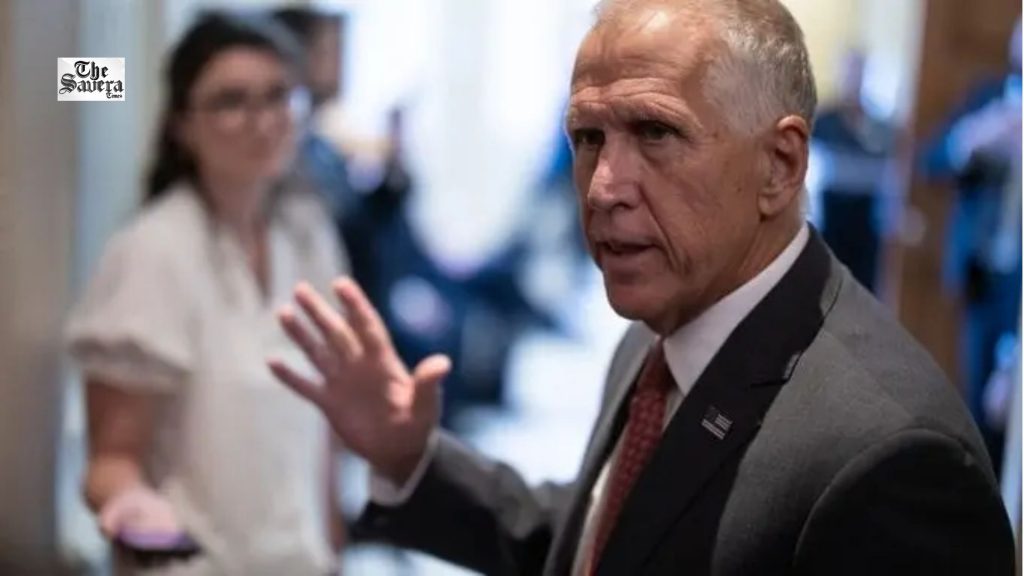
Washington: US President Donald Trump may be violating federal law through his Russian diesel deal, Republican Senator Thom Tillis has said, exposing divisions within the Republican Party over the administration’s approach to Russian energy purchases and sanctions against Moscow.
While Tillis questioned the legality of Trump’s actions, Senate Republican Whip John Barrasso defended the move, describing it as a source of leverage that the President could use against Russian President Vladimir Putin.
The disagreement emerged during appearances on two Sunday television programmes, NBC’s Meet the Press and CBS’ Face the Nation, just days before an October 18 deadline for Trump to decide whether to impose penalties on major buyers of Russian oil.
Thom Tillis Questions Legality of Trump’s Russian Diesel Deal
Asked by NBC’s Kristen Welker whether Trump was violating the 2022 law banning Russian oil imports, Tillis responded, “I believe that he may be.”
The North Carolina Republican added that there was a legitimate argument that the President was not complying with the law.
Tillis pointed to the overwhelming Senate support for the sanctions legislation named after the late Senator Lindsey Graham, saying the 86 votes in favour reflected a broadly shared position among lawmakers.
“That was 86 votes, if I remember. That’s a universal position of the US Senate. And the president’s actions and his comments over the last 24 hours are the exact opposite of the intent of that bill,” he said.
He also argued that the diesel agreement was undermining Graham’s efforts to advance the sanctions legislation.
Later on Sunday, Tillis joined six other senators in issuing a statement criticising Trump’s decision. The group was led by Jeanne Shaheen, the ranking member of the Senate Foreign Relations Committee.
The statement said the President’s decision “runs directly counter to that law” and called on the administration to reverse course immediately.
The other signatories were Republican Senators Susan Collins, Lisa Murkowski and John Curtis, along with Democratic Senators Richard Blumenthal and Ron Wyden.
John Barrasso Defends Trump, Calls Sanctions Law Leverage Against Putin
On CBS’ Face the Nation, host Margaret Brennan questioned Barrasso about the legislation he had supported, asking whether Trump’s actions undermined the law.
She pointed to the October 18 deadline and the authority granted to the President to penalise buyers of Russian oil.
Barrasso defended the administration, arguing that the legislation was designed to give Trump additional options in dealing with Moscow.
“We passed that law to give the president the flexibility and the firepower to use another tool against Vladimir Putin,” he said.
He described the move as another point of leverage that Trump could use against Putin in an effort to secure a long-term solution to the conflict.
The contrasting positions highlight a divide among Republicans over whether the President’s handling of Russian energy purchases is consistent with the intent of the sanctions legislation.
October 18 Deadline and Its Implications for India
Although neither Tillis nor Barrasso mentioned India during their television appearances, the October 18 deadline is significant for New Delhi because of its purchases of Russian energy.
Under Section 113 of the Lindsey O. Graham Sanctioning Russia and Iran Act of 2026, signed into law on September 18, the President must, within 30 days, raise duties to “up to 100 percent” on goods from countries that meet the law’s criteria relating to Russian crude oil or natural gas imports and continue purchasing those supplies.
The provision targets countries that were among the five largest importers of Russian crude oil or natural gas and continue buying these commodities. The deadline cited during the CBS interview therefore puts the administration’s next decision on Russian energy sanctions in focus.
However, the legislation also gives the President the authority to waive duties after certifying to Congress that a waiver is in the national interest.
Importantly, Section 113 counts purchases of crude oil and natural gas when determining which countries fall within the provision. It does not count refined petroleum products, including diesel, for that specific assessment.
This distinction is relevant to the controversy surrounding the Russian diesel deal, as the treatment of refined products differs from the criteria used to identify countries subject to the potential duties.
US Treasury Secretary Disputes Interpretation of the Law
US Treasury Secretary Scott Bessent also addressed the controversy during an appearance on Fox News on Sunday.
Bessent rejected claims by some members of Congress that the Graham law prohibits the diesel purchases, saying that anyone making that argument was “wrong”.
His remarks add another dimension to the disagreement over how the legislation applies to the administration’s Russian energy arrangements.
With the October 18 deadline approaching, the debate centres on the interpretation of the sanctions law, the President’s authority to impose or waive duties, and the use of energy-related measures as leverage against Moscow.
The dispute also reflects the wider challenge facing Washington as it seeks to pressure Russia while navigating questions over the scope and implementation of its own sanctions framework.