


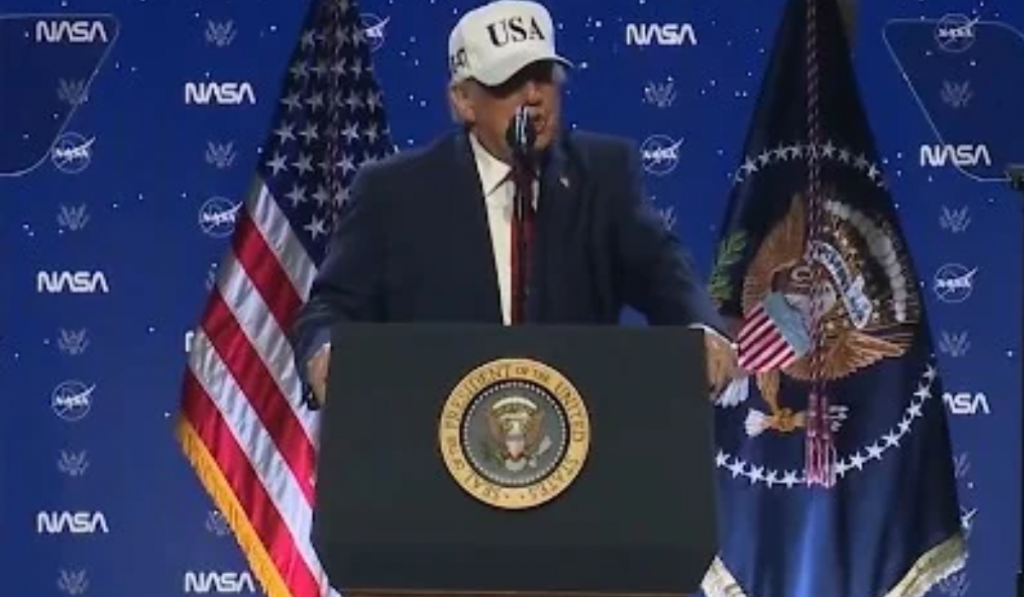
Washington: US President Donald Trump outlined plans for a sprawling aerospace exhibition venue at Florida’s former space shuttle landing facility, promising a show that would surpass the Paris Air Show within about two years.
Speaking at Kennedy Space Center, Trump said the proposed 1,900-acre venue would bring together commercial aircraft, private aviation and space technology, giving American companies a larger platform to unveil products and secure deals at home.
“We’re going to have a show the likes of which has never been done before,” Trump said.
He pointed to major aerospace exhibitions in Paris, Britain and Dubai, arguing that the United States should host the leading showcase for industries in which American companies hold a prominent position.
“We dominate and we should have the biggest show,” he said.
Trump projected hundreds of thousands of visitors annually, billions of dollars in economic activity and hundreds of billions of dollars in deals.
The president cited the runway and surrounding land as advantages for accommodating aircraft displays, space demonstrations and new exhibition buildings. He said the venue would expand over the next few years.
The proposal formed the centrepiece of an address during MAX POWER, the aerospace technology expo and air show taking place at and around Kennedy Space Center from November 6 to 8.
Trump praised NASA Administrator Jared Isaacman and linked the exhibition project to wider ambitions for American aviation, manufacturing and space exploration.
He reiterated his goal of returning American astronauts to the lunar surface before the end of his term, followed by an enduring presence on the Moon.
NASA’s published programme calls for Artemis III to test integrated systems and operational capabilities in Earth orbit in 2027, ahead of an Artemis IV lunar landing targeted for 2028.
Trump also repeated plans for a nuclear-powered spacecraft bound for Mars. NASA announced the Space Reactor-1 Freedom mission in March, targeting launch before the end of 2028.
The robotic mission would demonstrate nuclear electric propulsion in deep space and deploy a payload of small helicopters to explore Mars. It is separate from the longer-term ambition of sending astronauts to the planet.
Turning to aviation, Trump recalled travelling on Concorde and lamented the loss of supersonic passenger service.
“This may be the only industry in the world where we’ve gone backwards,” he said.
“But no more, no more we’re going way forward.”
He promoted efforts to develop supersonic aircraft that could operate without disruptive sonic booms, alongside drones, electric vertical takeoff and landing aircraft, and autonomous flight.Trump presented the proposed Florida exhibition as a common stage for those technologies and the space industry, with commercial aircraft manufacturers participating alongside companies developing new forms of transport.
The address combined near-term ambitions for an expanded aerospace event with longer-term exploration targets. The lunar and Mars programmes he highlighted were already part of NASA’s published plans.