


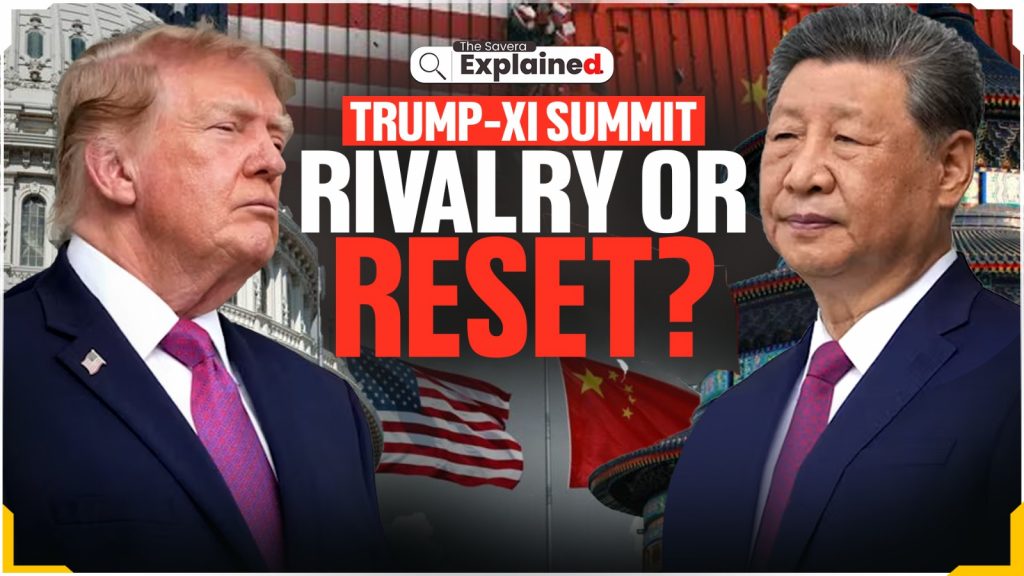
One handshake, two superpowers and a long list of disagreements. US President Donald Trump and Chinese President Xi Jinping met at the White House on September 24, but the biggest story was not a dramatic new deal. It was how the world’s two biggest economies are trying to compete without allowing that rivalry to spiral out of control.
What Happened At The Summit?
Trump hosted Xi at the White House on September 24, 2026, during Xi’s first US state visit in more than a decade. Trump personally welcomed Xi at Joint Base Andrews a day earlier. The summit focused on trade, AI, rare earths and security.
The meeting produced a friendlier tone and an extension of the existing trade truce, but it did not settle the deeper disputes between Washington and Beijing.
From Partners To Strategic Rivals
The US and China are deeply connected economically, but they are also major strategic competitors. Their relationship changed sharply during Trump’s first presidency, when Washington imposed tariffs on Chinese imports in 2018. China retaliated.
Trump’s return to office brought another round of tariff battles. In 2025, US tariffs and Chinese counter-tariffs briefly reached triple-digit levels. China also used restrictions on rare-earth exports, giving Beijing leverage over materials needed for electronics, electric vehicles, defence equipment and other high-tech industries. Negotiations eventually produced a fragile trade truce.
That is why the two leaders are often described as “frenemies”: they compete intensely, but neither can easily walk away from the other.
Today, that rivalry has moved well beyond tariffs. Technology, AI, semiconductors and critical minerals are now central to the competition.
Trade Truce Extended — But Only For Now
One of the clearest outcomes was an extension of the existing US-China trade truce.
The truce was extended by two months, until January 10, 2027, giving Washington and Beijing more time to negotiate a broader economic arrangement. But this is not a permanent trade settlement.
Tariffs, Chinese purchases of American goods, rare-earth supplies and US technology restrictions remain subjects for further negotiations.
Why AI And Microchips Are So Important
AI has become one of the biggest areas of US-China competition.
Both countries see advanced AI as important for the economy and national security.
The US has restricted China’s access to some advanced semiconductors and chip-making equipment since 2022. Washington is concerned that advanced chips could strengthen China’s AI and military capabilities.
China, meanwhile, is investing heavily in its domestic semiconductor and AI industries.
The summit also raised the possibility of greater communication on AI, including an AI dialogue and mechanisms to communicate about dangerous AI-related incidents.
Rare Earths And Taiwan
Rare earths were another major issue. China has a dominant position in global rare-earth processing and magnet production. These materials are important for electronics, EVs and defence.
Then there is Taiwan.
China claims Taiwan as part of its territory, while the US maintains unofficial relations with Taiwan and provides it with defence support. Taiwan remains one of the most sensitive issues in US-China relations, and the summit did not resolve the disagreement. Iran and wider security concerns were also part of the broader discussions.
The Big Takeaway
So, was the summit a breakthrough?
It did not resolve the major disputes between Washington and Beijing. The trade truce was extended, AI communication was discussed, and both leaders projected a more cooperative tone. But the fundamental disagreements remain.
The Trump-Xi relationship is therefore best understood as competition with cooperation when necessary.
The US wants to protect its technological advantages, while China wants access to markets and technology and to strengthen its own capabilities.
The economic relationship remains important for both countries.
And that is why AI, microchips, rare earths and trade are now at the centre of this complicated relationship.
The summit did not end the US-China rivalry. It showed that both sides are trying to manage that rivalry while keeping the economic relationship from breaking down.