


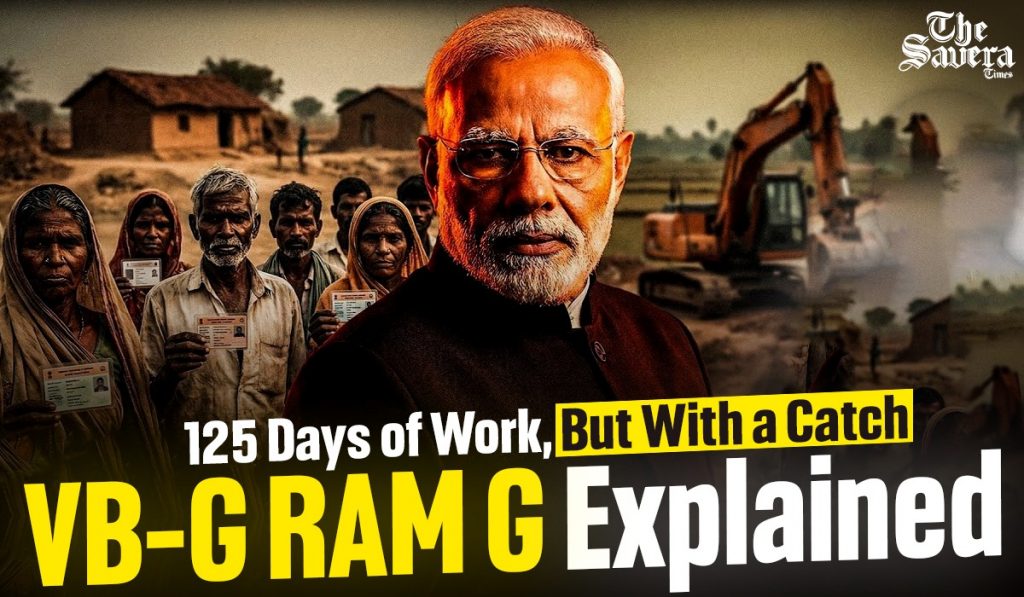
For nearly two decades, MGNREGA has been the backbone of rural employment in India. Now, the government has pressed the reset button. On December 18, 2025, the Lok Sabha passed the Viksit Bharat – Guarantee for Rozgar and Ajeevika Mission (Gramin) Bill, 2025, replacing the Mahatma Gandhi National Rural Employment Guarantee Act of 2005. The move marks a major shift in how India views rural employment—from a legal entitlement to a mission-driven development tool.
Introduced by Union Minister Shivraj Singh Chouhan on December 16 amid loud opposition protests, the new law guarantees 125 days of wage employment per rural household, up from the 100 days under MGNREGA. It targets adult members willing to perform unskilled manual work and aligns with the government’s Viksit Bharat @2047 vision. The Centre argues that the new framework fixes MGNREGA’s long-standing problems such as fund leakages, poor-quality assets, and delayed wages—issues flagged in audit reports across 23 states in 2025–26. However, the bill’s passage after heated debate reflects deep political divisions over the future of rural welfare.
Core Objectives and Structural Reforms
The VB-G RAM G bill reframes rural employment as a national mission focused on empowerment, productivity, and climate resilience. Instead of scattered works, it mandates convergence through Viksit Gram Panchayat Plans, which are pooled into a national rural infrastructure framework.
Work selection is streamlined into four priority areas: water security (such as irrigation channels and reservoirs), core rural infrastructure (roads, sanitation, housing support), livelihood assets (agroforestry, cattle shelters), and climate mitigation (flood barriers and drought-proofing). The government says this narrower focus ensures durable, income-generating assets rather than temporary works.

Digital reforms are a key pillar. Attendance will be Aadhaar-linked, wage payments must be made within seven days (compared to 15 under MGNREGA), and artificial intelligence tools will flag irregularities. Each gram panchayat must conduct two social audits annually. To address farmers’ concerns, states can pause works for up to 60 days during peak sowing and harvesting seasons, reducing farm labour shortages.
While gram panchayats retain planning authority, national-level aggregation ensures projects align with broader development goals such as PM Gati Shakti.
Funding Shift: From Demand-Based to Budget-Capped
The most controversial change lies in funding. MGNREGA was demand-driven, legally obligating the Centre to provide work whenever demanded. It fully funded unskilled wages and shared material costs with states.
VB-G RAM G shifts to a centrally sponsored, supply-driven model. The Centre will set state-wise expenditure caps based on rural poverty, population, and backwardness. If states exceed these limits, they must fund the excess themselves.
Cost-sharing will be 60:40 between Centre and states for most regions, 90:10 for northeastern and Himalayan states, and 100% central funding for Union Territories without legislatures. The government says this change will control ballooning budgets—MGNREGA’s allocation touched ₹86,000 crore in 2024–25—and curb misuse, citing ghost projects and frozen funds in states like West Bengal.
Critics, however, warn that poorer states may be forced to cut workdays due to fiscal pressure. States have six months to realign their schemes with the new law.
MGNREGA’s Legacy: Impact and Shortcomings
Launched in 2005, MGNREGA became one of the world’s largest social safety nets. It supported 15 crore rural workers, generated 2,500 crore person-days in 2024–25, and created assets such as 1.5 crore water bodies. During the COVID-19 crisis, it absorbed job losses as demand surged sharply.
Yet, problems persisted. Around 40% of wage payments were delayed, nearly 30% of works remained incomplete, and unpaid dues crossed ₹12,000 crore. These failures weakened trust among workers.
The government now frames VB-G RAM G as an “upgrade” that delivers outcomes rather than symbolism, arguing that rural development should focus on results, not just rights.
Opposition Backlash and Political Storm
The bill’s introduction triggered chaos in Parliament. Opposition MPs accused the government of insulting Mahatma Gandhi and diluting a legal right to work. Congress leaders demanded the bill be sent to a Standing Committee, warning that budget caps weaken worker entitlements.
Regional parties raised additional concerns—ranging from fiscal federalism to linguistic and cultural symbolism embedded in the acronym “RAM.” Even some NDA allies expressed unease about higher state financial burdens.
The BJP countered by highlighting higher rural spending under the Modi government and argued that welfare schemes must evolve with accountability and efficiency.
What It Means for Rural India
VB-G RAM G promises more workdays and better-quality assets, potentially benefiting five crore rural households. Improved monitoring could help women workers and SC/ST communities, who formed the backbone of MGNREGA. However, funding caps and state capacity will determine whether the promise translates into reality.
As the bill heads to the Rajya Sabha, it raises a fundamental question: should rural welfare remain a guaranteed right, or evolve into a performance-linked development mission?