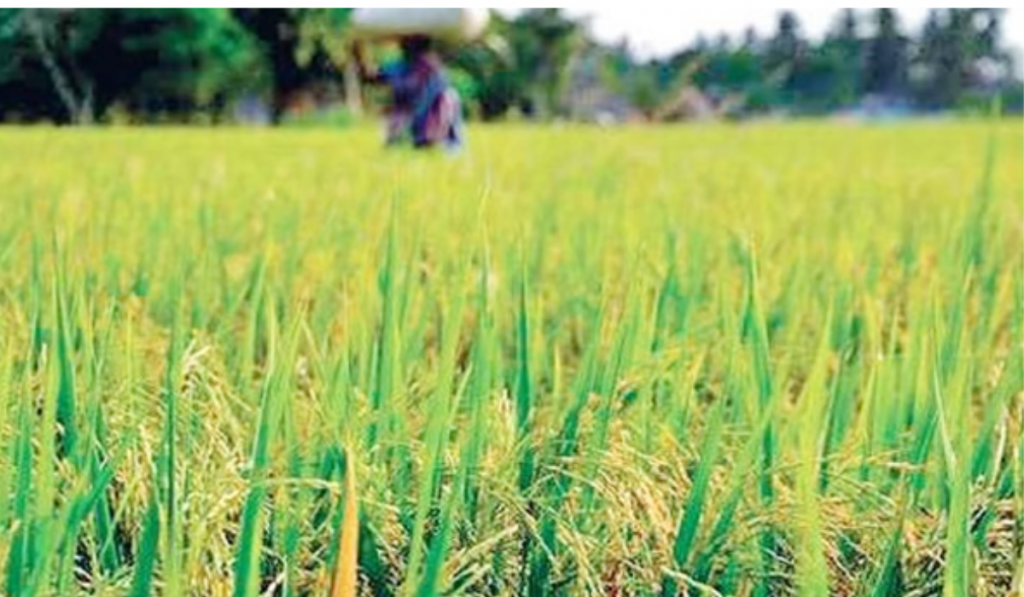
Kharif sowing across India has fallen sharply this year, with the total area under cultivation standing at 18.272 million hectares (mha) as of June 25 — a drop of nearly 23 per cent, or 5.374 mha, from 23.646 mha in the same period last year. According to figures released by the Union Ministry of Agriculture and Farmers Welfare, the shortfall spans nearly every major crop category, with rice, cotton, oilseeds and pulses all trailing last year’s pace, as a delayed and sluggish southwest monsoon across key farming states has left sowing operations stalled. The sharp drop in sowing mirrors the scale of this year’s June monsoon deficit. The month of June saw a huge deficit of 40 per cent, according to India Meteorological Department (IMD) data. The dry spell comes as El Niño conditions strengthen over the equatorial Pacific, a pattern typically associated with weaker monsoon rainfall over India, raising the risk that July offers little relief for farmers. During an El Niño event, the surface waters in the central and eastern Pacific Ocean become significantly warmer than usual and that interacts with trade winds which weaken and disrupt global weather patterns, triggering extreme climate events like droughts. Scientists have warned that this year’s El Niño is on track to be among the stronger ever recorded, often been referred to as a ‘super’ El Niño event. Rice, one of the major kharif crops, has seen its sown area shrink by 0.865 mha compared to last year, falling to 2.575 mha. Pulses have followed a similar trajectory, with area dropping from 2.146 mha a year ago to 1.492 mha this time. The steepest decline, however, has come in oilseeds, where area has more than halved — from 3.641 mha in 2025 to just 1.699 mha this year, a drop of 1.942 mha. India’s agriculture remains deeply tied to the southwest monsoon and its kharif planting season which coincides exactly with the monsoon, accounts for roughly half of India’s annual food grain production. About 55-60 per cent of India’s net sown area is rainfed, that is, it is majorly dependent on rainfall, with not much irrigation backup. Large parts of India are already in drought. According to the National Drought Monitor, maintained by IIT Gandhinagar, 41.2 per cent of India’s total area was under drought or neardrought conditions as of July 1. This figure was 37.1 per cent in the week before, and 19.6 per cent a month ago. This means drier conditions are expanding rapidly. The western part of India, including major agricultural states of Maharashtra, Gujarat, parts of Karnataka are the worst affected, with 71 per cent of its area in drought. Central India is not far behind at 53 per cent, and the northeast at 62 per cent. The north stands at 46 per cent. The Union Ministry of Agriculture and Farmers Welfare has flagged 111 districts across the country as high-risk and high priority. These are districts where two vulnerabilities compound each other — a weak monsoon already projected by IMD, and irrigation coverage below 25 per cent, meaning farmers have little to fall back on if the rain does not come. A majority of these districts are located across 12 states: Madhya Pradesh, Maharashtra, Gujarat, Uttar Pradesh, Rajasthan, Karnataka, Bihar, Jharkhand, Telangana, Andhra Pradesh and Odisha. Meanwhile, the Central has unveiled a special contingency plan amid concerns over a possible El Nino weather phenomenon that could lead to a weak monsoon this year and adversely impact the kharif crop in 315 vulnerable districts in the country. According to the Government, the southwest monsoon is significantly delayed this year, and rainfall so far has been around 43 per cent below normal. According to IMD forecasts, rainfall is likely to remain weak even during the week ending July 2. This could directly affect kharif crops, particularly in rainfed regions where agriculture is heavily dependent on monsoon rains. Around 315 districts have been identified that could be potentially affected by weak monsoon conditions. Of these, 111 districts have been categorised as high priority, where irrigation coverage is below 25 per cent. Another 76 districts fall under the medium-priority category with irrigation coverage between 25 and 50 per cent, while 128 districts have been classified as low priority owing to relatively better irrigation facilities through dams and other sources. A majority of these districts are located across 12 states—Madhya Pradesh, Maharashtra, Gujarat, Uttar Pradesh, Rajasthan, Karnataka, Bihar, Jharkhand, Telangana, Andhra Pradesh, and Odisha. Detailed discussions were held with Agriculture Ministers and District Collectors of these states, and they were urged to expedite preparedness at the local level. The ICAR and ICARCRIDA have prepared District Agriculture Contingency Plans for all districts. These plans incorporate districtspecific climatic conditions, cropping patterns, water resources and risk factors and prescribe measures such as suitable alternative crops under low rainfall conditions, crop diversification strategies, optimum use of available water resources and additional income opportunities to mitigate risks. Water conservation has been accorded top priority amid the possibility of a weak monsoon. Sensitive districts have been advised to accord top priority to drinking water supply and, if necessary, arrange water transfer from surplus regions to deficit areas. States have been advised to promote short-duration crop varieties and those capable of delivering higher yields with lower water requirements. Special emphasis has been laid on pulses, ‘Shri Anna’ (millets) and oilseeds, which perform relatively better under limited moisture conditions.
What Ails Kharif Sowing These Days