


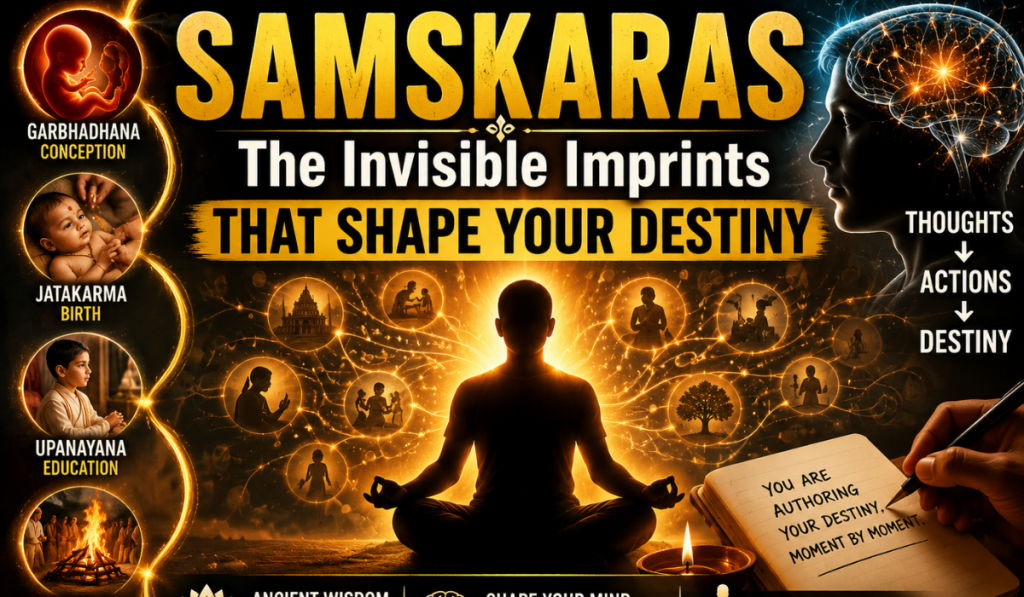
There are moments when a place seems to breathe a different order of reality. Rikhiyapeeth Ashram is one such space, where the ancient idea of samskara is studied as philosophy and also felt as lived experience. In such environments, one begins to comprehend how human life has been shaped by the distinct design of a higher consciousness rather than by a set of random events — a mystical consciousness that guides thought, behaviour, and destiny.
In the classical Indian tradition, the term samskara carries a dual meaning. At one level, it refers to the sequence of sacred rites that accompany a human being from conception to death. At a deeper, more psychological and metaphysical level, it denotes the subtle impressions left upon the mind by every experience, every intention, every action.
The Brihadaranyaka Upanishad offers a profound insight into the latter mechanism that creates our outer life constantly:
“As is one’s desire, so is one’s will; as is one’s will, so is one’s deed; and whatever deed one does, that he will reap.”
Here lies the architecture of samskara — desire shaping will, will shaping action, action shaping destiny.
The Bhagavad Gita deepens this understanding further when it states: “The mind is restless… but by practice and detachment, it can be controlled” (Chapter 6).
Traditionally, sixteen major samskaras (sodasasamskaras) structure human life — from Garbhadhana (conception) to Antyesti (last rites). These are carefully designed psycho-spiritual interventions. Samskara in ancient Indian tradition is a set of rites which take place for a child even before birth and continue until after death. It is a process of purification that prepares the individual for each phase of life and afterlife.
Samskaras seek to refine the body, mind, and soul so that the individual becomes fit to exist in harmony with higher consciousness and evolved spiritual states. The first samskara, Garbhadhana, emphasises the spiritual significance of conception itself. Through prayer, meditation, and disciplined thought, it is believed that parents can attract elevated consciousness into the womb.
The underlying assertion is that consciousness precedes biology. Interestingly, modern science echoes aspects of this idea. Research in epigenetics and prenatal psychology suggests that parental stress, emotions, and mental states can influence gene expression and foetal brain development. Likewise, studies in neuroplasticity show that repeated thoughts and actions reshape neural pathways.
Every experience leaves a trace. Over time, repeated traces accumulate into tendencies (vasanas), which later manifest as habits, fears, preferences, and emotional reactions. The Yoga Sutras of Patanjali describes samskaras as latent impressions that give rise to future thought patterns.
A person repeatedly exposed to rejection may develop samskaras of inadequacy, while one nurtured with trust and encouragement develops confidence. Gradually, these impressions become self-fulfilling. The world is no longer perceived objectively but filtered through accumulated samskaras.
Even moral behaviour often emerges less from conscious choice and more from deep conditioning accumulated over time.
The final samskara is Antyesti — the last rites. According to ancient traditions, this process helps guide the soul beyond physical existence. Rituals performed by family members are not merely ceremonial but are intended to support the soul’s transition toward higher realms of consciousness.
Texts such as the Garuda Purana describe this transition in detail. The belief is that samskaras shape not only life but also consciousness after death.
Modern explorations into near-death experiences and contemplative neuroscience have also sparked discussions about the continuity of consciousness. Research on long-term meditation practices has shown measurable effects on emotional regulation, fear reduction, empathy, and attention. In classical language, meditation does not merely calm the mind — it purifies samskaras.
If samskaras are impressions, transformation requires conscious re-imprinting.
Sit quietly for 10–15 minutes daily and observe thoughts without judgment. Awareness weakens automatic conditioning.
Spend a few minutes each day in complete stillness, letting thoughts arise naturally while remaining relaxed and detached.
Whenever fear, anger, or resentment arises, consciously replace it with a chosen positive response. Repetition creates new mental patterns.
Actively practising gratitude and appreciation reshapes emotional tendencies and cognitive patterns, reinforcing positive samskaras.
Samskaras are the silent scriptwriters of human life. Though invisible, they shape the visible narrative of existence. Ancient seers regarded this understanding as a path to liberation — the recognition that destiny is not entirely fixed but continuously authored through thought, intention, and action.
Moment by moment, thought by thought, human beings participate in shaping their own inner and outer worlds.