


Abhishek Vij
The peace talks scheduled between the United States and Iran in Pakistan’s capital, Islamabad, ended in failure following a marathon 21-hour negotiation session. The manner in which US President Donald Trump orchestrated these talks—by directing his “puppet state,” Pakistan, to host them—suggested that Trump, a quintessential businessman, sought to achieve through diplomacy what he had failed to secure through warfare. There was no lack of sincerity on Iran’s part regarding the desire to reach an agreement during these talks, as evidenced by the presence of a 71-member delegation led by the Speaker of the Iranian Parliament. The negotiations unfolded over 21 hours, conducted in various distinct phases.
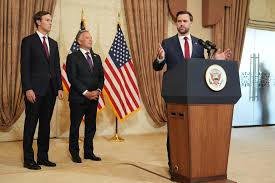
Commenting on the matter, US Vice President JD Vance stated that while consensus had been reached on certain issues, an agreement could not be finalized due to Iran’s stringent conditions; consequently, the US delegation withdrew. Subsequently, the Iranian delegation also departed. It was initially anticipated that a subsequent round of talks might take place. Some speculated that, perhaps, another attempt at reaching a treaty might be made during the remaining days of the ceasefire.
However, there were two specific issues on which Iran could never agree: first, the demand to open the Strait of Hormuz to traffic without Iran levying any tolls; and second, the demand that Iran halt its uranium enrichment program. One primary reason for the failure of the talks was the continued aggressive posture of Israel, coupled with Trump’s insistence on the unconditional opening of the Strait of Hormuz. Signs of the talks’ potential failure were, in fact, evident from the very beginning, given the inflammatory statements being issued by Donald Trump morning, noon, and night. Trump went so far as to declare that Iran would be completely annihilated and that the Strait of Hormuz would be opened—unconditionally and free of any tolls.
Trump warned that if Iran were to levy tolls on vessels passing through the Strait of Hormuz, the United States would take decisive action—extending its reach as far as the Gulf of Oman—to impose a blockade and collect those tolls itself. Furthermore, Trump asserted that any naval mines laid within the waters of the Strait of Hormuz would be cleared within a single day, declaring that Iran’s “bullying tactics” would not be tolerated in the region. The question facing the world is this: under such circumstances, which country’s ship would dare to venture into the Strait of Hormuz? In our view, this conflict is now shifting toward the objective of economically crippling Iran. However, the repercussions of this will be felt by nations across the globe, including India. As the battlefront increasingly centers on either forcing open the Strait of Hormuz or seizing control of it, how could other nations possibly muster the courage to navigate through these waters with ships laden with oil and gas?
The United States stands to lose nothing of its own resources amidst this conflict, given the vast distance some 10,000 kilometersseparating it from Iran. The economic blow will fall squarely upon Iran a nation that had envisioned its own economic resurgence through the collection of tolls from traffic passing through the Strait of Hormuz. Reports also suggest that China is now providing direct assistance to Iran in this conflict. Trump, for his part, has issued a stern warning to China against such “reckless audacity,” threatening to hike tariffs on Chinese goods to 50 percent should it persist. While Iran vows to stand its ground and fight back, the full extent of the damage inflicted upon the nation can only be accurately assessed once the conflict has drawn to a close.
For the moment, a battered nation demonstrates an unwavering commitment to fighting for its very survival. Meanwhile, Trumpalarmed by his dwindling popularityseeks to emerge from this conflict in a triumphant posture, hoping to instill a sense of pride in the American public.