


By Sheena Sandhu
Over 2,050 villages and nearly 3.9 lakh people in Punjab have been affected this monsoon— yet in those flooded landscapes, courage and coordination flowed stronger. The rescue efforts of the Armed Forces, NDRF, Air Force, and BSF show that preparedness must now be the norm, not the exception.
A state parched by water
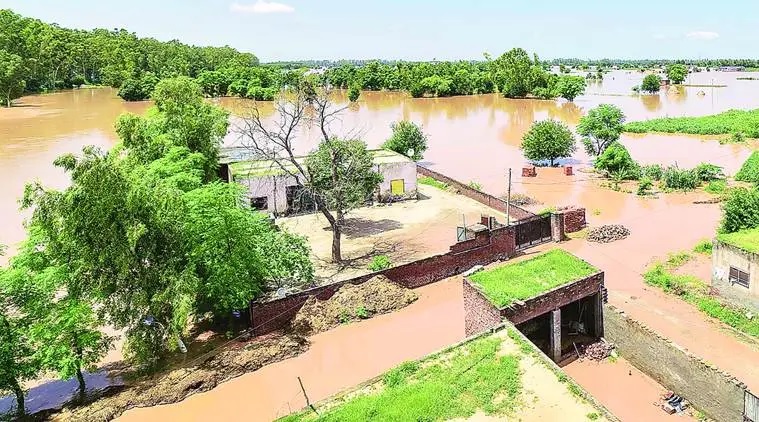
This monsoon, Punjab’s famed rivers—Sutlej, Beas, Ravi— breached memory’s bounds. Inundated fields turned into inland seas, roads vanished under murky sheets, and embankments stood battered. The crisis wasn’t just about water depth—it was about reaching the unreachable. Over 2,050 villages across the state are affected, impacting nearly 3.9 lakh people; crop losses exceed 4.42 lakh acres, with Gurdaspur alone accounting for over 40,169 hectares.
Relief camps dot the landscape—219 erected, with 124 still sheltering more than 5,400 displaced citizens. Twenty-two thousand nine hundred thirty-eight rescues have already been executed from submerged areas—Gurdaspur, Fazilka, and Ferozepur lead in numbers saved. Doctrine meets danger—and dismantles it. This was not a pageant of uniforms but a ballet of precision.
The NDRF sent 23 teams into the fray—boats slicing through flooded lanes, medics ensuring the elderly and infirm reached safety. The Army deployed 22 columns, shoring up embankments, stabilising hotspots, and securing evacuation routes. Over 30 helicopters from the Army and Air Force carved corridors in the sky. The BSF, with its water wings and patrol craft, became compassionate ferrymen in embattled border hamlets.
Key life-saving missions— closer view
These operations were more than rescues—they were lifelines: • In Dera Baba Nanak, an IAF operation winched 38 Army and 10 BSF personnel; simultaneously, 46 civilians were evacuated and 750 kg of relief supplies airdropped into Pathankot sectors.
- At Gurdaspur’s Jawahar Navodaya Vidyalaya, 381 students and 70 teachers were extracted by NDRF and BSF when floodwaters turned classrooms into islands.
- A “daredevil” helicopter m i s s i o n evac u at e d 2 7 individuals from Lassian, Gurdaspur, under extreme conditions via Army Cheetah.
- The IAF, deploying Mi-17 and Chinook helicopters from August 27, executed more than 55 sorties—evacuating civilians and security personnel from Dera Baba Nanak, Pathankot, Akhnoor, and more.
The airlift that fed the ground game
Every flood is a logistics conundrum masked as a weather emergency. In Punjab, aircraft didn’t just fly supplies—they delivered certainty. Winch rescues plucked families from rooftops; aerial drops of rations, medics, and technicians punctured the isolation. These sorties shortened the gap between crisis and care—a testament to strategic foresight.
Lives saved, trust earned
B e y o n d f i g u r e s a n d infrastructure, these rescues etched stories of hope. A child lifted to safety, a teacher leading students across floodwaters, a pregnant woman carried from a submerged dwelling. In that moment, trust in institutional intent replaced panic.
Lessons the water taught
Three tenets must guide the future: 1. Speed saves lives. Prepositioned assets and ever-practiced coordination saved hours, and those hours saved lives.
- Data is infrastructure. R e a l – t i m e r i v e r- l e v e l updates, mapping, and field connectivity should be as fundamental as embankments themselves.
- Dignity must anchor relief. Food is not enough— communication, medical care, schooling, and livelihood restoration sustain hope.
From relief to resilience
Punjab’s floods are a harbinger—not of rarity, but of recurrence. Our response must mature into readiness. That means: • F u n d i n g e m b a n k m e n t upgrades with the urgency of defence procurement. • Constructing all-weather helipads near river basins. • Mandating floodplainsensitive land use. • Institutionalising joint flood drills before every monsoon— muscle memory, not mere ritual.
The standard to demand
Hold onto this tableau: boats threading submerged lanes, soldiers wading shoulder-deep to lead villagers, helicopters roaring over fields turned seas, border guards ferrying neighbours, not scanning horizons. In this crucible, Punjab’s defenders didn’t just rescue lives—they reaffrmed faith. Let this become the benchmark, not the exception. When rivers rise again, let our resolve be policy— not serendipity