


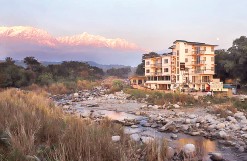
High in the Himalayas, where glaciers once appeared immovable and eternal, a slow and largely invisible crisis is unfolding. Rivers that sustain millions across South Asia are retreating—not in a dramatic collapse, but in a quiet, year-by-year shrinking that threatens water security, livelihoods, and regional stability.
The Himalayan region is often called the “Third Pole” because it holds the largest reserve of freshwater outside the Arctic and Antarctic. Glaciers here feed major rivers such as the Indus, Ganges, Brahmaputra, and Jhelum. For centuries, these rivers followed predictable seasonal rhythms: swelling in summer with glacial melt and monsoon rains, and receding in winter. Climate change has disrupted this balance.
Rising temperatures have accelerated glacial melting across the Himalayas. Initially, this creates the illusion of abundance rivers appear fuller, floods more frequent, and reservoirs temporarily replenished. But scientists warn this is a dangerous phase known as “peak water.” Once glaciers lose critical mass, river flows begin to decline sharply, leaving downstream communities vulnerable to chronic water shortages.
The consequences are already visible. In several Himalayan valleys, traditional springs have dried up. Farmers report irregular irrigation cycles, while hydropower projects face unpredictable generation patterns. Urban centres that rely on upstream flows are also feeling the strain, forced to deepen borewells or ration water during dry months.What makes the crisis more complex is its uneven impact. Mountain communities, often among the poorest and most isolated, experience the effects first. Their agriculture is rain-fed, their infrastructure fragile, and their access to alternative water sources limited. As rivers shrink, these populations face crop failures, livestock losses, and forced migration.
Downstream, the risks multiply. Reduced river flow can intensify disputes between regions and even countries that share river systems. South Asia already has a history of water-related tensions. As scarcity deepens, rivers risk becoming sources of conflict rather than cooperation.
Despite the scale of the problem, policy responses remain fragmented. Many governments continue to plan large dams and water diversion projects without accounting for long-term glacial decline. Environmental impact assessments often rely on outdated hydrological data, assuming river flows that may no longer exist in the coming decades.
Adaptation requires a fundamental shift in how water is managed. Instead of focusing solely on large infrastructure, experts argue for decentralised solutions—spring rejuvenation, rainwater harvesting, watershed protection, and sustainable groundwater use. Preserving forests in upper catchment areas is equally critical, as vegetation helps regulate water flow and reduce erosion.
Equally important is listening to local knowledge. Mountain communities have long practiced water conservation through traditional systems such as kuhls, zings, and community-managed channels. Reviving and integrating these methods with modern science could offer more resilient solutions than concrete-heavy interventions alone.
The Himalayan water crisis is not a distant future scenario—it is a present reality unfolding silently. Its impacts will not be confined to remote valleys but will ripple across plains, cities, and borders. Addressing it demands urgency, cooperation, and a willingness to rethink how humanity relates to rivers that once seemed endless.