


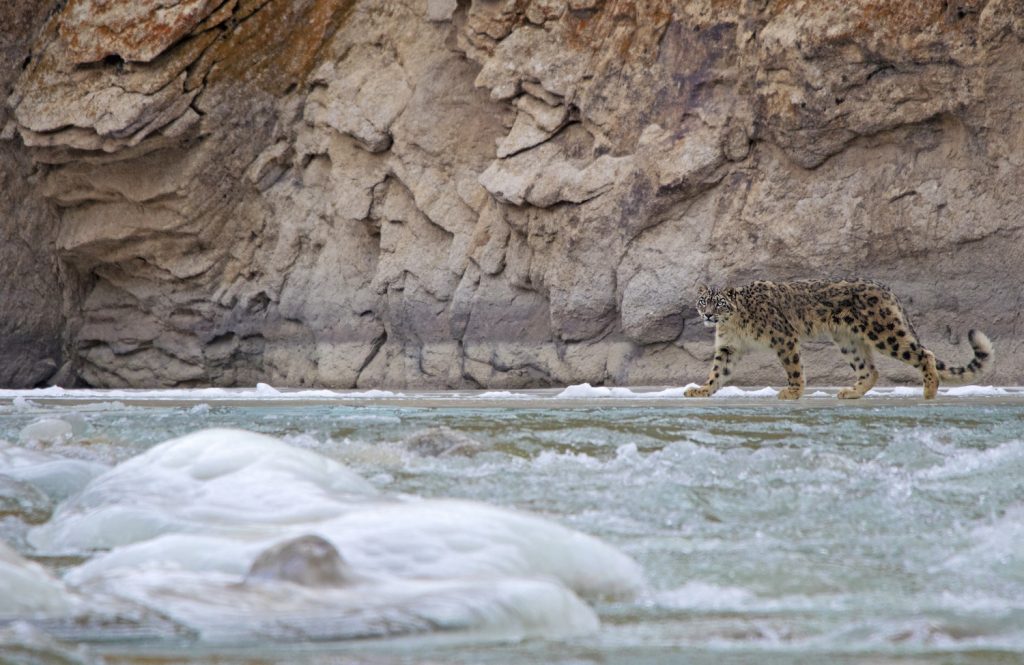
The Indus River, born from glaciers on the northern slopes of Mount Kailash, flows across the high Tibetan Plateau before entering India’s south-eastern Ladakh. This ancient river predates the rise of the Himalayas and has maintained its course for millions of years, carving deep gorges as it journeyed across the land. Along its fertile plains once thrived the Harappan civilisation, sustained for two millennia before shifting climate and the river’s changing path led to its decline three thousand years ago.
Across such vast stretches of time, humanity appears as a fleeting presence— civilisations rise and vanish while the river endures. Yet, despite k n o w i n g n a t u r e ’s permanence, humans continue to test its limits through reckless d e v e l o p m e n t a n d ecological disregard. On a more immediate scale, the Indus today flows through contested l a n d s c a p e s w h e r e political boundaries and ecological fragility i n t e r s e c t .
Na t i o n s compete for control, and development encroaches on the delicate balance of its high-altitude ecosystems. In 2006, before these pressures fully reached Ladakh, I encountered a snow leopard along the stretch of the Indus between the Ladakh and Zanskar ranges—a moment from a quieter time, when wilderness still ruled its domain. That April, I had gone to Kalak Tartar near Hanle, at 4,500 metres, hoping to spot the Tibetan gazelle.
I found instead the Changpas, Ladakh’s nomadic herders, grazing their livestock according to seasonal traditions. Riding back toward Leh, I travelled beside the calm Indus, winding through valleys and meadows. As evening approached, the road dipped beside the river near Likshe. The breeze stirred the willows, and the water shimmered under the soft light. Then, at the bend of the road, I saw it—a snow leopard walking along the tarmac, its grey coat marked with dark rosettes. I slowed the bike to a gentle roll.
The animal moved ahead, unaware of my presence until I was within twenty metres. When it heard the engine, it ran, leaping up a steep landslide slope toward a rock wall. I stopped, dismounted, and followed on foot. The leopard reached a vertical face with a narrow fissure halfway up. It leapt, missed, and tried again, this time pulling itself into the crevice and climbing upward with astonishing grace. It moved from ledge to ledge, ascending nearly nine metres until it reached a small hollow beneath an overhang. There it rested, calm and composed, watching me from its lofty perch. As the sun dipped lower, its face glowed in the fading light.
It alternated between watching me and scanning the river below. When a passing car broke the stillness, I realised how close this wilderness was to the world of people hurrying home, unaware of the rare creature above them. As dusk fell, the leopard disappeared into the shadows. I started my bike and rode toward Leh, carrying with me the image of that silent watcher in the rocks. Wildlife endures even in the harshest terrains, adapting and surviving where it can.
But resilience has limits. As human activity expands, species are pushed closer to extinction—today, at rates a hundred to a thousand times higher than nature’s baseline. Our disconnection from the land makes us blind to the damage we cause. Traditional pastoral systems like those of the Changpas once balanced survival with sustainability, but modern interventions—such as subsidised fodder that encourages overstocking for Pashmina wool— have disrupted this equilibrium.
The push for large-scale solar projects across Ladakh threatens even greater ecological harm. While renewable energy is essential, poorly planned ventures risk destroying habitats far more fragile than they appear. Ladakh needs development rooted in its unique terrain, guided by science and local knowledge rather than external ambition. The snow leopard’s survival depends not only on conservation but on redefining what progress means in such landscapes. Its presence reminds us that beauty, resilience, and fragility coexist here. The silence of Ladakh’s wilderness is not emptiness—it is life enduring quietly, waiting for us to listen. The Indus will continue to carve its course, indifferent to human existence, while we decide whether to live in harmony with it or be washed away by our own excess